Aare Amerijoye DOT.B
There are nations that perish at the hands of tyrants. There are nations that collapse under the accumulated weight of poverty and misgovernance. And there are nations that destroy themselves through something far more shameful: the deliberate fracturing of purpose at the precise moment history demands a fist. Nigeria is standing at that crossroads. And certain among us are handing history the knife.
Nigeria has survived military coups, economic collapse, civil war, and the recurring theft of democratic mandates. What it cannot survive is the deliberate sabotage of its own best chance at recovery, dressed up in the language of principle.
There is a peculiar, self-defeating madness gathering force inside the Obidient movement, and the republic cannot afford to let it ripen into catastrophe in 2027.
It must be said plainly, without diplomatic padding or political courtesy: a presidential election against a sitting incumbent is not a social media revolution. It is not a protest march dressed in electoral clothing. It is not won by the candidate who performs the most theatrical frugality or who thunders, with the greatest conviction, that he will not spend a single shishi. It is won by the candidate who brings the most formidable combination of structure, strategy, coalition breadth, and unyielding electoral arithmetic to the field of battle.
Bola Ahmed Tinubu is not the 2023 version of a candidate whose victory can be dismissed as a product of circumstance alone. He is now an incumbent. He commands the full instruments of a sovereign state. He controls the security apparatus, the federal allocation pipeline, the patronage networks that have always lubricated Nigerian electoral machinery, and the awesome weight of incumbency that every sitting president in this republic’s history has wielded with devastating, often conclusive, effect. Anyone who walks into 2027 imagining that righteous anger and the refusal to spend a kobo will be sufficient to dislodge this president from Aso Rock is not a strategist. Such a person is a hostage to illusion.
Passion and anger, without strategy and unity, do not defeat incumbents. They decorate defeat with noble intention.
The Obidient movement produced something genuinely remarkable in 2023. Peter Obi polled 6,101,533 votes. He electrified a generation grown weary of the old liturgy. He gave furious, public expression to a national despair that had long been swallowed in silence. The Narrative Force has never underestimated the significance of that moment.
But The Narrative Force will not lie to Nigeria either.
Examine the architecture of those votes with the dispassion the facts demand. Of Obi’s 6,101,533, approximately 32 per cent originated in the South-East, where he swept all five states with a dominance that bordered on unanimity. In Anambra, his ancestral stronghold, he secured 584,621 out of 613,861 valid votes cast, a return of 95 per cent of every valid vote cast in that state. Across the entire South-East zone, he polled approximately 1.96 million votes, capturing vote shares in each state that left his opponents without a foothold. Beyond the South-East, he drew heavily from the Christian solidarity vote across the Middle Belt and a youth insurgency in the major urban centres, winning 11 states and the FCT in total. These are genuine, combustible political forces. They are not, by themselves, the architecture of presidential victory.
Atiku Abubakar, operating under the crushing weight of PDP internal sabotage and the haemorrhage caused by Obi’s defection, still amassed 6,984,520 votes across 12 states spanning the North-East, North-West, South-West, and South-South. He recorded votes in every zone of the federation, including the South-East. That is a national candidate with a national footprint.
Atiku and Obi together: 13,086,053 votes. Tinubu’s winning total: 8,794,726. United, the opposition surpasses Tinubu’s winning total by more than four million votes , four million votes abandoned on the altar of division.
This is not speculation. It is cold, unflinching mathematics. And mathematics does not care for noise. It just tells the truth. Unity could have won. Unity must win in 2027. Division is not a luxury a suffering nation can afford to subsidise a second time.
THE RECORD IS THE VERDICT
Now let the question be put with the directness it deserves: what, precisely, qualifies Peter Obi as the candidate uniquely positioned to defeat Tinubu in 2027, above Atiku Abubakar?
His record as Anambra State Governor has been cited repeatedly by his admirers, and The Narrative Force will not pretend the record contains nothing of note. He left funds in the Anambra State coffer when he departed office. His supporters regard this as the defining proof of disciplined governance.
It is not.
Saving money for a state is not a metric for tracking developmental performance. The purpose of public finance is not preservation. It is deployment. It is the building of sustainable infrastructure, the expansion of human capacity, the provision of amenities that multiply opportunity and dignity for the citizenry.
A state is not a vault. A governor is not a custodian of idle reserves. Public office exists to transform public resources into public good: roads that cut journey times and open markets, schools that expand the ceiling of possibility for children born without inheritance, hospitals that stand between ordinary people and avoidable death, infrastructure that multiplies the productive capacity of a people across generations. The measure of a governor is not what he left in the bank. It is what he put in the ground.
By that measure, the comparative records of Rotimi Amaechi in Rivers State and Rabiu Kwankwaso in Kano State are more richly textured than Peter Obi’s Anambra tenure. Under Amaechi, Rivers State executed one of the most ambitious school rehabilitation programmes in the federation, rebuilding over four hundred primary schools under a single coordinated initiative, while simultaneously constructing the first monorail infrastructure in sub-Saharan Africa and delivering road networks that permanently altered the commercial geography of Port Harcourt. Under Kwankwaso, Kano witnessed systematic road construction and rehabilitation across the entire metropolis, a mass housing programme that delivered shelter to thousands of residents who would otherwise have had none, and an educational mobilisation so deep and sustained that it became a social movement bearing his name long after he left government.
These were governors who deployed resources. Obi preserved them. Deployment builds nations. Preservation builds reputations.
These were governors who deployed resources. Obi preserved them.Deployment builds nations. Preservation builds reputations.
And neither of those records, commendable as they are, approaches the breadth of national achievement that trails Atiku Abubakar’s eight years as Vice President. Under the Obasanjo-Atiku administration, the Nigerian economy grew from a GDP of approximately 58 billion dollars to 270 billion dollars. The country recorded a peak annual growth rate of 15.3 per cent. The telecommunications revolution that placed GSM in the hands of ordinary Nigerians, dismantling the monopoly that had kept the country in analogue darkness, was midwifed under that administration. These are not assertions. They are entries in the ledger of Nigerian history, available to any honest enquirer willing to consult the record rather than the rumour.
THE MYTH OF THE NON-TRANSACTIONAL CANDIDATE
Then there is the performance of incorruptibility that Obi has mounted with such theatrical consistency before the Nigerian public.
He has persuaded a significant portion of that public that he alone inhabits a plane above the transactions of Nigerian politics: that while others deal, he serves; while others distribute, he disciplines; while others spend, he saves. It is a compelling performance. It is also, upon examination, a fiction.
Let the record speak.
When Obi prosecuted his campaign for the PDP presidential ticket before he left the Party in 2022, delegates across every category who travelled to Abuja at his invitation received two hundred thousand naira each upon arrival, in which I was one. State Chairmen. State Youth Leaders. State Women Leaders. State Publicity Secretaries. State Executives. Zonal Executives. The accounts were consistent in their detail, uniform in the figure reported, and unmistakable in the pattern they collectively described.
Is that not a transaction?
And let the question proceed further. Would Obi consider it transactional politics to mobilise voters from their homes to their polling units on election day? Would he consider it transactional to sustain polling unit agents through long hours of waiting, equipped to defend their votes against manipulation and result falsification? If neither of those acts is transactional politics, then what is the Obidient movement’s actual theory of electoral mobilisation?
Nigeria needs Peter Obi to say, with the courage he displayed when he called out corruption in Anambra, what the arithmetic of 2027 plainly demands: that this is not the season for ego, it is the season for unity. His movement needs to hear it from him. And it needs to hear it before the opposition window closes.
Defeating Tinubu in 2027 requires more than emotional conviction and performing austerity on the campaign trail. It requires boots on the ground in 36 states and the FCT. It requires the North, where Tinubu’s electoral weakness is most exposed. It requires inter-regional coalition management of the kind that only a politician with Atiku’s decades of alliance-building can reliably deliver. It requires the strategic depth, the ground-level structure, and the financial stamina to sustain a national campaign from the primary through to the final declaration of results.
This is not the terrain of a candidate whose primary appeal is concentrated in one geopolitical zone and one religious demographic. Moral reputation, however deserved, cannot substitute for the hard, unglamorous machinery of votes. Passion, however genuine, does not replace structure.
IS ANYONE TELLING THE OBIDIENTS THAT ATIKU ELEVATED OBI’S NATIONAL STANDING?
In 2019, when Nigerian politics gasped for strategy and Atiku Abubakar, presidential candidate of the PDP, made a move that rewrote the calculus of alliance: he chose Peter Obi, the meticulous, technocratic Igbo son, as his running mate. He could have chosen any of the southern titans available to him. He chose Obi, and by that choice, delivered him from the confines of regional recognition onto the national stage, before the cameras, microphones, and constituencies of a federal republic.
Before 2019, Peter Obi had never mounted a national stage. Known in Anambra, respected in the South-East, admired by technocrats. Unknown, in any consequential political sense, to the North, to the South-West, to the international community that tracks Nigerian presidential politics. The national platform? Atiku gave it to him. In Abuja. Without condition. Without price.
Obi himself did not evade this truth in 2022 when he acknowledged publicly that he owed a great deal to Atiku Abubakar, that Atiku gave him the opportunity to stand on the national stage, and that he held him in the highest esteem.
Those are Peter Obi’s words. Not The Narrative Force’s construction. Not Atiku’s self-description. Peter Obi’s own testimony, offered freely. Said when gratitude had not yet been crowded out by ambition. Said when the facts were fresh.
If Peter Obi himself can honour, in his own voice, the bridge that lifted him, who are the Obidients to reduce that bridge to ash?
Any movement that burns that bridge is not fighting Tinubu. It is fighting the coalition that represents its only credible path to the power it claims to seek. And any calculation that removes Atiku from the centre of the 2027 opposition effort is a calculation that ends in Tinubu’s re-election.
THE ONLY PATH THAT LEADS AWAY FROM TINUBU
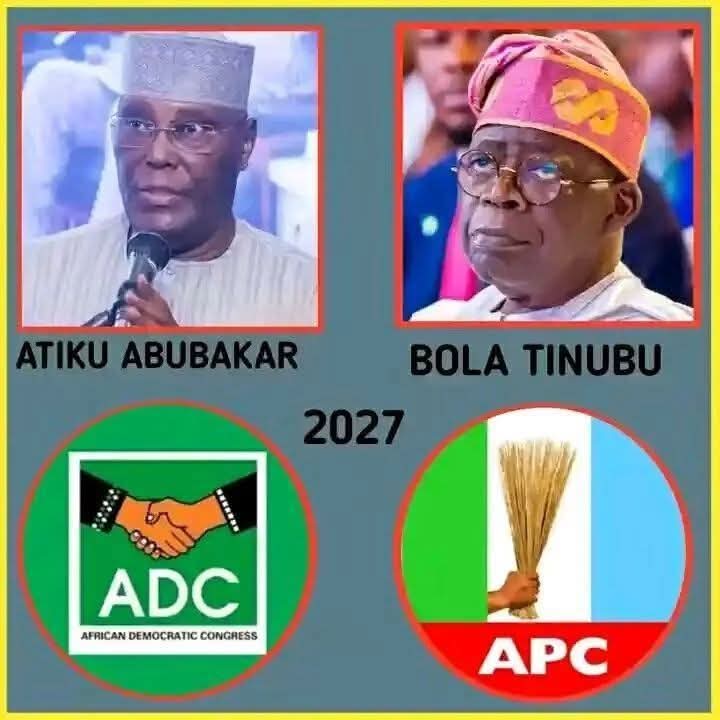
The African Democratic Congress now carries the most consequential opposition coalition Nigeria has assembled since the historic merger of 2013 that produced the APC and ended sixteen years of PDP federal dominance. That coalition carries a confirmed base exceeding 13 million votes, a total that already surpasses Tinubu’s winning figure before a single additional voter has been mobilised. It carries the organisational structures of parties whose members have united behind the project of removing a president who has presided over the collapse of the naira from N460 to above N1,740, the erosion of purchasing power across every social stratum, the insecurity that has turned swathes of the North into killing fields, and the misery that has driven 141 million Nigerians below the poverty line.
That coalition cannot be fractured from within. Not by movement politics. Not by ego. Not by the vanity of spoiler candidacies that serve no purpose except to divide an arithmetic that already points toward victory.
The Obidients are not the enemy of Nigeria. Their anger is legitimate. Their passion is real. Peter Obi remains, for millions of young Nigerians, a symbol of integrity with genuine resonance, and The Narrative Force respects that symbol. But symbols do not cast ballots. Structures do. Coalitions do. Strategy does.
Atiku Abubakar is no sectional champion. He is a national institution. Decades of political steel, statesmanship, and organisational structure trail him across the length and breadth of this country. He remains the compass by which the opposition must navigate the complexity of a multi-ethnic, multi-religious, profoundly divided national electorate. A compass discarded in the middle of a difficult journey is not a compass that was too imprecise. It is a compass thrown away by people who were already lost and did not know it.
In 2027, the cost of discarding that compass would not be abstract. It would be measured in four additional years of the administration that has caused demonstrable, measurable, documented suffering to the Nigerian people.
Unity could have won in 2023. In 2027, disunity cannot be indulged. The arithmetic does not forgive division. It does not forgive a second act of self-sabotage.
To the Obidient movement: tone down the noise. Your candidate was lifted by the man you now vilify. Your energy is needed against Tinubu, not against Atiku.
To Atiku’s supporters: elevate the tone. Do not descend into digital warfare. Prosecute the argument with facts, with evidence, and with the calm authority of those who know the numbers are on their side.
To the ADC coalition: protect the bridge. Synergise. Build. Because only a united, disciplined, strategically coherent opposition defeats a president sitting atop the full apparatus of the Nigerian state.
The enemy is not among the opposition. The enemy occupies the Villa, commands the treasury, controls the security apparatus, and is already planning the 2027 campaign with the resources of the Nigerian state. Act accordingly. And act together.
2027 is not distant. The decisions being made today, in broadcast studios and party caucuses and newspaper columns and WhatsApp corridors, will determine whether Nigeria wakes up in 2028 with a new direction or with the same administration and a fractured opposition nursing its self-inflicted wounds in the ruins of another squandered opportunity.
2027 is tomorrow.
Let the arithmetic speak.
The bridge must be built, not burned.
There is no second chance.
A WORD ON POSTURE: TNF WILL NOT BE DRAWN INTO THE PIT
Let this be placed on the record with the permanence it deserves.
Within The Narrative Force, and across the full breadth of Atiku’s political architecture, our position is fixed and will not be moved: no quantum of innuendos spewed by the Obidients, or by any other quarter within the Party, will attract a response from us in the same measure or the same register. We will not descend. We will not trade bile for bile. We will not allow the conduct of our adversaries to set the standard of our own.
There is wisdom in the conduct of an experienced hunter: he does not destroy the skin of the animal he has brought down, because that skin will serve a purpose long after the hunt is over. The practitioner of discipline preserves what remains useful. The political novice, driven by emotion, ruins in one outburst what could have been harvested across a season.
We will not destroy what can still be useful. The opposition’s united front is a skin worth preserving. Every piece of it.
All the assertions advanced in this piece serve one disciplined purpose: to correct wrong notions and faulty permutations before they calcify into assumptions that damage the broader opposition project. This is not an attack on Peter Obi. It is an inoculation against strategic error.
And so The Narrative Force addresses, directly, the spokesmen and communications operatives of every coalition leader under the ADC umbrella: your mandate is not to make Atiku Abubakar the target of your messaging. Your mandate is to make Tinubu’s record the target of every Nigerian’s attention.
Build a synergy of narratives. Coordinate your messaging around the coalition’s strategic political goals and objectives. Drive the shared agenda of economic restoration, security recovery, and institutional reform. That is the terrain on which Tinubu is most vulnerable. That is the ground on which the opposition wins.
Every hour a coalition spokesman spends attacking Atiku is an hour gifted, free of charge, to Aso Rock. The enemy is not inside the tent. Direct your fire accordingly.
And while we are on the subject of discipline, a word must be addressed to ADC presidential aspirants and their spokesmen personally.
Why are aspirants within the same party going on air to ridicule fellow members who carry the same presidential ambition? What is the strategic logic of that exercise? Let it be stated with unmistakable clarity: the general public does not vote in a party primary. The media does not vote in a party primary. The audience before whom these aspirants are performing their contempt for one another has absolutely no role in determining who emerges from the ADC’s internal process. The only constituency that matters at the primary stage is the party itself, its delegates, its structures, and its leadership.
Every broadcast in which an ADC aspirant or their spokesman mocks a fellow aspirant is a broadcast that hands the APC a clip, gives Tinubu’s media handlers free material, and tells the Nigerian public that the opposition cannot govern its own internal affairs, let alone the country. It is self-inflicted damage of the most avoidable kind.
The primary is the arena for internal contest. The broadcast studio is the arena for prosecuting Tinubu. An aspirant who confuses the two serves neither ambition nor nation.
Reserve the competitive energy for the primary process where it belongs. Reserve the broadcast studio and the national platform for the unified prosecution of a government that has failed demonstrably, measurably, and without mitigation. That is the discipline that marks the difference between a coalition that wins power and a collection of individuals who were, once, an opportunity.
Aare Amerijoye DOT.B
Director General,
The Narrative Force
thenarrativeforce.org
18 April 2026