AA Movement
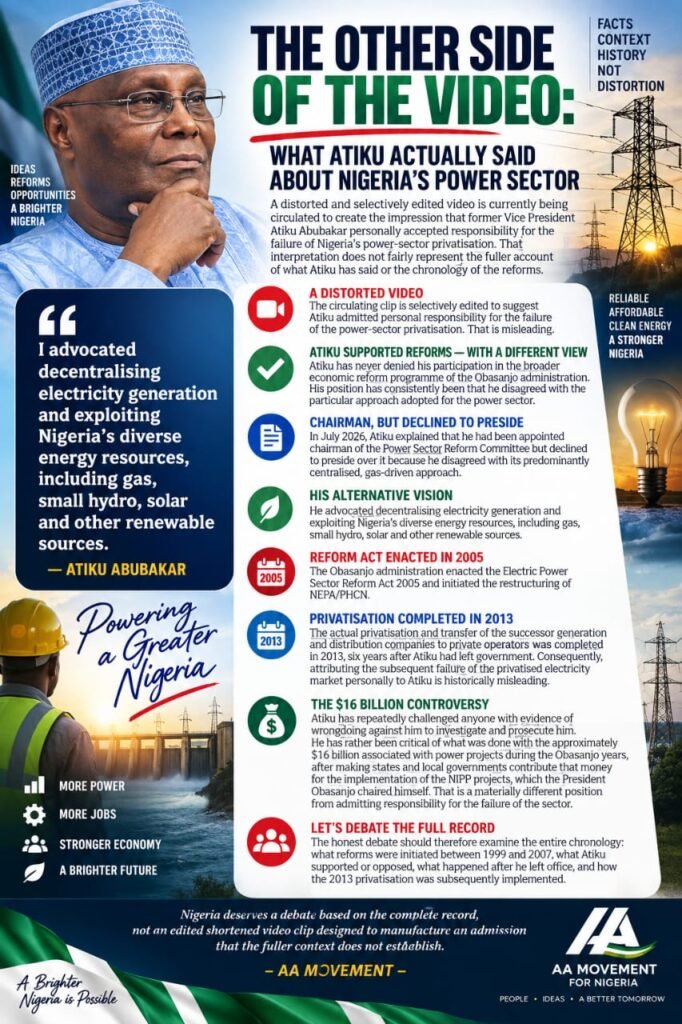
A distorted and selectively edited video is currently being circulated to create the impression that former Vice President Atiku Abubakar personally accepted responsibility for the failure of Nigeria’s power-sector privatisation. That interpretation does not fairly represent the fuller account of what Atiku has said or the chronology of the reforms.
Atiku has never denied his participation in the broader economic reform programme of the Olusegun Obasanjo administration. His position, however, has consistently been that he disagreed with the particular approach adopted for the power sector.
In July 2026, Atiku explained that he had been appointed chairman of the Power Sector Reform Committee but declined to preside over it because he disagreed with its predominantly centralised, gas-driven approach. He said he advocated decentralising electricity generation and exploiting Nigeria’s diverse energy resources, including gas, small hydro, solar and other renewable sources.
That distinction is crucial.
The Obasanjo administration enacted the Electric Power Sector Reform Act 2005 and initiated the restructuring of NEPA/PHCN. However, the actual privatisation and transfer of the successor generation and distribution companies to private operators was completed in 2013, six years after Atiku had left government.
Consequently, attributing the subsequent failure of the privatised electricity market personally to Atiku is historically misleading.
There is also the separate controversy over the approximately $16 billion associated with power projects during the Obasanjo years. Atiku has repeatedly challenged anyone with evidence of wrongdoing against him to investigate and prosecute him. He has rather been critical of what was done with that money after making states and local governments to contribute that money for the implementation of the NIPP projects, which the President Obasanjo chaired himself. That is a materially different position from admitting responsibility for the failure of the sector.
The honest debate should therefore examine the entire chronology: what reforms were initiated between 1999 and 2007, what Atiku supported or opposed, what happened after he left office, and how the 2013 privatisation was subsequently implemented.
Nigeria deserves a debate based on the complete record, not an edited shortened video clip designed to manufacture an admission that the fuller context does not establish.
-AA MOVEMENT-