Alex Ter Adum, PhD*
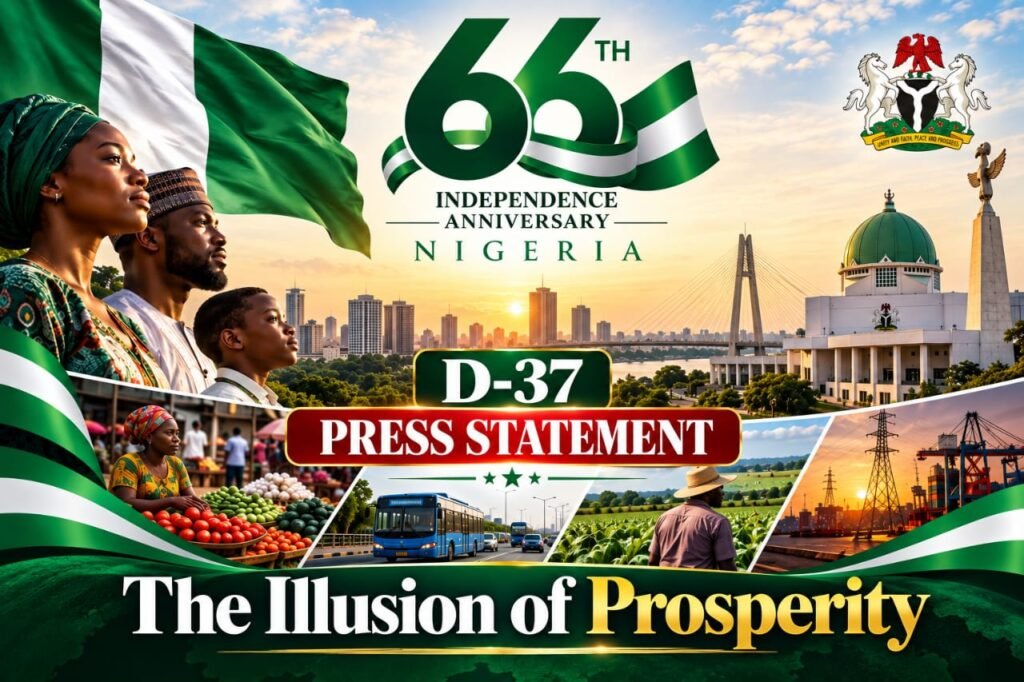
THE ILLUSION OF PROSPERITY
A Reality Check on President Tinubu’s 66th Independence Address
President Bola Ahmed Tinubu’s 66th Independence Day address was a confident presentation of an economy supposedly moving from painful reform to shared prosperity. The administration pointed to GDP growth above 4 per cent, declining inflation, greater foreign-exchange stability, stronger reserves and rising non-oil exports as evidence that its economic reforms are working.
These developments deserve acknowledgement. But they do not, by themselves, establish that Nigeria has entered an era of shared prosperity.
The fundamental weakness in the presidential narrative is the distance between macroeconomic indicators and household reality.
Nigerians do not live inside GDP statistics. They live in markets, buses, farms, classrooms, hospitals and small businesses. They know the price of food, transport, electricity, rent and medicine. They know when their salaries disappear before the month ends.
The real question, therefore, is not whether the government can point to improving statistics. It is whether Nigerians are actually better off.
Growth Without Sufficient Household Relief
GDP growth is important, but GDP growth is not the same thing as improved living standards.
An economy can grow while real household incomes remain under pressure. What matters to the ordinary citizen is whether economic expansion is generating productive employment, higher real incomes, stronger purchasing power and affordable necessities.
The government’s own emphasis on creating jobs and translating macroeconomic stability into broader prosperity implicitly acknowledges that stabilisation is not the destination.
Growth is an achievement. Shared prosperity is the test.
Disinflation Is Not Deflation
The administration is also correct that inflation has fallen from its peak. But this claim requires context.
When inflation falls from 30 per cent to 15 per cent, prices have not fallen by 15 per cent. Prices are still increasing; they are simply increasing more slowly.
Nigeria’s current official inflation rate remains significant, with the National Bureau of Statistics reporting all-items inflation at 15.39 per cent and food inflation at 19.57 per cent on its current statistical dashboard.
The family whose food bill has risen dramatically does not experience disinflation as prosperity. It experiences a permanently higher cost of living.
This is why the government must distinguish between slowing inflation and falling prices.
The former may indicate improving macroeconomic conditions. The latter is what households actually experience when their purchasing power improves.
A Stable Naira Is Not Necessarily a Strong Naira
The same distinction applies to the foreign-exchange market.
Greater exchange-rate stability is preferable to extreme volatility. But stability at a substantially weaker exchange rate does not restore the purchasing power of the naira.
The question is not simply whether the currency is moving less violently.
The question is what the naira can buy.
What does it cost to import machinery? To manufacture? To purchase medicine? To transport agricultural produce? To operate a small business?
A more orderly FX market is welcome. But Nigerians cannot consume exchange-rate stability.
They need purchasing power.
The Cost of Reform Must Also Be Counted
President Tinubu described the pre-reform economy as a critically ill patient and his reforms as necessary surgery.
That metaphor is politically powerful, but surgery is ultimately judged by the patient’s recovery.
The removal of the petrol subsidy and foreign-exchange reforms addressed genuine structural problems. But the manner and sequencing of those reforms also transmitted enormous costs into transportation, food distribution, household energy expenditure and business operations.
The opposition is not arguing that Nigeria needed no reform.
The question is more fundamental:
Where is the dividend of the sacrifice?
Reform is not successful merely because government removes a distortion. It succeeds when productivity increases, businesses become competitive, employment expands and living standards improve.
Nigerians were asked to endure pain in the expectation of a better economic future. They are entitled to ask when that future begins.
Palliatives Are Not Prosperity
The administration points to NELFUND, CREDICORP, social investment programmes and other interventions.
Where these programmes genuinely assist citizens, they should be acknowledged. Not when the government’s Auditor General raises a red flag that there is no evidence of any cash transfer beneficiaries on the record; and the incumbent party Chairman responds that the 10 million Nigerians who benefited from the N750 billion cash transfer have no banking details to track transactions.
Granted but not conceding that were true, fathom assistance cannot even be a substitute for income.
A student loan is also not affordable education. Consumer credit is not higher wages. A cash transfer is not a productive job.
Nigeria cannot build its future around permanently managing poverty.
The objective must be to create an economy that produces fewer poor people.
That requires production, investment, enterprise and employment, not simply more mechanisms for cushioning the consequences of economic hardship occasioned by bad economic policies.
Agriculture Requires Security and Profitability
The President’s commitment to mechanisation, irrigation and agricultural expansion is welcome. But agricultural transformation begins with the farmer’s ability to farm safely.
A farmer needs security, access to land, affordable inputs, reliable transport, storage and a profitable market.
If farmers cannot safely reach their farms, mechanisation alone will not produce food security.
Food security begins with the security and profitability of the farmer.
October 1 and the Transport Fare Promise
Perhaps the most immediate test of the government’s prosperity narrative is transportation.
On August 27, the government announced a national programme intended to reduce transport costs, with October 1 designated as the date from which Nigerians should begin experiencing measurable reductions in fares. The President reiterated that commitment on September 19.
Today is October 1.
So the question is simple:
How many Nigerians are actually paying less to travel?
Not how many buses have been converted to CNG.
Not how many meetings have been held.
Not how many policy announcements have been made.
How much has the commuter actually saved?
The government has cited substantial reductions on selected CNG and electric transport routes. Those successes should be acknowledged. But selected routes are not the same as nationwide delivery.
The government should therefore publish the states and routes covered, the percentage reductions achieved and the number of commuters benefiting.
Because the passenger does not experience CNG conversion as a statistic.
The passenger experiences the fare.
THE D-37 ALTERNATIVE
The D-37 believes that the opposition must offer Nigerians more than criticism.
To this end, it believes that the better alternative to the Tinubu led government’s failure should be a production-led economy centred on lower costs, productive investment, jobs and household purchasing power.
The policy difference is clear.
Where the government emphasises macroeconomic stabilisation and expects prosperity to follow, the alternative should insist that stabilisation and household relief proceed together.
Where government points to GDP growth, the alternative should measure real wages, productive employment, productivity and purchasing power.
Where government points to lower inflation, the alternative should pursue concrete measures to reduce the cost of food, transport, energy and production.
Where government offers credit and palliatives, the alternative should make jobs, enterprise growth and rising incomes the primary route out of poverty.
Where government announces CNG transport, the alternative should measure success by the actual fare paid by passengers.
Where government promises agricultural transformation, the alternative should begin with security, affordable inputs, irrigation, storage, market access and farmer profitability.
And where government spends public money, every major programme should have a transparent cost, defined beneficiaries, a timetable and measurable outcomes.
This is not reform versus no reform.
It is reform that asks Nigerians to wait for prosperity versus reform that measures success by whether Nigerians are already becoming more prosperous.
The Final Test
After all the speeches and statistics, the test remains brutally simple.
Can a Nigerian worker feed a family and pay rent?
Can a young graduate find productive employment?
Can a farmer cultivate safely and make a decent return?
Can a small business survive its energy, financing and logistics costs?
Can parents educate their children without unsustainable financial pressure?
Can commuters get to work without surrendering an unreasonable share of their income to transportation?
These are the questions that determine whether “shared prosperity” is already a reality or remains an aspiration.
The opposition should therefore demand measurable delivery, not another cycle of announcements. Government must be judged by results rather than rhetoric; by what happens to household incomes, food prices, transport fares, jobs and productive enterprise.
After years of sacrifice, Nigerians deserve more than another request for patience.
They deserve results.
Nigeria does not need a prosperity narrative that Nigerians cannot feel.
It needs an economy in which prosperity is visible in the household, affordable in the marketplace and sustainable in the workplace.
That, not the hollow eloquence of an Independence Day speech, is the ultimate measure of economic success.
Thank you.
Alex Ter Adum, PhD
D-37 Policy Reform Think Tank