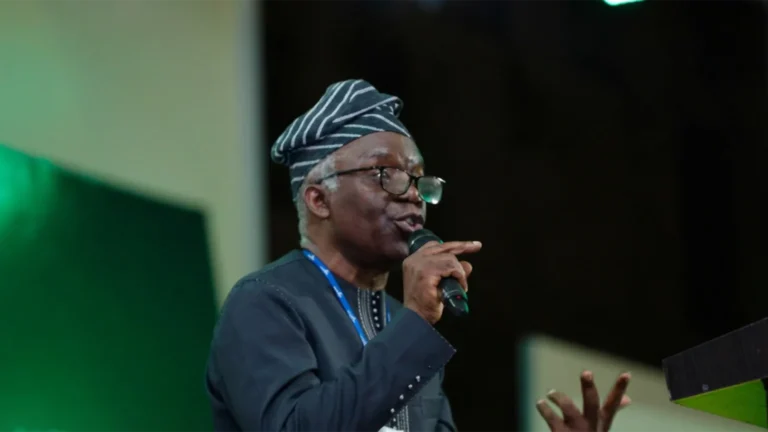
Aare Amerijoye DOT.B

You have money.
Not in your pocket. Not in the bank. It is under your feet. It is in the land your father left you. It is in the house you built. It is in the shop you have kept open through hard times.
But you cannot use it.
Let me show you what I mean.
LOOK AROUND YOU
In Oja Oba market, Ado Ekiti, a woman has sold pepper in the same spot for twenty years. She has no paper to show that spot is hers.
In Gboko, a Tiv farmer farms land his grandfather farmed. He has no paper for it.
In Kano, a tailor has six sewing machines in a rented shop. His business is not registered anywhere.
In Onitsha, a trader’s store is full of goods. He goes to the bank for a loan. The bank says no.
In Okene, an Ebira widow built three rooms on her late husband’s land. If anyone challenges her, she has no paper to prove it is hers.
All these people have something of value. But because they have no proper papers, no bank will lend them money on it. They cannot use it to grow. They cannot be sure their children will inherit it.
They are not poor because they have nothing. They are poor because what they have cannot work for them.
THE MAN WHO EXPLAINED IT
A famous economist from Peru, Hernando de Soto, studied this problem for years. He called it “dead capital”. In simple words: property that is real, but cannot make money for its owner because the law does not recognise it properly.
In his book, The Mystery of Capital, published in 2000, he said poor people in poor countries were holding property worth at least 9.3 trillion dollars that they could not use.
Think about that. The poor are not empty handed. They are holding a fortune they cannot touch.
He explained why rich countries are rich. It is not because their people work harder than us. Nobody works harder than a Nigerian farmer or market woman. It is because in those countries, when you own a house, you get a proper paper. You take that paper to the bank. The bank gives you a loan. You use the loan to start or grow a business. Your house works for you.
Here, your house just sits there.
THE DAY TINUBU WAS TOLD
In March 2010, this same De Soto was invited to Lagos to explain this to Nigerians. It was at the lecture held to mark Bola Tinubu’s birthday.
Tinubu sat there and heard the whole thing. The secret of how ordinary people can become wealthy was explained to him on his own birthday.
Today, Tinubu is President.
So what did he do with the secret?
The pepper seller still has no paper. The farmer still has no paper. Nothing changed for them.
Instead, things got worse. Since he became President on 29 May 2023, the naira has lost more than half of its value against the dollar.
What does that mean for you? If you saved money before, that money now buys less than half of what it used to buy. The trader’s capital, the worker’s savings, the pensioner’s money, the school fees a mother kept aside: all of it shrank.
Nobody stole it from your house. It just became smaller in your hand.
He was taught how to make ordinary people rich. In power, he made them poorer.
WHY YOU CANNOT GET YOUR PAPER
Now, here is something many people do not know.
There is a law called the Land Use Act of 1978. It says all land in a state belongs to the Governor, held for the people. If you want to sell land, buy land, or use land to get a bank loan, you need the Governor’s approval.
Getting your land paper, called a Certificate of Occupancy, can take years. It can cost more money than a market woman makes in many months.
And this law is written inside the Nigerian Constitution. That means it cannot be changed easily. You need to change the Constitution itself.
So the reason the pepper seller has no paper is not just her fault. It is the way Nigeria is set up.
HOW NIGERIA IS SET UP
This brings us to the bigger problem.
Nigeria says it is a federation. That means the states are supposed to have real power to manage their own affairs. But in practice, almost everything is controlled from Abuja.
One police force, controlled from Abuja, for more than 200 million people. Thirty six states waiting every month for money shared from Abuja, like tenants waiting on a landlord. Too much power at the top, too little power close to the people.
When a country is set up like this, the ordinary person suffers. Decisions that should be made near you are made far away from you.
The countries that became rich first sorted out how they would be governed. After that, the wealth followed. China decided to do whatever works for its people. Their leader, Deng Xiaoping, said it does not matter if a cat is black or white, as long as it catches rats. Countries like South Korea, Singapore and Malaysia also sorted out their system first. Then they grew.
Nigeria has not sorted out either one: how we are governed, or how ordinary people can use what they own.
If a country is not properly arranged, its people cannot prosper. Nigeria has not done the arranging.
WHY ATIKU
This is where Atiku Abubakar comes in.
On 16 January 2027, you will choose between people who talk about wealth and one man who has actually built it. Between people who mention restructuring only at election time and one man who has preached it for many years.
First, Atiku knows how wealth is made, from his own life.
He worked in the Nigeria Customs Service for twenty years. He retired in 1989 as Deputy Director, the second highest rank. He built his first house when he was still in his twenties. He started businesses that employ Nigerians today. With his own money, he built the American University of Nigeria in Yola, which stayed open even during the Boko Haram crisis when others ran away.
Second, he has done it for the country before.
When he was Vice President, the law made him chairman of the National Council on Privatisation. That council dealt with government companies that were wasting public money and producing nothing. Many of them were fixed or sold to people who could run them, and companies like Eleme Petrochemicals came back to life. Dead property, made alive again.
In 1999, Nigeria had fewer than 500,000 telephone lines. Most people had never owned a phone. In 2001, their government sold GSM licences to mobile phone companies at 285 million dollars each. Within a few years, ordinary Nigerians had phones. The trader used it to call customers. The farmer used it to check prices. The artisan used it to get jobs. That one decision put money in millions of pockets.
In 2004, the Pension Reform Act was passed. Before then, workers’ pension money often disappeared. After the reform, every worker had their own pension account, and that money is now worth trillions of naira. Workers’ money, working for workers.
Between 1999 and 2007, the size of Nigeria’s economy grew from 58 billion dollars to 270 billion dollars. It grew almost five times.
That is not a promise. That is what happened.
Third, he wants to fix how Nigeria is set up.
For many years, Atiku has said Nigeria must be restructured. In simple words: give the states more power to manage their own affairs, let them have their own police, let them have more say over their own resources, and leave the federal government to handle things like the army, foreign affairs and the currency. He says this should be done properly, by changing the Constitution.
As the ADC candidate, he has committed to giving the states the power to grow and compete with one another.
Remember the Land Use Act inside the Constitution? Remember the pepper seller with no paper? The door to her wealth is locked inside that Constitution. Only a President who believes in changing it will open that door.
Tinubu heard the lecture. Atiku has lived the lesson all his life.
TWO RICH MEN, TWO KINDS OF WEALTH
Both men are rich. Nobody is hiding that. The real questions are simple: where did the money come from, and what is it doing?
Start with Atiku.
You can see his wealth. You can visit it. You can drive to Yola and stand in front of the American University of Nigeria, a university he built with his own money, where young Nigerians study and Nigerians earn salaries. You can go to his farms and businesses in Adamawa and beyond, where people go to work every morning and go home with pay.
His wealth is alive. It employs people. It trains people. It feeds families. That is exactly the kind of wealth De Soto was talking about: money that works, grows and spreads.
And when people make claims about his money, Atiku’s answer has always been the same: if you have evidence, take it to court. Come and look.
Now look at Tinubu.
Ask the ordinary Nigerian to name one factory, one farm or one school that Tinubu built with his own money and where ordinary people work. Most will scratch their heads.
But there is one record about his money that the whole world can read. In 1993, in the United States, American authorities went after money in bank accounts linked to him, saying it was connected to the proceeds of drug dealing. The case ended with Tinubu forfeiting 460,000 dollars to the US government. He was not criminally charged, but he gave up the money.
Some people will say 1993 was a long time ago. But look at the world we live in today.
America now treats drug money very differently from how it did in 1993. On his first day back in office in January 2025, President Donald Trump signed an order declaring the big drug cartels to be terrorist organisations, a threat to America’s national security. His government now treats drug gangs the way it treats groups like Al Qaeda.
Since September 2025, the American military has been firing missiles at boats it says are carrying drugs in the Caribbean Sea and the Pacific Ocean. Hundreds of people have been killed. America’s Defence Secretary has said drug gangs will be hunted and killed like terrorists. And this month, Trump told the United Nations that he plans to wipe the cartels out of the Western Hemisphere completely.
In today’s America, drug money is not a small matter. It is treated as a matter of war.
Tinubu was never charged with any crime. But think about what this means for Nigeria. When our President sits across the table from American leaders to talk about trade, security, loans, or visas for our children, his name sits in an American court record about drug money. How strong can he stand for Nigeria in that room? How hard can he bargain for you?
A President of Nigeria should walk into any room in the world with his head high and nothing to hide.
And the worry is not only about what happened in America long ago. Remember what happened here at home only last year.
In October 2025, after a Council of State meeting, Tinubu approved a presidential pardon for about 175 prisoners. When Nigerians read the list, they were shocked. Dozens of the people he wanted to set free were convicted drug offenders. The list also carried kidnappers, human traffickers, fraudsters and people jailed for dealing in guns.
At the very time America was treating drug gangs as terrorists, the President of Nigeria was signing papers to open prison doors for drug convicts.
Nigerians did not keep quiet. Lawyers, clergy, civil society, students, mothers and ordinary people on social media rose up and said no. The anger was everywhere.
Only then did Tinubu turn back. On 29 October 2025, his office announced that people convicted of drug offences, kidnapping, human trafficking, fraud and gun dealing had been removed from the list.
Think about that. He did not remove them because his conscience told him to. He removed them because Nigerians shouted.
And Nigerians were left with a question nobody in Aso Rock has ever answered: of all the prisoners in Nigerian jails, why were so many drug convicts on the President’s list in the first place?
When America was hunting drug gangs, Tinubu was signing pardons for drug convicts. It took the anger of Nigerians to stop him.
A good leader does not need a crowd to tell him right from wrong.
Then there is the matter of openness. Instead of saying “come and look”, Tinubu’s lawyers have gone to American courts to stop the release of his school records and to block US government agencies from releasing their files on him.
So here is the difference in plain words.
One man says: come and look at my wealth.
The other pays lawyers on two continents to keep the door shut.
One man’s wealth is a university you can visit. The other man’s wealth is a file his lawyers fight to keep closed.
Now ask yourself: which of these two men understands how honest wealth is built? And which of them can teach Nigerians to build it?
YOUR CHOICE ON 16 JANUARY
So when you go out to vote, ask yourself simple questions.
Will the pepper seller finally get a paper for her spot?
Will the farmer’s son inherit land he can take to the bank?
Will the tailor be able to register his business easily and get a loan?
Will the widow get a paper that says her rooms are hers?
Will the money you save this year still be worth something next year?
Whose wealth can you go and see with your own eyes?
Which of these men will protect your children from drug dealers, and which one tried to set drug convicts free?
Then ask the most important question: which of these candidates has ever done this before?
Only one has.
You are sitting on money you cannot use. The man who was told how to fix it has done nothing for three years.
On 16 January 2027, the choice is in your hands.
Vote Atiku Abubakar.
109 days to 16 January 2027.
#Atiku2027 #ADC #16January2027
Aare Amerijoye DOT.B
Director General,
The Narrative Force
thenarrativeforce.org
30 September 2026