Aare Amerijoye DOT.B
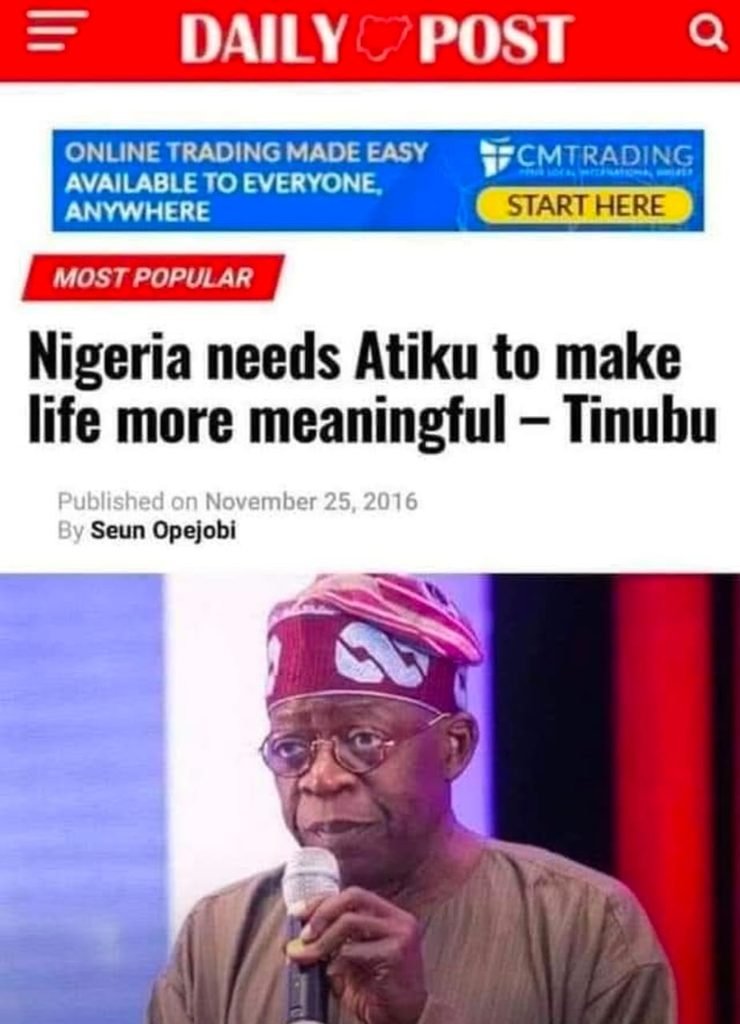
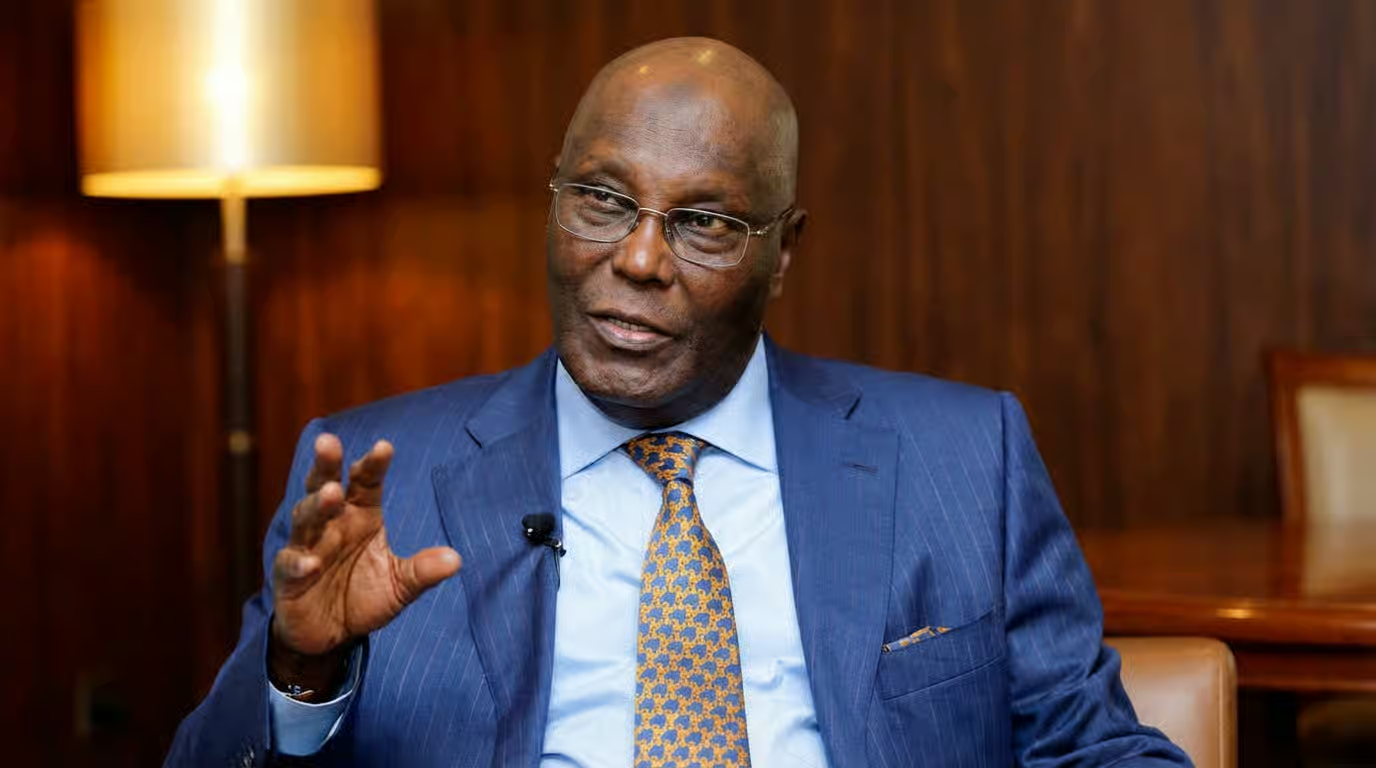
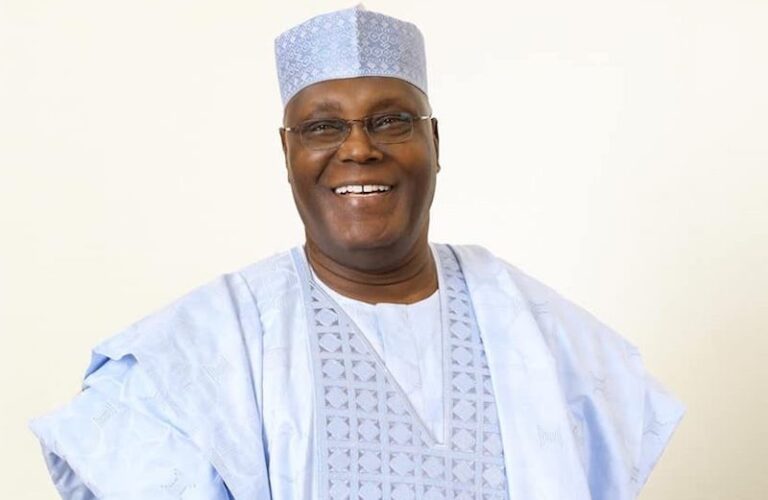
On 25 November 2016, the very day Atiku Abubakar turned 70, Daily Post carried a report by Seun Opejobi under a headline that deserves a frame in every ward office in this country. Nigeria needs Atiku to make life more meaningful. The man who said it was Asiwaju Bola Ahmed Tinubu.
Read it slowly. Not that Nigeria can tolerate Atiku. Not that Atiku is a useful ally. Nigeria needs him, and needs him for a stated purpose: to make the life of the ordinary Nigerian more meaningful.
Tinubu did not say this as a stranger reading a curriculum vitae. He said it as a man who had watched Atiku at close range for almost three decades. That is what lifts the headline above birthday courtesy. It is testimony, and testimony from the witness who knows the most.
THE COMRADES OF THE PEOPLE’S FRONT
The acquaintance began in the late 1980s, inside the political family of the late General Shehu Musa Yar’Adua. In 1989 Atiku was elected a National Vice Chairman of the Peoples Front of Nigeria, the association Yar’Adua led into the Babangida transition, and its membership included Bola Tinubu alongside men who would shape the next thirty years of Nigerian politics.
So the young Lagos politician learnt his early trade in a structure Atiku helped to lead. Tinubu did not discover Atiku in 2016. He grew up in his political company.
JOS 1993 AND THE MANDATE TINUBU DEFENDED
When the Social Democratic Party gathered in Jos in 1993 to choose its presidential candidate, Atiku was a serious contender. He stood down, and his support went to Chief MKO Abiola. That act of self denial helped make the Abiola candidacy possible.
Tinubu, then SDP Senator for Lagos West, went on to fight for the June 12 mandate through NADECO and years of exile. The mandate he spent those hard years defending was a mandate Atiku’s sacrifice at Jos had helped to create. Both men stood on the same side of history, and one of them had paid for the ground they stood on.
The mandate Tinubu went into exile to defend was one Atiku stepped aside to make possible.
2007: A PARTY ATIKU CO-FOUNDED
When the Third Term battle was over, Atiku did not go looking for a platform. He built one. The Action Congress was founded and registered with Atiku among its founding owners, standing as an equal partner with Tinubu and the progressives who joined them.
The presidential ticket was his as of right, as a founder of the party, not as a favour from anyone. And what Atiku brought into that partnership was what no one else in it could supply: a former Vice President with a following in every zone and a network across the North, turning a party whose strength had been largely in the South West into a national force.
When INEC struck his name from the ballot, it was Atiku who went to court, and it was the Supreme Court that held INEC had no such power and restored his name. The courage was his. The victory was his.
Tinubu sat across the founding table from Atiku and saw at first hand what he was worth. He would not forget it.
In 2007 Atiku did not borrow a platform. He built one, and gave it a nation.
2016: THE WORDS ON THE RECORD
Nine years later, both men were in the APC, a party Atiku helped to form. Tinubu’s own structures had carried another man through the 2014 presidential primary. He owed Atiku no flattery and had no campaign to win from him.
Yet on Atiku’s 70th birthday, with nothing to gain, Tinubu told the whole country that Nigeria needs this man to give meaning to the lives of its people.
That is the value of the headline. Praise given when nothing is at stake is the purest form of belief a politician can offer.
Praise given with nothing to gain is the truest verdict a politician ever delivers.
WHAT CHANGED WAS NOT ATIKU
On 24 November 2017, Atiku announced his exit from the APC, almost a year to the day after that tribute. From that moment the tone from Tinubu’s camp turned. By 2023 they were opponents on the ballot. Today, when Atiku placed his plan to bring down fuel costs before Nigerians, Tinubu waved it away as proof of “serious ignorance” of governance.
Ask the simple question. What changed?
Not Atiku. He is the same Customs officer who retired as Deputy Director with his integrity intact. The same Vice President who chaired the National Economic Council and the National Council on Privatisation. The same restructuring creed, the same belief that reform must be phased and cushioned so that the people who bear the pain share the gain.
What changed is Tinubu’s seat. In 2016 he had no throne to protect. Today he has one, and the man he once said Nigeria needs is the man standing at its door.
So Nigerians must choose which Tinubu to believe. The Tinubu who spoke freely in 2016, or the Tinubu who speaks defensively in 2026. The first spoke from conviction. The second speaks from fear.
THE TEST TINUBU SET FOR HIMSELF
Tinubu’s own words set the measure: life must be made more meaningful for Nigerians. He has had more than three years in Aso Rock to meet that measure.
The minimum wage of 70,000 naira now buys about 50 litres of petrol at 1,400 naira a litre. Families have dropped from three meals to one. The meaning Tinubu promised to others has drained out of the lives of the people he now governs.
The standard is his. The failure is his. And the answer, by his own testimony, is the man he named on 25 November 2016.
Tinubu wrote the question in 2016 and supplied the answer himself: Atiku.
On 16 January 2027, Nigerians need only take Tinubu at his word. In 110 days, the suffering masses of this country have the power to do what he himself said Nigeria needs.
Aare Amerijoye DOT.B
Director General,
The Narrative Force
thenarrativeforce.org
29 September 2026