By Kunle Oshobi
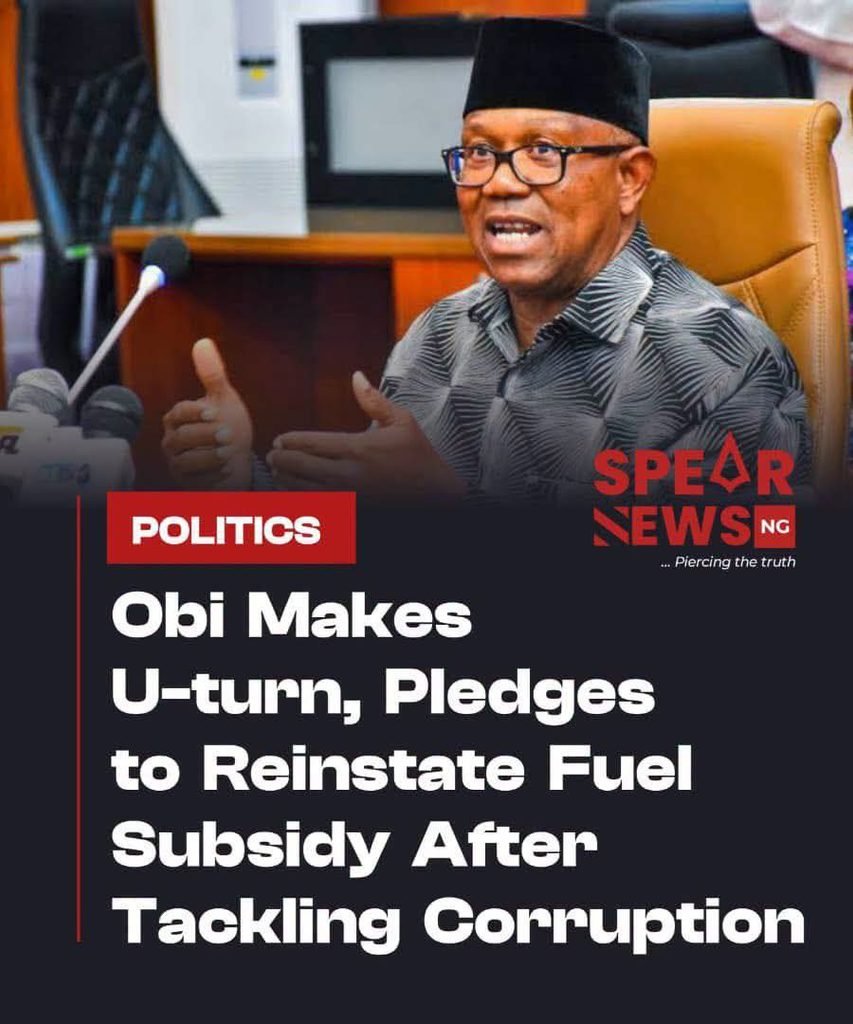
In political theatre, consistency is often praised as a virtue, while sudden policy reversals, especially those delivered with grandstanding theatricality, usually signal desperation. Peter Obi’s recent pronouncement promising to reinstate the petrol subsidy after “tackling corruption” is a textbook case of flip-flop politics.
For months, the former Anambra State governor consistently peddled the gospel of subsidy removal. At public lectures, media appearances, and policy forums, he repeatedly argued that the subsidy regime was an unsustainable, corruption-ridden drain on public resources that needed to end. Yet, in a sudden twist designed to court public favor, Obi has now executed a 180-degree turn, promising to restore the very mechanism he previously declared dead and buried.
Playing to the Gallery or Lacking Economic Depth?
This sudden reversal betrays a candidate operating without a clear, coherent economic philosophy. Rather than offering grounded, long-term economic strategies, Obi’s promise reads like a cheap publicity gimmick meant to inject artificial life into a sluggish campaign.
Promising to restore subsidies “after tackling corruption” is a convenient populist talking point, but it reveals a fundamental lack of economic realism. Subsidies, by their very design, create price distortions, encourage cross-border smuggling, and drain treasury reserves regardless of administrative intentions. By suggesting that corruption control alone magically turns an unsustainable fiscal policy into a sound one, Obi demonstrates a shallow grasp of macroeconomic realities.
Borrowing Atiku’s Playbook Without the Implementation Strategy
This ideological shift highlights another glaring issue: Obi’s increasing reliance on opposition rhetoric pioneered by Atiku Abubakar. For years, Atiku’s economic strategy has leaned into hybrid models of state intervention and market liberalisation, framed around structural anti-corruption initiatives.
By adopting Atiku’s talking points regarding conditional state relief and anti-corruption sequencing, Obi appears to be copying homework without understanding the underlying formulas. Atiku’s framework, whatever its critics may say, relies on established structural reform mechanics. Obi, by contrast, presents these ideas as simplistic slogans. Offering a complex policy shift without detailing the fiscal mechanics, budget allocations, or revenue strategies needed to sustain it exposes a campaign driven by headlines rather than actionable governance blueprints.
The Ultimate Gift to the Ruling Party: Splitting the Opposition
Beyond the policy confusion, Obi’s political posturing continues to serve a specific strategic outcome in Nigerian electoral dynamics: the fragmentation of the opposition vote.
By positioning himself as a distinct third force while simultaneously echoing the policy positions of mainstream opposition figures like Atiku, Obi effectively splits the anti-incumbent electorate. Rather than building a consolidated, formidable opposition coalition capable of presenting a unified alternative, his campaign fragmented votes across key regions. Consequently, every dramatic U-turn and populist appeal from Obi does less to challenge the political status quo and more to guarantee that opposition forces remain hopelessly divided, ultimately paving an easier path for President Bola Tinubu and the ruling party.
Conclusion
Politicians often alter their stances, but true leadership requires consistency, structural clarity, and honest engagement with complex fiscal realities. Obi’s recent attempt to pivot on the fuel subsidy issue is a mirror reflecting a political strategy built on convenience rather than conviction. Between copying borrowed policy frameworks and continually splitting opposition votes, Peter Obi, may find that swapping economic principles for populist applause leaves voters with little substance to buy into.
Kunle Oshobi is The Head of Planning and Strategy, and Chairman Narrative Command of The Narrative Force.