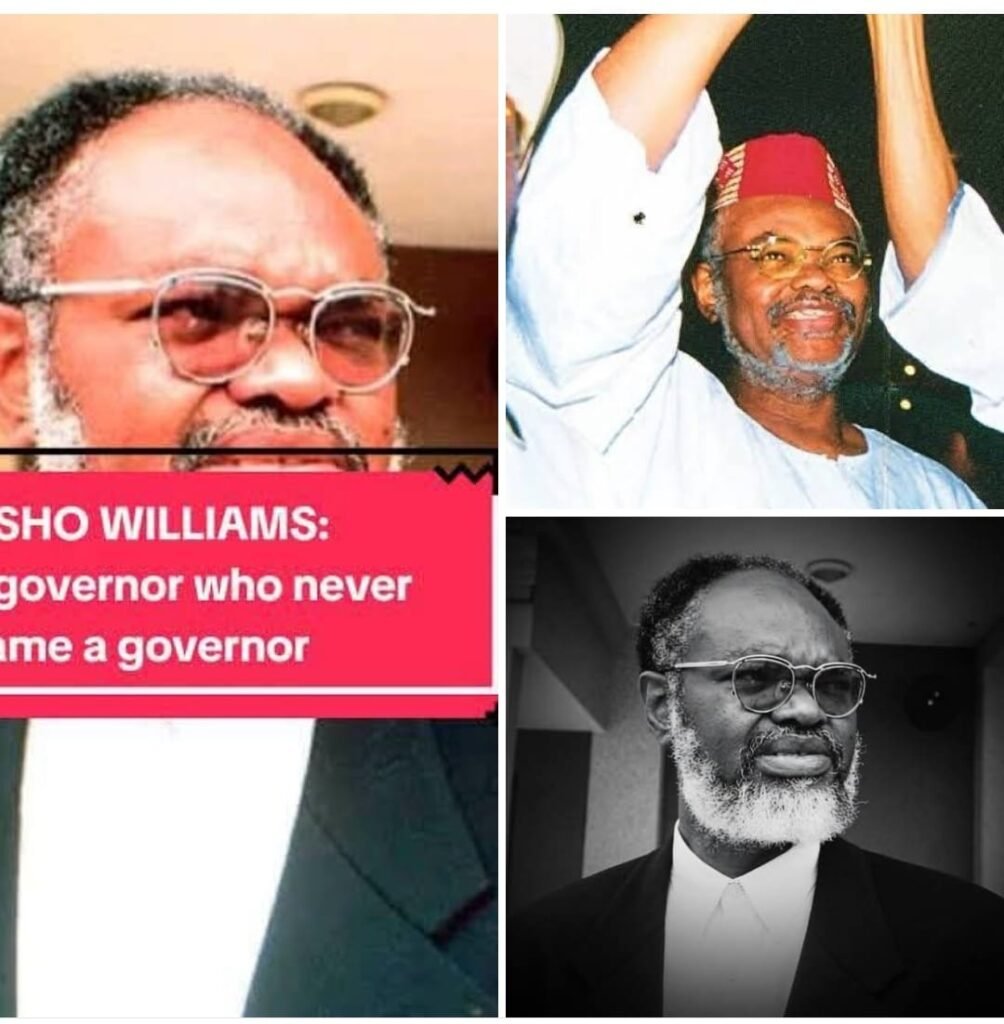
Funsho Williams, Twentieth Anniversary
Aare Amerijoye DOT.B
Nigeria has been demystified of its evils. We have arrived at a place where there is no court for the wicked man, where everyone knows he kills, and where, the moment fortune begins to smile on him, the same people will turn and call him a strategist. Our national honours are pinned on chests that still carry the shadow of corruption. And our press, ever gentle, has perfected the craft of giving terrifying things soft and pleasant names.
There is a kind of man every serious conversation in this country can point to and no courtroom can reach. Ask who was truly behind this killing or that one, and voices drop, fingers lift, and everybody in the room is sure. Yet the law never lays a hand on him, for knowing a thing is not the same as proving it. And since he is never caught, we spare ourselves the discomfort of naming what he is. We call him, instead, the best strategist.
Yesterday marked twenty years since one of those soft named horrors.
THE LANGUAGE OF SOFT MURDER
Read the reports again and listen to the vocabulary. Unknown men. Unidentified gunmen. Assailants who gained access through the roof. A political elimination. Every phrase is built to hold the horror at a polite distance, and every phrase keeps the guilty conveniently nameless.
Where the killer is never named, the killing is never quite made to mean anything.
That is not a failure of language. It is a service that language performs, and we should ask, quietly, whom it serves.
LAGOS, JULY 2006
On the twenty seventh of July 2006, unknown men entered the Ikoyi home of Engineer Funsho Williams, the Peoples Democratic Party governorship frontrunner in Lagos, and left him dead in a house turned upside down. His driver of twenty two years found him the next morning.
What came after is the part we prefer to forget. Six men were charged and held for years. Then, on the thirtieth of June 2014, a Lagos court discharged and acquitted every one of them, holding that the prosecution had not established even a prima facie case. No mastermind was ever named. Every later attempt to reopen the file was struck out for want of diligent prosecution.
So when we say there is no court for the evil man, we are not reaching for a phrase. We are reading from the record.
EKITI KEEPS ITS OWN LEDGER
And Ekiti, our Ekiti, keeps its own ledger of the unanswered dead.
Tunde Omojola, in May 2005. Doctor Ayo Daramola, in August 2006, a governorship aspirant and economist cut down barely a fortnight after Williams, so that two PDP hopefuls fell in the same bloody season and neither killing produced a reckoning anyone would call justice. Chief Ayo Awolumate, in 2009. Foluso Ogundare, shot at Emure Ekiti in 2013. Juliana Adewumi and Ayo Jeje, both killed on the thirtieth of May 2014 as that year’s contest boiled. Chief Omolafe Aderiye, the former transport union chairman, killed at his office in the Ijigbo area of Ado Ekiti in September 2014.
Different years, different camps, the same silence at the end.
AND THEN, BUNMI OJO
On the night of the tenth of August 2018, Comrade Bunmi Ojo sat at a viewing centre along the Ado to Iworoko road. He was a commissioner representing Ekiti on the Federal Character Commission and a chieftain of the All Progressives Congress, a man who had once served as personal assistant to former governor Segun Oni. Gunmen found him there. He did not fall alone. Two other people were killed beside him.
Ido Ekiti buried him with its markets shut and its offices deserted, and then the state performed the ritual we have all watched too many times. One party blamed the other for the insecurity. The other threw the blame straight back. The gunmen stayed unidentified. The police announced an investigation.
And then nothing. Ojo took his place on the same shelf as Daramola and Aderiye, honoured at the graveside and abandoned by the very machinery that was meant to answer for him.
A loud killing, a silent accounting, and a name we agree to remember only on its anniversary.
THE THIRD JUSTICE
The late Justice Chukwudifu Oputa once observed, in Josiah against the State, that justice is not a one way street. It is owed three ways at once, to the accused, to the victim, and to the society that has to go on living afterward. In case after case, in Lagos and in Ekiti alike, all three have been shortchanged. The accused walk free for want of proof. The victim receives no verdict. And the society is schooled, lesson upon lesson, in the understanding that ambition here can be settled with blood at no cost to the man who spills it.
That is the real danger. Impunity is a teacher. Every unpunished killing is a lecture delivered to the next man who is weighing whether to reach for a gun, and the lesson never changes. He will most likely get away. And should fortune smile on him afterward, we will not only spare him the law, we will hand him the compliment. We will call him a strategist.
Twenty years after Funsho Williams, the kindest thing we can still do for the dead is to stop crowning the men behind their deaths as our finest political strategists, and to stop handing plain murder a pleasant name.
Aare Amerijoye DOT.B
Director General, The Narrative Force
thenarrativeforce.org
28 July 2026