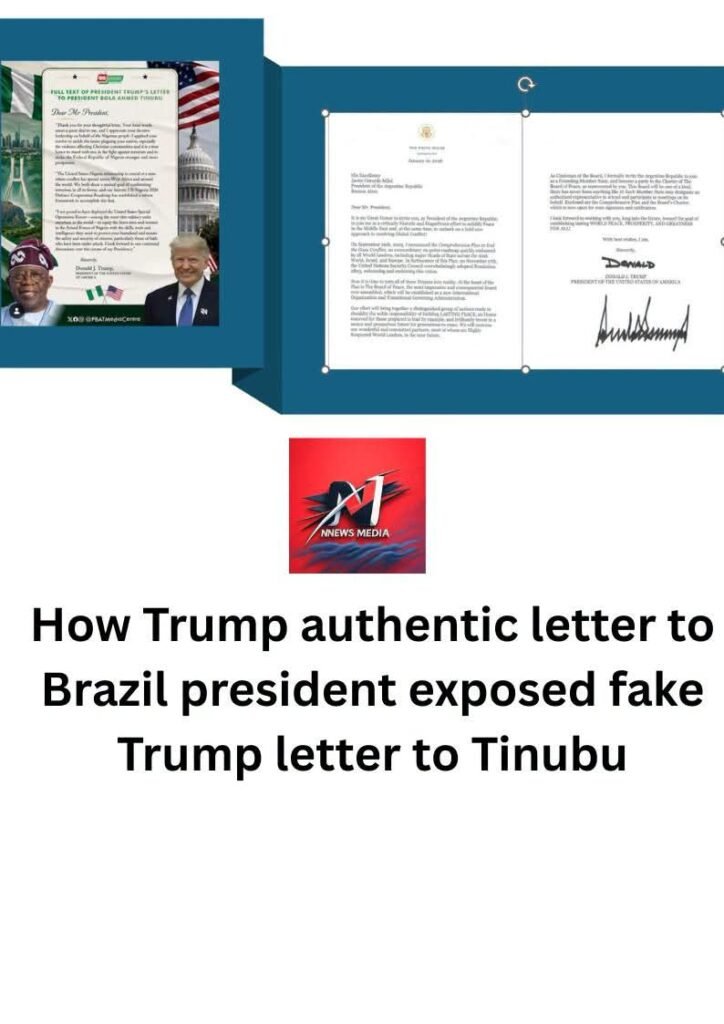
The Nigerian Presidency’s publication of what it claims is a letter from United States President Donald Trump dated July 6, 2026, endorsing Tinubu’s fight against terrorism, raises more questions than it answers. Once the government elected to make what ought to have been a private diplomatic correspondence public and deploy it as evidence of international endorsement, it assumed a corresponding duty to satisfy the public that the document is authentic.
The simplest way to achieve that is to publish the original signed letter in its entirety.
The version released to the public lacks features ordinarily associated with USA official presidential correspondence under President Donald Trump. Secondly, it has not been independently published or acknowledged by the White House, nor does it appear on any official United States government platform available to the public. While it is true that not every letter exchanged between heads of state is published by the White House, the absence of any independent confirmation inevitably invites legitimate scrutiny, especially where the communication is being used for domestic political messaging.
More importantly, if the Presidency seeks to rely on the letter as proof of international validation of its security efforts, Nigerians are entitled to inspect the original document. A copy bearing official White House letterhead, President Trump’s authentic signature, the date, and other identifying security features would immediately dispel doubts and silence sceptics.
This is not an allegation of forgery. It is a demand for transparency and accountability. Extraordinary claims deserve credible proof, particularly when they are advanced by a government that has, in the eyes of many Nigerians, suffered a profound crisis of credibility. In an era where citizens have witnessed controversies over fake government agencies, forged documents, manipulated records and conflicting official narratives, public trust has been severely eroded. Many Nigerians now fear that there is little beyond the capacity of government propaganda to manufacture whatever narrative best serves its political interests. Whether that perception is fair or not, it underscores why openness is indispensable.
If the letter is genuine, publishing the original signed copy will reinforce the credibility of both the Presidency and the communication itself. If, however, the government continues to rely only on a reproduced text while withholding the original document, it cannot reasonably expect Nigerians to accept its authenticity on faith alone.
Transparency is the currency of democratic governance. Since the Presidency has already chosen to publicise what it describes as official diplomatic correspondence, it should complete the process by releasing the original signed letter for independent public examination. That is the surest way to replace suspicion with confidence and speculation with proof.
Alex Ter Adum, PhD
DDG THE NARRATIVE FORCE