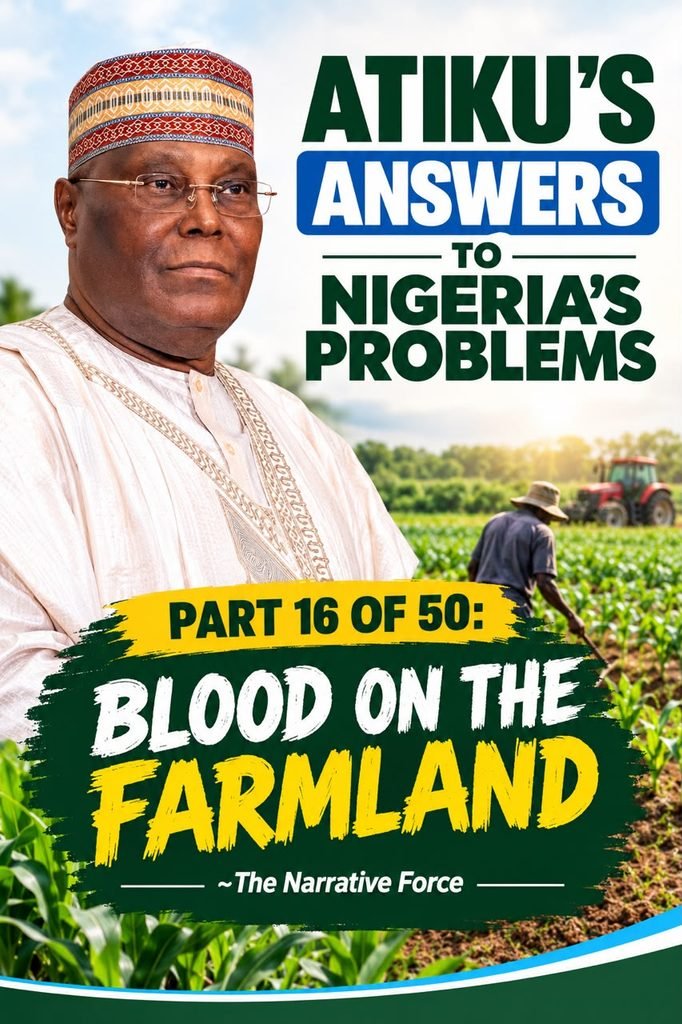
PART 16 OF 50: BLOOD ON THE FARMLAND
Aare Amerijoye DOT.B
Two men who have never met lost the same thing in the same year.
The first is Terkula, a yam farmer in Benue. He planted his heaps in April. In July, men with guns came through his village at night. By morning his brother was dead, his barn was ash, and the heaps he had sweated over were left to the weeds. He now sleeps in a camp for displaced people in Makurdi, a farmer with no farm.
The second is Ardo Musa, a herder in Plateau. He had a hundred and twenty cattle, the savings of three generations. Rustlers came at dusk, shot his eldest son and drove the herd into the forest. He now walks the edges of Jos with a stick and nothing to lead.
One is Tiv. The other is Fulani. One is Christian. The other is Muslim.
They have been taught to blame each other.
But look closely. Both lost a son or a brother. Both lost their livelihood. Both were failed by the same missing thing: a state that protects every life, every farm and every herd.
The farmer and the herder are not each other’s enemy. Their common enemy is the absence of security and justice.
THE KILLING FIELDS
The farmland of Nigeria’s middle belt has become the most dangerous place to earn a living in this country.
In June 2025, at Yelwata in Benue State, scores of people were killed in a single night of horror. The nation mourned, leaders made speeches, and the world took notice.
And then the killing continued.
In July 2026, attackers struck Akpachi and Otukpo-Nobi in Otukpo Local Government Area of Benue, and at least eighteen people were killed. In the same weekend, in Riyom, Plateau State, gunmen killed nine members of one family, including a baby two months old.
Two months old.
Weeks later, cashew farmers were murdered on their farmlands in Benue. Across Plateau, Benue, Southern Kaduna, Nasarawa, Taraba, Niger and beyond, the pattern repeats: a village attacked at night, a mass burial by day, a statement of condolence by evening, and then silence until the next village.
The farming communities of the Middle Belt have borne the heaviest and most repeated massacres of all. Their grief must never be diluted, and their dead must never be reduced to a statistic.
And the suffering does not stop there. Herders have lost cattle, sons and whole camps to rustlers and reprisal attacks. Communities across the North West, of every ethnic group, have been ravaged by bandits who spare no one.
No community has been spared. That is the truth no tribal propagandist wants you to hear.
When the killers go unpunished, every community becomes the next target.
THE COST ON YOUR TABLE
If you live in Lagos, Enugu, Port Harcourt or Ibadan, you may think this is a distant tragedy.
It is not. It is on your plate.
The middle belt is Nigeria’s food basket. When Benue farmers cannot reach their fields, yam becomes scarce in Lagos. When Plateau farmers abandon their land, Irish potatoes, tomatoes and vegetables become expensive in Abuja. When farmers in Niger and Kaduna stay away, maize and rice prices climb everywhere.
Every abandoned farm is a smaller plate in a home hundreds of kilometres away. Part 14 told you that prices are born on the insecure farm. This is where they are born.
And every displaced farmer is a family pushed from producer to beggar, from feeding the nation to waiting for relief in a camp.
The violence on the farmland is not a regional problem. It is a national hunger crisis written in blood.
Insecurity on the farm is inflation in the market.
WHY IT NEVER ENDS
Ask why the killings never end, and the answer is painful but simple.
Because the killers are rarely caught.
After every attack, the same words: “We will fish them out.” “The perpetrators will be brought to justice.” “Security has been beefed up.” And after every attack, too few arrests, too few trials and too few convictions.
When killing carries no cost, killing continues.
The second reason is distance. As Part 15 showed, the power to protect sits far from the villages that need protection. A community under attack at midnight is often alone until morning.
The third reason is poverty. Idle young men, from every ethnic group, are easy recruits for whoever pays, whether bandit, rustler or militia. A young man with no farm, no herd and no job can be hired to destroy someone else’s.
And the fourth reason is the poison of tribal blame. Every attack is turned into a story of one ethnic group against another, and every story becomes a reason for the next reprisal. Those who profit from division feed the fire.
Impunity, distance, poverty and hate: four fuels for one fire.
THE LEADER WHO SPEAKS FOR EVERY VICTIM
Here is what every Nigerian must understand about Atiku on this issue.
He is a Fulani man and a farmer, and his opponents have tried to use both against him. Some have claimed he would favour herders. The record tells a different story.
In 2019, a Fulani socio-cultural group, Miyetti Allah Kautal Hore, publicly urged Nigerians to reject his presidential bid. Its complaint was that he had spoken out about the killings on the farmlands and drawn attention to a report documenting them.
Think about what that means. Atiku chose to speak the truth about the killings even when it cost him support among some of his own people. A man who was only looking after his tribe would have kept quiet.
He has also walked into this fire before. Speaking in Makurdi in February 2023, Atiku recalled the peace effort he helped broker between Tiv farmers and Fulani herders in 2011, and promised Benue: “I will come and make sure peace returns to Benue.” He told the crowd: “Today, our farmers in this state can’t go to farm again because of insecurity.”
He spoke for the victims when silence would have been easier. That is a leader for every tribe.
ATIKU’S ANSWER: SECURE EVERY FARM, PROTECT EVERY LIFE
Atiku’s 2027 plan attacks each of the four fuels.
Against impunity and weakness, security that works. Point 8 of his 12 Point Agenda commits to strengthening national security through recruitment, welfare and modern technology. In his acceptance speech on 27 May 2026, he committed to strengthening the military, police and intelligence services with better welfare, recruitment, equipment and training. At his screening on 20 May 2026, he committed to intelligence-led operations and inter-agency coordination. Intelligence finds the killers before they strike, and better-equipped forces catch them after.
Against distance, security close to the people. At the same screening, he committed to decentralised security structures, so that the forces protecting a village know its paths, its people and its language, and arrive before the attackers leave.
On the farm itself, Return to Farms. Point 9 commits to securing farms, reducing farming costs and financing farmers, with the campaign’s target of 20 million farmers on 20 million hectares. That target cannot be met without peace on the land, which is why security and agriculture sit side by side in his plan. A secure farm feeds the nation. A financed farmer rebuilds his barn.
Against poverty, jobs and capital. Point 7, the $10 billion Youth and Women Fund, and the campaign’s target of 20 million new jobs give young men an honest future, so that nobody can hire them to burn another man’s harvest.
And against the poison of hate, a leader who belongs to all. A president who has spoken for the victims even at a cost to himself can stand before the Tiv farmer and the Fulani herder alike and say: your life is equal, your loss is equal, and your protection will be equal.
He has also been direct about the urgency. Speaking to BBC Hausa in August 2026 about insecurity, he said: “I will not take more than one year to end it.”
That is not a promise made lightly. It is a standard he has set for himself, and Nigerians will hold him to it.
Secure the farm. Protect the herd. Punish the killer. Employ the youth. Unite the people.
TO TERKULA AND ARDO MUSA
To Terkula in the camp at Makurdi, a farmer with no farm. To Ardo Musa on the edge of Jos, a herder with no herd. To the family in Riyom burying a two-month-old baby. To the cashew farmers’ widows in Benue. To every Nigerian who has been told that his neighbour is his enemy.
Your enemy is not the man of another tribe. Your enemy is the system that let the killers walk free.
So share this with your farmers’ association, your herders’ union, your community development association, your traditional council, your youth and women’s groups, your family platform and your church and mosque communities. Share it especially across the lines of tribe and faith. Send it to the friend whose people you were taught to fear. Then sit together and ask: who has protected us so far, and who will protect us next? Tell them about the leader who spoke for the victims when silence was easier, and about his plan to secure every farm and every life.
Collect your PVC if it is ready, and keep checking with INEC until it is. On Saturday, 16 January 2027, go early, vote, stay and protect your vote until the result is pasted at your polling unit.
Tonight, somewhere on the farmland, a family will lie awake listening for motorcycles.
On 16 January, vote for the morning when the farmer and the herder both go to work in peace.
Vote Atiku. Vote Amaechi. Vote ADC.
Next: Part 17, Roads of death: Nigeria’s broken highways.
#Atiku2027 #AtikuAmaechi2027 #AtikusAnswers #VoteADC #PeaceOnTheFarmland
Aare Amerijoye DOT.B
Director General,
The Narrative Force
thenarrativeforce.org
27 October 2026