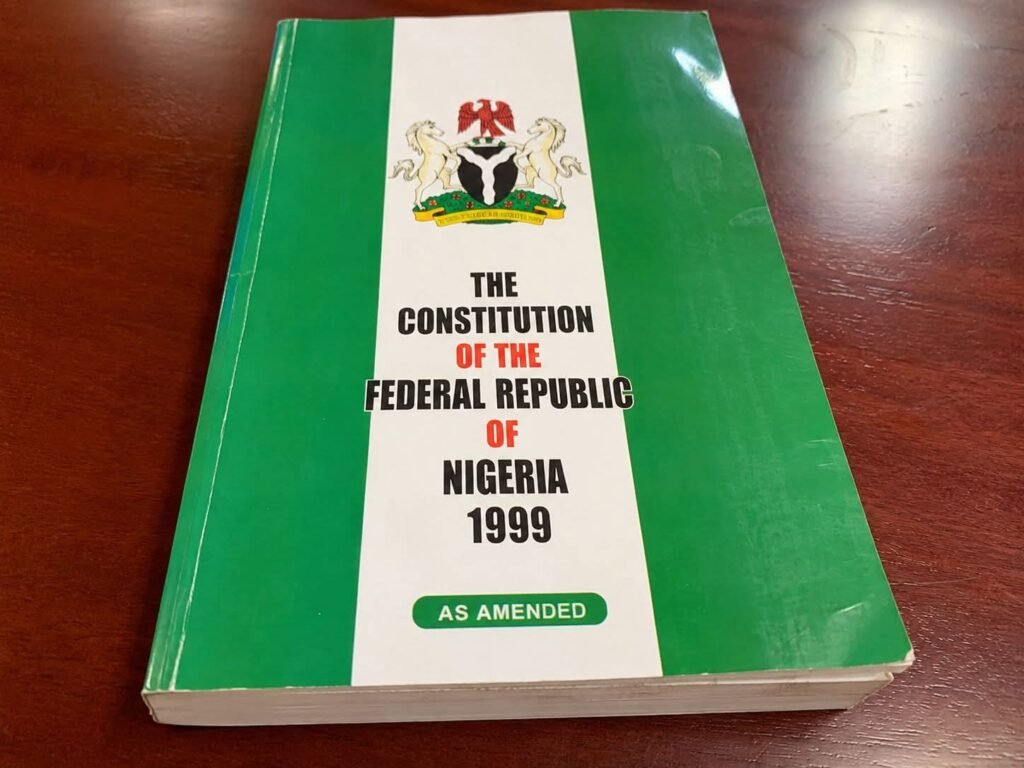
The Constitution of the Federal Republic of Nigeria, 1999 (as amended), is the grundnorm and the supreme law of the land by virtue of Section 1(1) thereof, which provides that “this Constitution is supreme and its provisions shall have binding force on all authorities and persons throughout the Federal Republic of Nigeria.” Consequently, every person aspiring to the office of President must strictly satisfy the qualifications prescribed therein, and no political consideration, administrative convenience, or personal assertion can override constitutional command.
Section 131(d) of the Constitution provides that a person shall be qualified for election to the office of President if, and only if, “he has been educated up to at least School Certificate level or its equivalent.” This provision is mandatory and couched in peremptory terms. Nigerian courts have consistently held that where the Constitution uses the word “ shall ,” it denotes compulsion and leaves no room for discretion. See Amaechi v. INEC (2007) 18 NWLR (Pt. 1065) 42, where the Supreme Court emphasized that constitutional provisions must be obeyed as written and cannot be diluted by administrative or political convenience.
The expression “School Certificate or its equivalent” is further defined in Section 318(1) of the Constitution, which expands the meaning to include not only the West African School Certificate or its modern equivalents but also “any other qualification acceptable to the Independent National Electoral Commission (INEC) as being equivalent thereto.” This definition is inclusive rather than restrictive, but it does not abolish the requirement itself. It merely broadens the category of acceptable qualifications while preserving the constitutional burden of proof on the candidate.
The legal burden of proof in matters of qualification is governed by both constitutional principle and statutory evidence law. Sections 131 and 132 of the Evidence Act, 2011 place the burden of proof on the party who asserts the existence of a fact. Accordingly, a candidate who asserts compliance with Section 131(d) bears the legal burden of proving such compliance with credible, admissible, and sufficient evidence. The Supreme Court in Buhari v. INEC (2008) 19 NWLR (Pt. 1120) 246 affirmed that where qualification is in issue, the candidate must establish it affirmatively and not rely on presumption.
Under the Evidence Act, documentary evidence is the best form of evidence where the contents of a document are in dispute. Section 85 of the Evidence Act provides that “documentary evidence means documents produced for the inspection of the court.” Section 86 further provides that documents must be proved by primary evidence except as otherwise permitted. Section 88 reinforces that documents must be proved by primary evidence, meaning the original certificate, transcript, or official record. Section 102 classifies public documents, including educational records issued by public institutions, while Section 104 requires certified true copies where public documents are tendered in evidence.
The Supreme Court has repeatedly affirmed the primacy of documentary evidence. In Ogunleye v. Oni (1990) 2 NWLR (Pt. 135) 745, the Court held that documentary evidence is the best proof of its contents and cannot be varied by oral testimony. Similarly, in Kimdey v. Military Governor of Gongola State (1988) 2 NWLR (Pt. 77) 445 , the Court emphasized that where documents exist, they speak for themselves and oral evidence cannot displace them.
In electoral jurisprudence, the courts have consistently insisted on strict compliance with documentary requirements. In Nyesom v. Peterside (2016) 7 NWLR (Pt. 1512) 452, the Supreme Court reiterated that qualification issues are threshold matters that go to the root of candidacy and must be resolved in accordance with clear and credible evidence.
Where educational qualification is placed in issue, the law requires production of verifiable academic records such as certificates, transcripts, admission records, and where necessary, corroborating institutional confirmation. Mere personal assertion, political biography, or self-declared credentials cannot substitute for admissible documentary proof. This is consistent with the principle in Section 167(d) of the Evidence Act, which allows the court to presume that evidence which could be produced but is not produced would be unfavourable to the party withholding it.
A university degree, while ordinarily a higher qualification, does not automatically extinguish constitutional inquiry under Section 131(d). This is because the constitutional requirement is not merely about attainment of a higher academic status but about lawful educational progression. Where it is alleged that admission into a degree programme was obtained without the requisite foundational qualification, the legitimacy of the educational pathway becomes a justiciable issue. Nigerian courts have long recognized that fraud, misrepresentation, or illegality in the procurement of a qualification can vitiate reliance on such qualification in legal proceedings. See Okafor v. Nweke (2007) 10 NWLR (Pt. 1043) 521 , where the Supreme Court held that a process tainted by illegality cannot stand.
Thus, the issue is not merely the existence of a degree certificate but whether it can validly satisfy the constitutional requirement when the foundational educational steps are disputed. Constitutional supremacy under Section 1(1) demands that all qualifications must be traceable to lawful and verifiable processes.
INEC, as established under Section 153 of the Constitution and empowered by the Electoral Act 2022, has a statutory duty to regulate political parties and conduct elections in accordance with the Constitution and the Electoral Act. Section 29(1) of the Electoral Act 2022 requires political parties to submit the list and personal particulars of candidates, including Form EC9 (Affidavit and personal particulars), which must contain truthful disclosure of educational qualifications. Section 29(5) further empowers INEC to reject or disqualify candidates who fail to comply with statutory requirements.
The Supreme Court in PDP v. INEC (2014) 17 NWLR (Pt. 1437) 525 affirmed that INEC has a constitutional responsibility to ensure compliance with the law in the nomination and submission of candidates. However, where disputes arise, the final arbiter is the judiciary, pursuant to Sections 6(6)(a) and (b) of the Constitution, which vest judicial powers in the courts to determine civil rights and obligations.
Comparative constitutional practice in common law jurisdictions such as India, Ghana, and Kenya similarly demonstrates that educational qualifications for public office must be proven through authentic, verifiable documentation. Courts in those jurisdictions consistently reject unverified claims of academic attainment where statutory qualifications are prescribed, reinforcing the principle of transparency and accountability in democratic governance.
It is also a settled principle of constitutional interpretation that provisions relating to qualifications for public office must be strictly construed. In Attorney-General of Bendel State v. Attorney-General of the Federation (1981) 10 SC 1 , the Supreme Court held that constitutional provisions must be given their ordinary meaning and not expanded beyond their clear intent.
Accordingly, where a genuine dispute arises as to whether a candidate has satisfied Section 131(d) read together with Section 318 of the Constitution, such dispute is justiciable and must be resolved by a court of competent jurisdiction based on admissible evidence. The court is empowered to evaluate documentary evidence, apply statutory presumptions under the Evidence Act, and determine whether the constitutional threshold has been met.
Ultimately, constitutional democracy is anchored on the supremacy of the Constitution and the rule of law, not on political expediency or personal declarations. The qualifications prescribed under Section 131(d) are mandatory constitutional conditions precedent to eligibility. They must be strictly complied with, objectively demonstrated, and proved by credible documentary evidence where challenged. Any relaxation of these requirements would undermine constitutional supremacy, weaken electoral integrity, and erode public confidence in democratic institutions.
Alex Ter Adum, PhD
DDG THE NARRATIVE FORCE