The Journey to 2027 Is Mature — Part Two of Four
Aare Amerijoye DOT.B
How Atiku’s opponents are constructing his victory, one Southern division at a time.
In the grammar of Nigerian electoral politics, there is no more consequential sentence than this: a sitting state governor has looked at the incumbent president’s record, found it wanting, and declared his intention to contest against him from within the same geopolitical zone. That sentence describes the 2027 South-West precisely. It describes the specific condition of Bola Ahmed Tinubu’s hold on the region he calls home. And it describes, with forensic clarity, why every calculation of southern resistance to Atiku Abubakar’s candidacy must be revised downward before a single vote is cast.
Part One of this series established that Atiku Abubakar is not merely the North’s candidate. He is Nigeria’s only genuinely pan-Nigerian one, the sole figure in the 2027 field with a documented electoral footprint across all six geopolitical zones. It established the Northern arithmetic: 44.8 million registered voters, a unified candidate, and the moral force of the rotational presidency covenant. Part Two makes the complementary case. The South, which constitutes Tinubu’s primary support territory, is not merely divided. It is conducting a surgical self-dismemberment. And the ADC, far from watching from the sidelines, must drive aggressively into every crack, every fracture, and every opening that southern fragmentation has created.
A GOVERNOR’S VERDICT: THE LEGITIMACY FRACTURE IN TINUBU’S FORTRESS
Of all the structural gifts that the 2027 landscape has delivered to the ADC, none is more immediately consequential than the presidential candidacy of Governor Seyi Makinde of Oyo State under the African Peoples Movement.
Makinde does not enter this race as a private citizen or a peripheral party agitator. He enters it as a sitting Governor of Oyo State whose decision to contest against Tinubu sends a signal far more consequential than any machinery argument can capture.
Let it be stated plainly, because it must be understood correctly. Governors do not deliver their states. They never have. The people of Oyo State will not vote for Atiku Abubakar because Makinde tells them to, any more than Tinubu’s parade of sitting governors will deliver their states to APC on a platter of administrative loyalty. The Narrative Force has argued this consistently and argues it again here: Nigerian voters are not the property of whoever currently occupies the Government House. They are sovereign. They decide.
What Makinde’s candidacy does is something altogether more subtle and more devastating to Tinubu’s political standing in the South-West. It provides legitimacy to doubt. It tells every Oyo voter, every Osun voter, every South-West Nigerian who has watched Tinubu’s presidency with growing unease that their reservations are not disloyal or eccentric. They are confirmed by a man of substantial political standing from within their own geopolitical territory.
When a sitting governor of one of the most consequential states in the South-West publicly repudiates the incumbent president’s leadership by contesting against him, it does not coerce a single vote. What it does is remove the psychological inhibition that keeps wavering voters from acting on their convictions. It licenses the South-West’s private doubts to become public ballots. And it fragments the South-West’s political attention, its media oxygen, its donor energies, and its organisational bandwidth between two competing presidential campaigns in a zone that Tinubu cannot afford to split.
That is not gubernatorial machinery at work. That is the legitimate verdict of a significant South-West political figure, delivered in the most consequential way available to him. And in a five-candidate field where margins determine outcomes, that verdict is not a complication for Tinubu. It is a catastrophe.
Tinubu secured approximately 3.1 million votes from the South-West in 2023. That figure was already compromised by Peter Obi’s documented result in Lagos State, where INEC’s certified figures show Obi defeating Tinubu with 582,454 votes against Tinubu’s 572,606. A South-Eastern Labour Party candidate breached Tinubu’s home state in a three-way race in 2023. In 2027, a sitting South-West governor of substantial political credibility publicly contests the same territory in a five-candidate field, licensing millions of wavering South-West voters to act on doubts they already carry. The consequences for Tinubu’s numbers are not difficult to project. They are devastating.
But the legitimacy fracture that Makinde’s candidacy opens in the South-West is not a gift to be received from a distance. It is an opening that the ADC must enter with maximum organisational energy, speaking directly and authentically to the South-West voter whose doubts have now been licensed by a governor’s public verdict.
“When your enemy is making a mistake,” said Napoleon Bonaparte, “do not interrupt him. Exploit it.” Atiku must carry the ADC’s pan-Nigerian campaign aggressively into the South-West, not with the instruments of coercion or administrative leverage, but with the superior argument: that the president who was born in this zone has failed this zone, that the naira this zone earns has been destroyed, that the fuel this zone buys has been quintupled, and that the governor of Oyo State agrees. The objective is not to win the South-West outright, though that possibility is not beyond the reach of a properly prosecuted campaign. The objective is to minimise Tinubu’s South-West margin so severely that his national aggregate cannot survive the Northern consolidation, the South-South capture, and the South-East lockout that the ADC coalition is simultaneously prosecuting across every other theatre.
The people of the South-West are not Tinubu’s property. They are not Makinde’s property. They are sovereign voters facing quintupled fuel prices, a collapsed naira, and a doubled food bill. Atiku’s campaign must speak to that sovereignty directly, consistently, and without apology.
THE ARITHMETIC OF TINUBU’S DEFEAT
In 2023, Tinubu won not because Nigeria chose him, but because Nigeria’s opposition was divided. He secured 8,794,726 votes, representing 36.61 percent of valid votes cast, according to INEC’s certified results. A combined opposition total of approximately 14.5 million votes demonstrated conclusively that the Nigerian majority rejected his candidacy. He did not win Nigeria’s confidence. He inherited Nigeria’s division.
In 2027, that division is reversed. It is now the South that is divided, into at minimum four competing candidacies, with two of them contesting the exact same South-West voter pool, one of them a governor whose public repudiation of Tinubu’s leadership has already licensed millions of wavering voters to act on their convictions. Into that divided South, a pan-Nigerian ADC campaign must insert itself with maximum force, minimising Tinubu’s margins in every zone where penetration is possible.
The conservative modelling is precise.
South-West: Makinde’s public repudiation of Tinubu’s leadership, Aregbesola’s institutional estrangement in Osun, the residual NDC youth vote in urban Lagos, and an ADC campaign prosecuted directly and aggressively among South-West voters suffering the full consequences of this administration’s economic policies combine to erode Tinubu’s 2023 base by a conservative 25 percent, approximately 775,000 votes, threatening multiple South-West states and decimating his national aggregate.
South-South: Jonathan, commanding deep personal loyalty across the Ijaw heartland, Bayelsa, Delta, and Rivers communities, draws the region away from APC. A properly configured ADC campaign contests the margins, drawing from the liberated PDP voter base and the Christian Middle Belt constituencies that a balanced ADC ticket will speak to directly. The South-South contributes nothing to Tinubu’s national total.
South-East: Obi’s NDC candidacy anchors the South-East completely outside APC’s reach. Imo, Enugu, Anambra, Abia, and Ebonyi remain beyond Tinubu’s grasp as they were in 2023. The ADC contests the margins here as well, drawing from every constituency where Atiku’s pan-Nigerian record and economic credibility resonate beyond ethnic and regional loyalty.
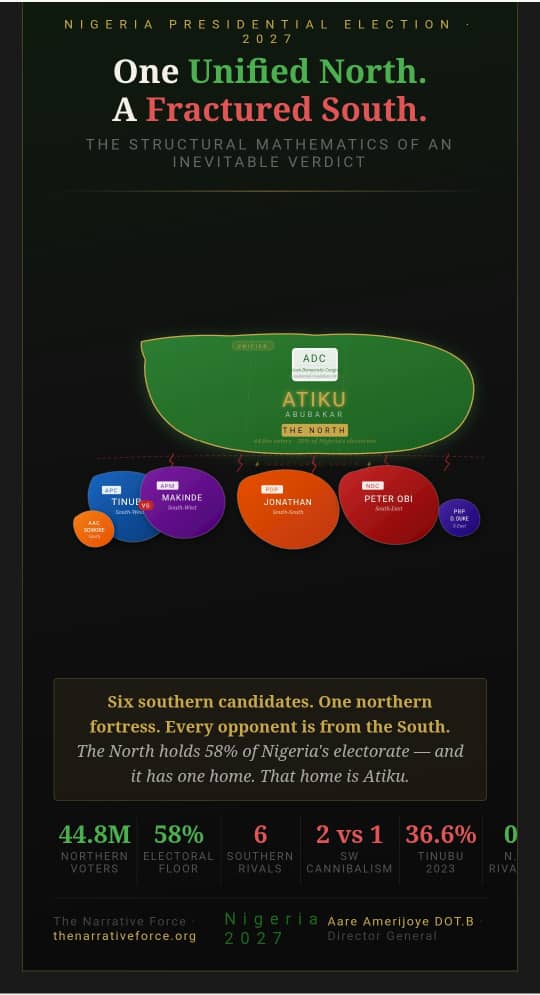
The net result is inescapable. Tinubu, who won with 36.61 percent in a three-man race, now faces a five-candidate field in which his home region’s own political establishment has publicly repudiated his leadership, his South-South flank is captured by Jonathan, his South-East ceiling is sealed by Obi, and the North, with 58 percent of Nigeria’s voter population, is consolidated behind the one candidate in the field with a pan-Nigerian footprint.
The mathematics of Tinubu’s defeat does not require a single vote to be cast. It is already written in the structure of the field. The ADC’s task is not to wait for that mathematics to operate passively. Its task is to accelerate it, deepen it, and drive it to its inevitable conclusion in every ward, every local government, and every state where Tinubu’s numbers can be further compressed.
“Facts are stubborn things,” said John Adams. These facts are beyond stubbornness. They are destiny. But destiny must be organised.
THE JONATHAN PARADOX
The positioning of former President Goodluck Jonathan through a PDP formation appears, on the surface, to complicate the anti-APC field. In structural reality, it is one of the most beneficial developments for Atiku Abubakar’s campaign.
Jonathan’s electoral geography is rooted in the South-South: the Ijaw heartland, Bayelsa, Delta, and Rivers communities. None of these are Atiku’s primary territories. The South-South mobilising around Jonathan does not vote Tinubu. It votes Jonathan. APC loses the South-South entirely.
The Christian Middle Belt, partially drawn to Jonathan’s religious identity, is also contested ground for a properly configured ADC ticket. A balanced ADC ticket that reflects Nigeria’s religious diversity speaks directly and authentically to the same Middle Belt Christian constituency that Jonathan’s candidacy will partially engage. What is beyond dispute is that no meaningful fraction of that constituency returns to APC under a Muslim-Muslim ticket that has already spent two years failing them economically.
Furthermore, Jonathan’s prospective candidacy sends the deepest possible institutional signal about the state of his own party. The PDP, which produced four consecutive presidents and held federal power for 16 unbroken years, is now so fundamentally fractured that one of its own former presidents operates through a splinter formation. This is not the behaviour of a party with a future. It is the behaviour of a party writing its own political obituary in public.
Every voter who might have defaulted to PDP by institutional loyalty is now liberated. Those political energies, freed from the ruins of a collapsing party structure, flow naturally toward the ADC as the only nationally structured opposition platform with the candidate quality, geographic reach, and electoral arithmetic to actually win. The ADC must be present and organised in every state where that liberated PDP voter is looking for a credible new political home.
THE SOUTH IS DELIVERING ATIKU’S VICTORY. THE ADC MUST COLLECT IT.
Here is what the southern fragmentation ultimately means for a pan-Nigerian candidate with Atiku Abubakar’s national profile. It is not simply that his opponents are dividing votes among themselves. It is that each of those divisions is doing specific, targeted work in Atiku’s favour, and a disciplined ADC campaign must be present in every theatre to collect what the fragmentation is producing.
Makinde’s public verdict against Tinubu’s leadership licenses millions of wavering South-West voters to act on doubts they already carry. The ADC drives aggressively into that legitimacy fracture, speaking to sovereign voters, not managed electorates, minimising Tinubu’s margins ward by ward and local government by local government. Jonathan captures the South-South and seals it from APC. The ADC contests the margins there with a properly balanced ticket. Obi anchors the South-East beyond Tinubu’s reach. The PDP’s collapse liberates millions of institutionally loyal voters toward the strongest opposition platform available. The ADC must be organised to receive every one of them.
The PDP’s self-destruction, Jonathan’s South-South engagement, Makinde’s legitimacy fracture in the South-West, and Obi’s South-East consolidation are not passive gifts to be received from a distance. They are operational opportunities to be prosecuted with maximum organisational energy across every southern theatre simultaneously.
A regional candidate benefits from his opponents’ division in one zone. A pan-Nigerian candidate benefits across every zone simultaneously, and then organises to maximise every benefit. Atiku Abubakar is the only figure in the 2027 field for whom the entire structural map of southern fragmentation works as a coordinated instrument of national victory, provided the ADC deploys with the discipline, the reach, and the urgency that this historic moment demands.
The South has not merely fractured. It has fractured in the most structurally advantageous configuration possible for the one man whose candidacy was never confined to a single zone, a single region, or a single constituency. The opening is historic. The obligation now is to enter it.
The journey to 2027 is mature. The South has delivered its gift. The ADC must now collect it, ward by ward, state by state, and zone by zone, until the verdict is beyond reversal.
Aare Amerijoye DOT.B, Director General, The Narrative Force, thenarrativeforce.org
May 2026.