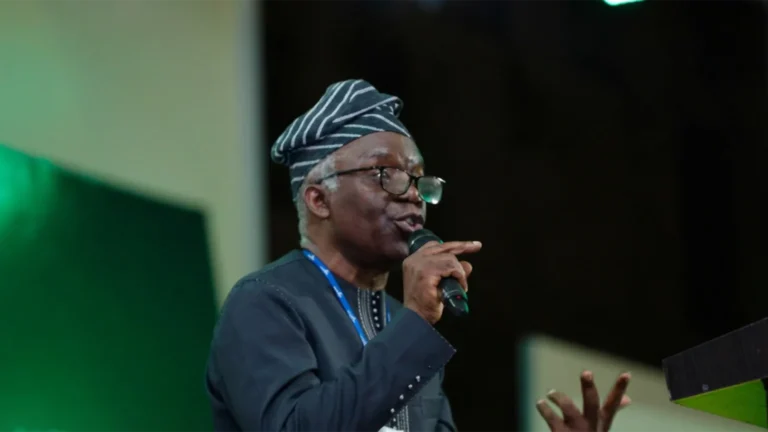

PROFILE OF A STRATEGIC OPERATIVE
Babachir David Lawal is a man of corrupted judgment and demonstrable moral bankruptcy who has refined a particular venomous craft over the years: the weaponisation of the microphone as an instrument of psychological terrorism designed with singular strategic purpose. That purpose is calculated, relentless, and transparent: to obscure, to muddy, to discredit, and ultimately to prevent serious national discourse about Atiku Abubakar’s actual record and achievements.
What we are witnessing in his current cascade of noxious television appearances is not aberration but pathological strategy. This is a systematic, calculated descent into squalid invective dressed as political commentary, deployed specifically because he lacks the intellectual ammunition to debate Atiku’s actual record. Here stands a man fundamentally unmoored from decency, intellectually hollow, and serving as a tactical smokescreen operator whose sole purpose is to prevent the Nigerian people from seriously examining Atiku’s documented achievements in governance.
His tenure as Secretary to the Federal Government (SGF) between 2015 and 2017 left no ambiguity about the nature of this degenerate operator. As one contemporary analysis noted, his “trouble days as SGF emerged on October 17, 2015”, barely six months into his appointment. Within that truncated window, this malignant figure demonstrated the precise behaviours that define his present television strategy: rash decision-making, offensive utterance calculated for shock value, and a contemptuous, brazen dismissal of legitimate questions about the conduct that would ultimately end his tenure.
During those years he was documented as having been in “constant struggle with a host of political actors.” His “offensive utterances” left confrontations settled not through resolution but through damaged relationships poisoned by what observers termed “exuded bad blood.” His contempt for serious institutional processes was epitomised by his sneering dismissal of the National Conference report as merely “job for the boys.” These are the tools of someone incapable of principled argument. These are the weapons of a man whose only recourse is invective.
And now he has graduated from the screen to the page. Having tested the waters with his first effusion titled KACHALLA 1, he has doubled down in a rambling sequel he calls KACHALLA 2, committing his fabrications to writing not once but twice. We thank him for this. A television outburst evaporates into the air; a written document can be dissected line by line, claim by claim, lie by lie. By returning for a second instalment, he has confirmed that the first was no accident of temper but a deliberate campaign. He has given us the scalpel. We now proceed to the surgery.
Stripped of its insults, its tribal incitement and its self-pity, KACHALLA 2 contains four substantive claims. Every single one of them collapses under scrutiny. We take them in turn.
CLAIM ONE: THE SANITISED GRASS CUTTER
Babachir devotes the longest portion of his document to laundering his own history. He tells us he was acquitted. He tells us it was all a setup by jealous Northern senators. He tells us only 7.2 million naira was involved. He tells us he was the innocent victim of a conspiracy against a Kilba Christian who was too close to Buhari.
Let us be precise, because precision is what he fears most. Yes, in November 2022, an FCT High Court discharged and acquitted him on a no-case submission. We do not dispute the ruling of a court. But let every Nigerian understand exactly what that ruling said and what it did not say. The court held that the EFCC failed to establish that Babachir was a member of PINE which awarded the contract, or a member of the Ministerial Tenders Board which approved it, or linked to the Bureau of Public Procurement which cleared it. That is an acquittal built on an evidential gap. It is not a judicial declaration that the grass-cutting affair was clean. The EFCC announced immediately that it was dissatisfied and would appeal.
And here is the question Babachir cannot answer, the question that no court ruling can erase. Muhammadu Buhari, the man Babachir tells us has been his mentor since 1971, the man he says personally recruited him in 2002, the man he describes as resisting a high-powered delegation sent to remove him: that same Buhari sacked him. The panel that recommended his removal was headed by the Vice President of the Federal Republic and its conclusion, by Babachir’s own admission in KACHALLA 2, was that he abused his oath of office when a company he once owned took a consultancy in an agency under his supervision.
Read that again, in his own words. A company he founded, Rholavision Engineering, took a contract under PINE, the very agency his office supervised, while he sat as Secretary to the Government of the Federation. He calls this a pittance. He calls it 7.2 million naira. The charge sheet before the court read 544 million naira. But let us even grant him his own framing: he asks Nigerians to believe that an SGF whose former company benefits from contracts in an agency under his own office is a matter of no consequence because the figure was, in his estimation, small.
There it is. The moral universe of Babachir Lawal, stated in his own hand: a conflict of interest is of no consequence when the figure is, in his estimation, small enough. An oath of office is only breached when the breach is expensive. By his own logic, ethics in public office is a matter of arithmetic. This is the man who now sets himself up as the examiner of Atiku Abubakar’s character.
His own mentor fired him. The man who knew him for over five decades, who trusted him with the highest administrative office in the land, looked at the evidence assembled by his own Vice President and removed him. Babachir would have Nigeria believe that everyone was wrong: the Senate was wrong, the Vice President was wrong, the panel was wrong, and Buhari, his mentor of fifty years, was wrong. Everyone conspired. Everyone lied. Only Babachir is pure.
A small detail before we move on. In KACHALLA 2 he writes that the EFCC called 14 witnesses. The court reporting of his acquittal, from Vanguard to Daily Trust to TheCable, records the trial judge ruling on the evidence of 11 witnesses. Even in the retelling of his own acquittal, the man cannot keep his facts straight.
CLAIM TWO: THE SILENCE THAT NEVER WAS
The centrepiece of his attack on Atiku is a string of rhetorical questions. Why has Atiku never publicly sympathised with victims of banditry? What did he say about the massacre of Christians in Owo? Why is he silent on Plateau?
These are not questions. They are fabrications dressed in interrogative clothing, and they are demolished by the public record in minutes.
On 5 June 2022, the very day of the Owo church massacre, Atiku Abubakar published the following words on his verified handle: I condemn the attack on the St Francis Catholic Church, Owa-luwa Street, in Owo council area of Ondo State capital. My prayers are with the people of Owo, especially families of the deceased. The same day, through his spokesman Paul Ibe, he declared that any attack on innocent citizens, indeed a gathering of worshippers in any place in Nigeria, stands condemned, and that it is a red line. He demanded that the state government and security agencies leave no stone unturned in apprehending the criminals. He condoled with the body of Catholic faithful in Nigeria.
That statement is dated, published, archived and reported by Premium Times, Channels Television, Vanguard and the Voice of Nigeria. Babachir asked what Atiku said about Owo. We have answered him. The question now reverses onto the questioner: Babachir, did you not know this, in which case you mouthed off on a matter you never bothered to research, or did you know it and lie anyway? Ignorance or mendacity. There is no third option.
On Plateau, the record is equally merciless to him. In January 2020, Atiku publicly expressed shock at the renewed violence in Plateau and Taraba, called for a recalibration of the national security architecture through community policing, and demanded that the justice system be empowered so that killers face real consequences, warning that a society with a derelict justice system is a fertile land for misconduct. In 2025, he condemned the renewed Plateau attacks again, stating plainly that the security infrastructure had failed. Year after year, statement after statement, the man Babachir accuses of silence has been on the record.
CLAIM THREE: THE DEBORAH SAMUEL DISTORTION
Babachir asks why Atiku recanted his condemnation of the barbaric murder of Deborah Samuel. Here he is at his most cunning, because he builds his lie on a sliver of fact.
The facts are these. On 13 May 2022, hours after that horrific killing, a post on Atiku’s verified handle read that there cannot be a justification for such gruesome murder and that all those behind her death must be brought to justice. The post was deleted shortly afterwards, and the deletion drew legitimate criticism, which we do not pretend away. But what happened next is what Babachir conceals. In December 2022, before the entire nation at the Channels Television town hall, Atiku was asked about the matter directly. His answer, on live national television: I condemned it. There is nowhere it is said, nor is there an injunction in the Islamic faith, that you can go and take someone’s life.
To recant is to withdraw a position. Atiku did not withdraw his condemnation; he restated it before the largest possible audience, on camera, in an election season, in front of the very constituencies whose threats had followed the original post. Whatever one thinks of the deleted tweet, the man’s settled, public, on-record position is unambiguous condemnation of that murder. Babachir took a social media management controversy and inflated it into a fabricated moral verdict. That is not analysis. That is forgery.
CLAIM FOUR: THE BUSINESS SMEAR
Finally, Babachir sneers at Atiku’s businesses. He lists Gotel, Adama Beverages, Rico Gado and others and pronounces them distressed or divested, and dismisses the American University of Nigeria as a rotting relic.
Consider first the standing of the man making this claim. Babachir Lawal’s most documented commercial achievement is a consultancy contract that his former company took from an agency under his own office, an arrangement that cost him the secretaryship of the federal government. He now presumes to audit the business empire of a man who built, from Yola, one of the most consequential private investment portfolios in the entire North East.
Now consider the record. The Priam Group spans Adama Beverages, producer of Faro water and juice distributed across the country; Rico Gado Nutrition; Priam Logistics; Adama Plast; Chicken Cottage; Gotel Communications, the first privately owned radio station in the entire North East; and Standard Microfinance Bank. As recently as 2021, while Babachir was giving television interviews, Atiku was commissioning a new Woven Sacks Factory with capacity for nine million sacks annually and a Shrink Laminate Plant in Yola. His ventures are credited with creating over ten thousand direct and indirect jobs in Adamawa alone. And the American University of Nigeria, which Babachir mocks, educated and sheltered thousands through the darkest years of the Boko Haram insurgency, absorbing displaced children when the state could not.
Have businesses operating in the epicentre of a fifteen-year insurgency faced difficulties? Of course they have. Every enterprise in the North East has bled. The remarkable fact is not that some of Atiku’s companies have struggled; it is that he kept building there at all. While others fled the region with their capital, he commissioned factories in Yola. A man who plants ten thousand jobs in the most dangerous corner of the country has earned the right to be assessed on his full record. A man whose one famous contract ended his career has not earned the right to assess anybody.
THE OPERATIONAL FRAMEWORK: FABRICATION AS STRATEGIC NECESSITY
Examine what we have established. His grass-cutting defence conceals that his own mentor sacked him on a panel finding that his oath of office was abused. His silence allegation is contradicted by dated, published, archived statements. His recantation claim inverts a televised condemnation into its opposite. His business smear collapses against a verifiable record of factories, jobs and a university built in insurgency country.
Four claims. Four fabrications. This is not a man who got his facts wrong. A man who gets his facts wrong is wrong randomly; sometimes his errors favour his opponent. Babachir’s errors all point in one direction, every time, like iron filings around a magnet. That is not error. That is manufacture.
This is the operational framework of his criminal mouthing: the systematic deployment of reckless, unsubstantiated, and deliberately inflammatory utterance against Atiku, functioning as organised distraction. Lawal understands that in the age of viral clips and social media amplification, the most outrageous statement against Atiku will be repeated; the most execrable utterance will circulate. He is not attempting to persuade anyone of anything. He is deliberately attempting to contaminate the political space with enough noise, enough vulgar insult, enough gutter-level language that serious, dignified examination of Atiku’s record becomes difficult. His strategy succeeds only if Atiku’s record remains unexamined.
This is not leadership. This is not even honest opposition. This is calculated fabrication and psychological terrorism designed explicitly to prevent national discourse about Atiku’s governance achievements.
THE VERDICT
Babachir Lawal’s recent calculated, empty and reckless vitriolic outbursts against Atiku Abubakar from one television interview to another constitute not politics but criminal mouthing: the systematic, deliberate deployment of unsubstantiated, inflammatory, dehumanising fabrication designed to obscure, muddy, and prevent serious examination of Atiku’s documented achievements in governance.
His attacks are empty because they offer no substantive policy critique. They are reckless because they are unanchored to evidence, as we have now demonstrated four times over. They are calculated because they are deployed with knowledge of how they will spread and contaminate discourse. And they are fabrication because they represent his attempt to create a false narrative about a man whose record speaks for itself.
The vitriolic outbursts, the tribal incitement, the rhetorical questions whose answers he dares not research: all of it is designed to prevent the one conversation he cannot survive, which is a sober comparison of records. Atiku’s record: GDP growth from 58 billion dollars to 270 billion dollars during the administration he served as Vice President, the most consequential privatisation and reform programme in the Fourth Republic, ten thousand jobs planted in the North East, a university raised from the savannah. Babachir’s record: a terminated secretaryship, an oath of office that his own government’s panel found abused, and an acquittal won on the prosecution’s failure to connect the dots.
He is a serial operator of psychological warfare designed to prevent honest discourse. He is fundamentally unworthy of any platform. He wants to talk about everything except records. Now we understand why.
Aare Amerijoye DOT.B, Director General, The Narrative Force, thenarrativeforce.org. 10 June 2026.