Aare Amerijoye DOT.B
There are witnesses you can dismiss, and there are witnesses you cannot. A man’s political enemies will call him anything. His hired praise singers will call him everything. But when the testimony comes from inside the rival camp itself, from the very man employed to manage the image of another principal, that testimony carries the weight of an affidavit.
Onyeama Ugochukwu was the Director of Publicity for the Obasanjo campaign. His job was to sell Obasanjo, not Atiku. Yet listen to what he placed on record about the man from Jada:
“We used to call Atiku the bulldozer. He was not afraid to take risks. If there were something to be done, he would go ahead and do it, clearing the obstacles. His arrival after winning his governorship election strengthened and reinvigorated the campaign in terms of funding, decision making and campaign organisation.”
Read that again. Slowly. Because in that single paragraph lies the answer to the question Nigeria has been too distracted to ask: who actually built the machinery that returned this country to democracy in 1999, and who has the proven capacity to rebuild what has since been demolished?
THE MAN WHO CLEARED THE OBSTACLES
The bulldozer is not a subtle machine. It does not negotiate with the rubble. It does not hold committee meetings with the debris. It moves, and the obstruction moves with it or moves out of the way.
That is the picture Ugochukwu painted, and he painted it from the inside. He watched a newly elected governor of Adamawa State arrive at a national presidential campaign and transform it on three fronts at once: funding, decision making and organisation. Not one front. Three. Money, judgement and structure, the three pillars on which every serious political enterprise stands or collapses.
Ask yourself how many Nigerian politicians, in the entire history of the Fourth Republic, have been credited by an opposing principal’s own publicity chief with reinvigorating all three at the same time. The list is short. In truth, the list is one name long.
RISK IS THE PRICE OF NATIONHOOD
“He was not afraid to take risks.”
In today’s Nigeria, that sentence reads like a foreign language. We have been governed by men who treat caution as a philosophy and paralysis as a strategy. Fuel queues are managed, not ended. Insecurity is condoled, not confronted. The naira is mourned, not rescued. Every crisis is met with a committee, every committee with a communique, every communique with silence.
Atiku Abubakar’s entire public life is a rebuke to that culture of timidity. This is the man who staked his political career against a military dictatorship in the trenches of the Peoples Democratic Movement. This is the man who, as Vice President, chaired the National Economic Council and the National Council on Privatisation through the most consequential economic reforms of the Fourth Republic, an era in which Nigeria’s GDP grew from 58 billion dollars in 1999 to 270 billion dollars in 2007. Those figures are not campaign poetry. They are the arithmetic of what happens when a risk taker is placed near the levers of the economy.
The bulldozer did not stop working after 1999. It has simply been waiting for Nigeria to summon the courage to put it back on the site.
THE TESTIMONY THEY CANNOT REBUT
Here is what makes the Ugochukwu testimony so devastating to Atiku’s detractors: it is not new, it is not paid for, and it is not deniable.
It was not manufactured for the 2027 election. It describes events of 1998 and 1999, long before today’s political alignments existed. It comes from a man whose professional loyalty lay elsewhere. It is, in the strictest sense, evidence against interest, and any lawyer will tell you that evidence against interest is the most credible evidence there is.
So when the merchants of propaganda tell you Atiku is this or Atiku is that, place their anonymous smears beside the on-record words of Obasanjo’s own Director of Publicity and ask which one history will believe.
FROM ADAMAWA 1999 TO NIGERIA 2027
There is a detail in that testimony that should not escape you. Atiku arrived at the presidential campaign after winning his own governorship election. He was not a spectator drafted into relevance. He came as a man who had just tested his name before the people of Adamawa and won, then immediately placed that victory, that structure and that momentum at the service of a national project bigger than himself.
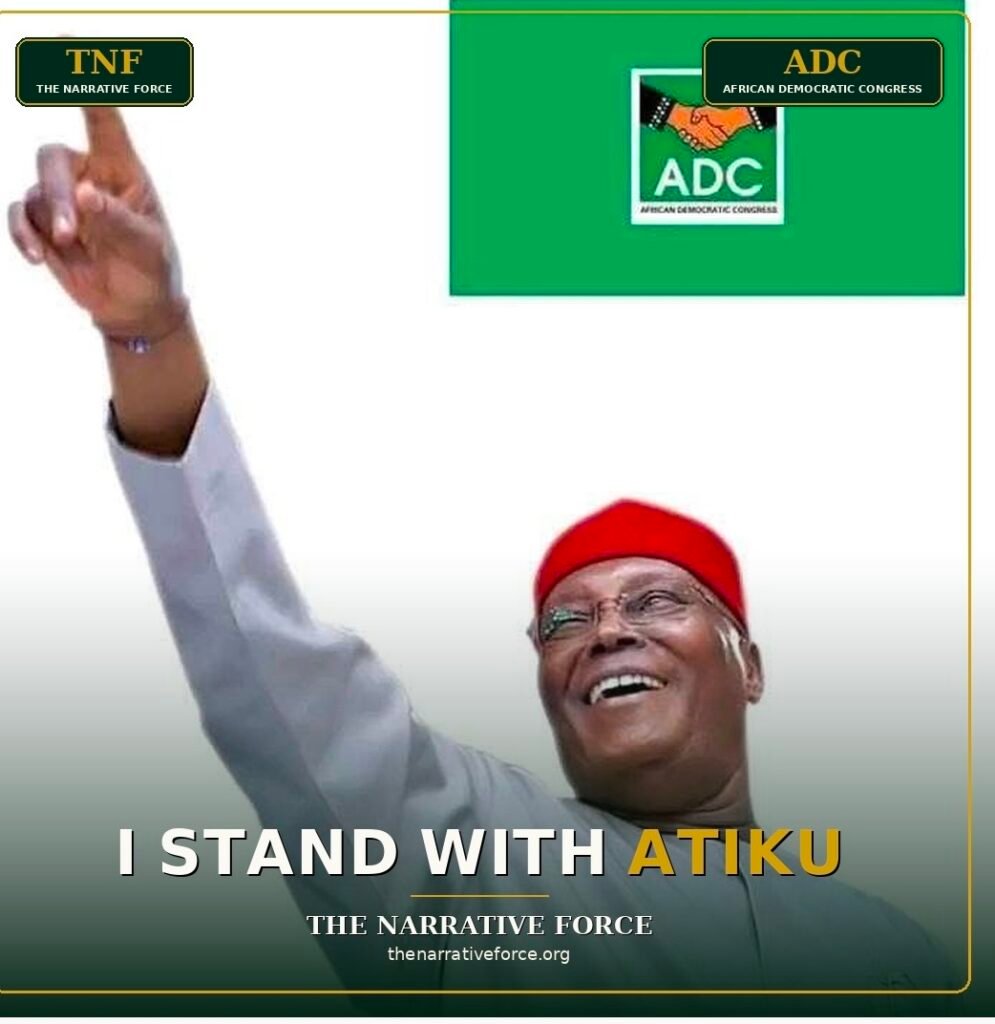
That is the pattern of his politics: build, win, then lift others. It is the same pattern Nigerians will be invited to reward on the sixteenth of January, 2027, when this country chooses between the managers of decline and the clearer of obstacles.
The African Democratic Congress has presented Nigeria with a candidate whose capacity is not a matter of speculation but of sworn, cross-camp, historical record. The rubble of the last decade is everywhere: a broken economy, a bleeding countryside, a demoralised youth population scattering across the departure lounges of the world.
Rubble does not clear itself.
Nigeria does not need another committee. Nigeria needs the bulldozer, the fixer, the unifier.
Aare Amerijoye DOT.B
Director General, The Narrative Force
thenarrativeforce.org
15 July 2026