In politics and governance, there are moments when reality appears so unbelievable that satire struggles to compete with it. This, in my opinion, is one of those moments.
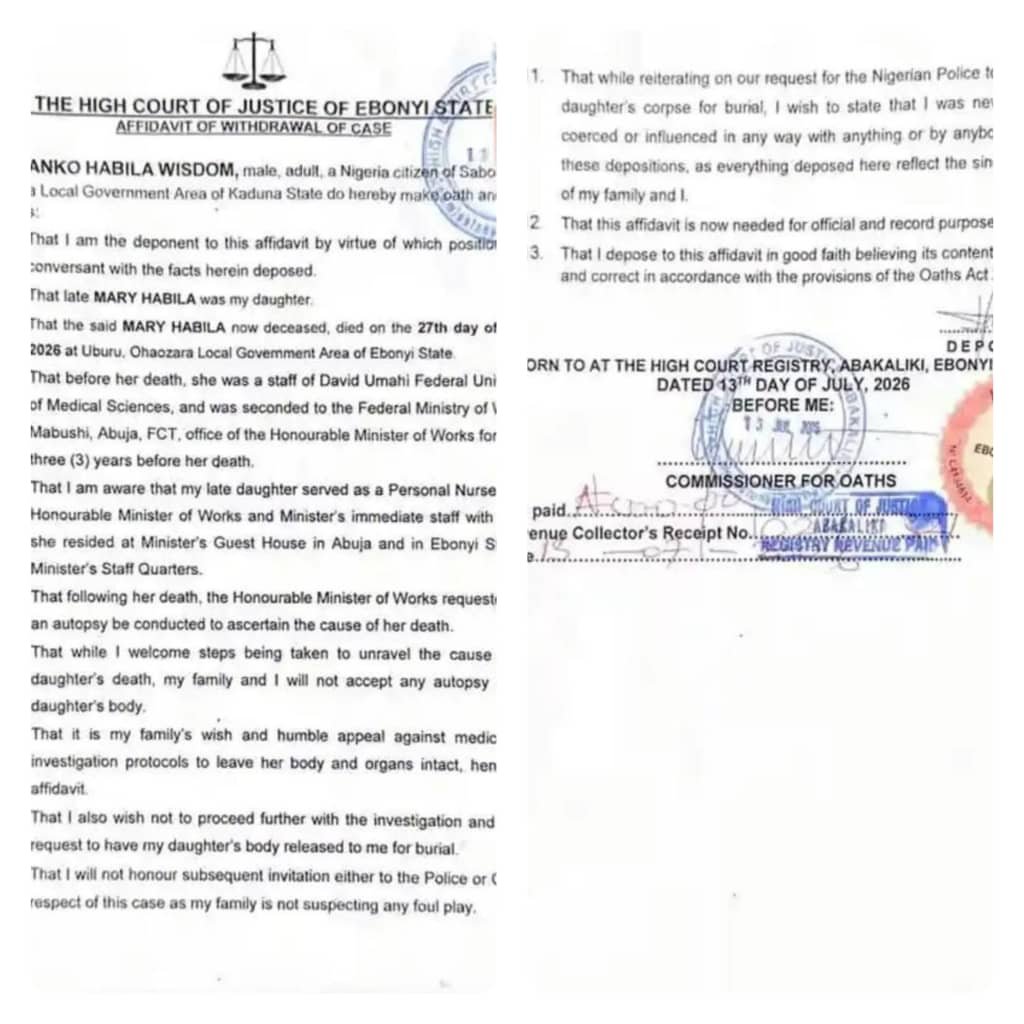
If the affidavit currently circulating in the public domain is authentic, then Nigerians have every reason to be deeply concerned. Mary Habila, reportedly a Personal Nurse to the Honourable Minister of Works, Senator David Umahi, dies under circumstances that trigger widespread public interest and calls for a thorough investigation. Then, almost as suddenly as the questions arose, an affidavit surfaces stating that the family no longer wants an autopsy, no longer suspects foul play, no longer desires further investigation, and simply wants the body released for burial.
If this were a stage play, critics would reject the script as unrealistic. Yet here we are.
Perhaps this is the new Nigeria we have been promised, where mysteries are resolved not by investigation but by paperwork. Where public concern is expected to disappear the moment an affidavit appears. Where difficult questions are politely escorted out of the room while everyone pretends that nothing unusual has happened.
One is tempted to ask whether affidavits have now replaced forensic science. Has the laboratory been retired? Have detectives become spectators? Has truth become negotiable?
These are questions that naturally arise in the minds of ordinary Nigerians.
No reasonable person begrudges a grieving family the right to bury their loved one. Grief is personal and deserves compassion. However, where a death has generated enormous public interest because of the position of those connected to it, transparency becomes not merely desirable but indispensable. Justice must not only be done; it must be seen to be done.
The government should understand that public trust cannot be manufactured through silence. Confidence cannot be restored by expecting citizens to suppress legitimate questions. Every attempt to close a matter prematurely without convincing answers only widens the gulf between government and the governed.
Satirically speaking, perhaps the next innovation in governance will be a Ministry of Affidavits, where every controversy is settled with sworn declarations rather than transparent investigations. Elections may no longer require ballots. Budgets may no longer require audits. National crises may simply require a commissioner for affidavits to certify that everything is perfectly fine.
That would indeed be governance by paperwork.
But governance is not theatre, and citizens are not an audience obliged to applaud every performance. Nigerians deserve institutions that inspire confidence, investigations that withstand scrutiny, and leaders who understand that accountability is not an inconvenience but a constitutional obligation.
Let me be clear. This is not an accusation against Senator David Umahi or any individual. It is my opinion that the circumstances surrounding Mary Habila’s death deserve the highest level of transparency. If everything is above board, then a thorough and credible investigation should strengthen public confidence rather than diminish it.
Until that happens, the affidavit may close a file, but it is unlikely to close the questions in the minds of Nigerians. Truth does not fear investigation. Only uncertainty fears the light.
Aare Amerijoye DOT.B.
Director General
The Narrative Force (TNF)