
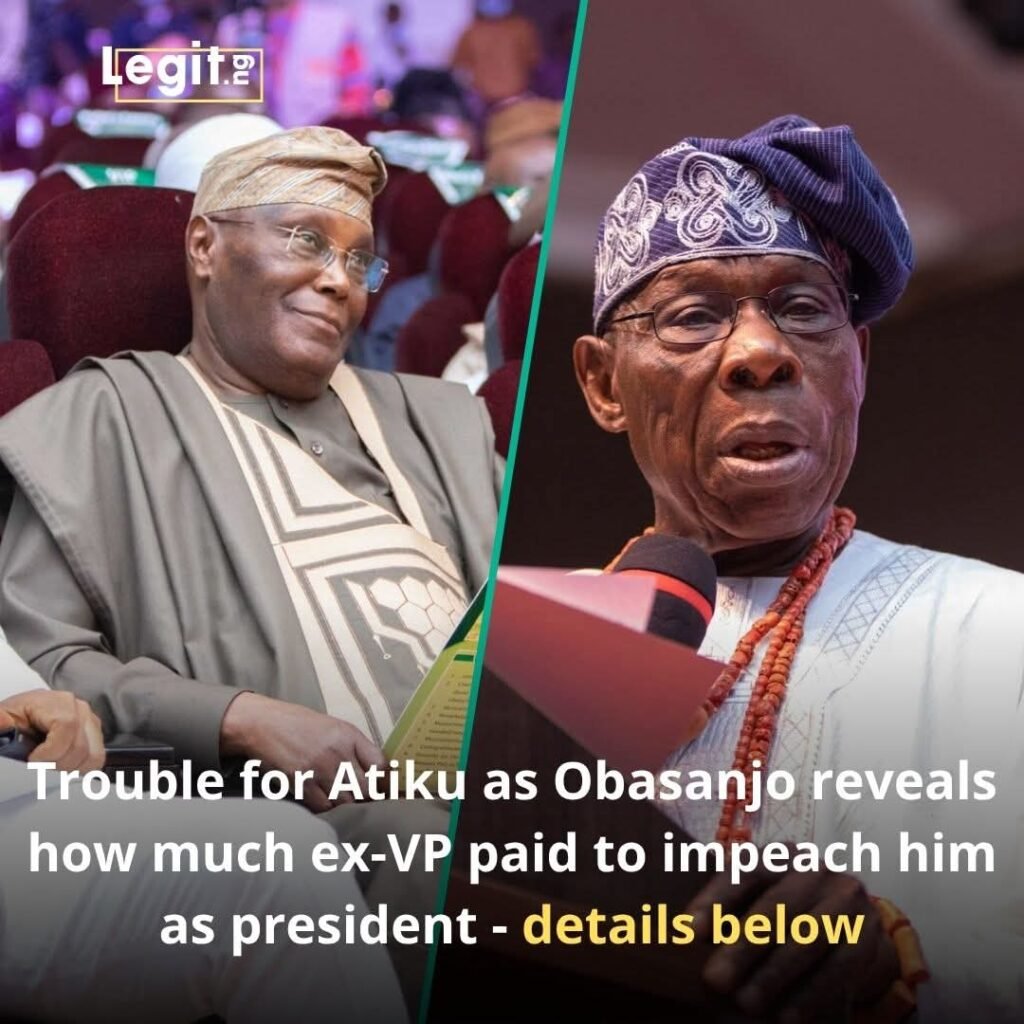
Chief Olusegun Obasanjo’s lengthy letter to former Governor Olusegun Osoba purports to be a response to the politics of the 2003 elections and his relationship with the Alliance for Democracy (AD) and Afenifere. Yet, stripped of its historical anecdotes, personal recollections and philosophical reflections, the central objective of the letter is unmistakable: to once again cast Atiku Abubakar as a disloyal subordinate through allegations that remain unsupported by any verifiable evidence.
Chief Obasanjo, your account of your consultations before the 1999 elections, your meetings with Bola Ige, Abraham Adesanya, Jimmy Carter, and other political actors may be interesting historical recollections. Likewise, your explanation of why you sought a Government of National Unity with the AD is your prerogative. However, none of those narratives supplies proof for the grave accusation you make against your former Vice President.
Your claim that Atiku Abubakar gave the late Speaker of the House of Representatives, Ghali Umar Na’Abba, ₦5 million to commence impeachment proceedings against you rests entirely on your assertion that your late Chief of Staff, Major General Abdullahi Mohammed, reported it to you. That is not evidence. It is hearsay. Intelligence reports are investigative leads, not proof of criminal conduct. In every democracy governed by the rule of law, such reports must be independently investigated, corroborated and tested before they can form the basis of criminal liability.
The obvious question therefore remains unanswered: if this allegation was true, why did you never investigate or prosecute it?
At the time of the alleged incident, you were not an ordinary citizen recounting history decades later. You were the sitting President and Commander-in-Chief of the Federal Republic of Nigeria. The Nigeria Police Force, the DSS, military intelligence, the Attorney-General of the Federation and every relevant law enforcement institution were under your constitutional authority. If your Vice President had truly financed a criminal conspiracy to remove you from office, why was no investigation commenced? Why was no charge filed? Why was no prosecution pursued? Why was no judicial finding ever made?
Your complete failure to invoke the machinery of the state while you possessed all constitutional powers fatally weakens the credibility of the allegation you now seek to revive.
Even more curious is the timing of this story. These allegations have become increasingly elaborate only after Atiku Abubakar emerged as the leading figure who frustrated your controversial third-term agenda. History records that Atiku stood firmly against the constitutional amendment that would have prolonged your tenure beyond the two-term limit prescribed by the Constitution. It is difficult to ignore the pattern that, ever since that political disagreement, fresh accusations against Atiku have surfaced at politically convenient moments, particularly whenever he emerges as a leading presidential contender.
The financial aspect of your allegation also raises serious questions. You allege that Atiku gave Ghali Na’Abba ₦5 million to commence impeachment proceedings against a sitting President. Nigerians equally remember the widespread allegations surrounding your third-term project, during which reports of inducements running into about ₦50 million per National Assembly member dominated national discourse. Against that background, the suggestion that ₦5 million could realistically finance or trigger the impeachment of a President appears implausible. Even assuming, without conceding, that such a payment was made, you have produced no evidence whatsoever linking it to an impeachment plot. Political leaders frequently exchange financial support for legitimate political, social and personal reasons. Without documentary evidence or credible testimony, your conclusion is speculative.
Your timing is perhaps the most troubling aspect of the entire allegation. For more than twenty years, you never publicly presented this story in the form you now have. Today, both Major General Abdullahi Mohammed, the intelligence source upon whom you rely, and the late Speaker, Ghali Umar Na’Abba, the two individuals best placed to confirm or refute your account, are no longer alive. Only after the deaths of the principal witnesses do you choose to elevate an untested allegation into historical fact. That approach does little to enhance the credibility of your narrative.
The legal position is straightforward. Section 97 of the Criminal Code criminalises conspiracy only where there is credible evidence of an agreement to commit a criminal offence. None has ever been produced. Equally, Section 143 of the 1999 Constitution establishes impeachment as a constitutional process for holding a President accountable under specified circumstances. Political advocacy for impeachment, however unpopular, is not itself a criminal offence. Without proof of bribery, fabrication or other unlawful conduct, your allegation remains legally hollow.
Ironically, your own letter undermines your claim. You state that you treated the alleged impeachment plan “with contempt” because you believed you had committed no impeachable offence. If that was your genuine assessment, it further explains why no prosecution ever followed. It also demonstrates that, at the time, you yourself did not consider the allegation sufficient to invoke the criminal law.
The broader pattern reflected in your letter is equally revealing. While professing that politics should be conducted without bitterness and that relationships should outlive political disagreements, your public interventions over the past two decades have repeatedly singled out one individual, Atiku Abubakar, for relentless criticism through allegations that have never resulted in criminal charges or judicial findings. That contradiction speaks for itself.
History deserves to be preserved through verifiable facts, not retrospective recollections shaped by political disappointment. In every constitutional democracy, allegations remain allegations until supported by credible evidence and tested in a court of law. No open letter, memoir or personal recollection, however eloquently written, can substitute for proof.
Ultimately, Nigerians will judge this latest allegation by one undeniable fact: when you possessed every constitutional power to investigate, prosecute and establish the truth, you did none of those things. That omission carries far greater evidential weight than any accusation made twenty-three years after the events in question.
Yours truly,
Alex Ter Adum, PhD
DDG THE NARRATIVE FORCE