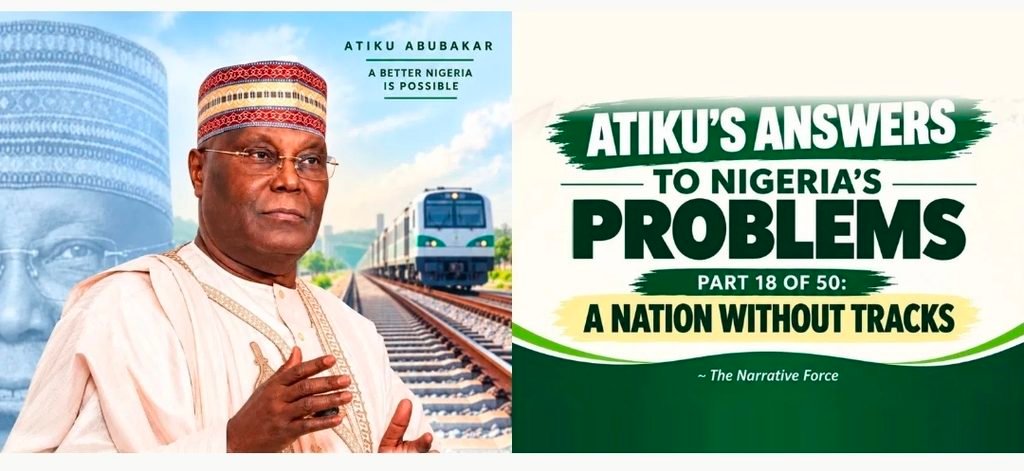
PART 18 OF 50: A NATION WITHOUT TRACKS
Aare Amerijoye DOT.B
Ask your grandfather about the train.
If he is from Kano, he may tell you about the groundnut pyramids, and the trains that carried the harvest south to the sea. If he is from Ibadan, he may remember the whistle at dawn and the platform crowded with traders, students and soldiers. If he is from Enugu, he may remember the coal trains rolling down to Port Harcourt. If he is from Kaduna, Jos, Maiduguri, Ilorin or Osogbo, he may remember a journey taken in a seat by a window, with a ticket bought for a few kobo.
Long before most Nigerians alive today were born, this country had a railway of roughly 3,500 kilometres stretching from the coast to the far north.
Then, over the decades, it died.
The tracks rusted. The stations crumbled. The coaches were left to rot in the bush. Grass grew between the sleepers, and goats grazed where trains once ran.
And Nigeria, a nation of more than two hundred million people, was left to move almost everything by road: every bag of cement, every tanker of fuel, every container, every cow and every passenger.
A nation that loses its railway does not just lose a train. It loses a backbone.
THE BURDEN ON THE ROAD
Part 17 showed what this costs us in blood. More than fourteen Nigerians die on our roads every day, and our highways crack under loads no road should carry alone.
Now consider what it costs us in money and time.
A container landed at Apapa can take weeks to reach Kano. A tomato harvest from the North can rot before it reaches the South. A factory in Aba must pay for diesel trucks to bring in raw materials and carry out finished goods, and every kilometre is added to the price you pay.
A single freight train can carry the load of dozens, sometimes hundreds, of trucks. Every load moved by rail is a truck taken off the highway, fuel saved, a road spared and a life protected.
And for the worker in Lagos who spends three hours each way crawling from Ikorodu or Ojo to the Island, or the civil servant in Abuja who leaves Nyanya before dawn, a working mass transit train is the difference between a life spent in traffic and a life actually lived.
Every country that moved its economy forward laid its tracks first.
THE TRACKS THAT CAME BACK
There is a truth Nigerians should hear clearly, because it matters in this election.
In recent years, the tracks began to come back.
The Abuja to Kaduna standard gauge line was commissioned in 2016. The Itakpe to Warri line, first started in 1987 and stalled for decades, was finally commissioned in 2020. The Lagos to Ibadan standard gauge line, 156 kilometres long, was commissioned in 2021, linking the nation’s biggest port to the heart of the South West.
By October 2021, the Federal Ministry of Transportation reported that about 700 kilometres of railway had been completed.
The Minister of Transportation who completed and commissioned these lines, building on work begun by earlier governments, was Rotimi Chibuike Amaechi, who held that office from 2015 to 2022.
That same Amaechi now stands beside Atiku Abubakar as his running mate.
Some will say the credit belongs to the government he served. But the credit for a job belongs to the hands that did it, and those hands are on this ticket. When Nigerians ask who can rebuild the railway, they need not rely on promises. They can look at what has already been built.
One ticket has already laid the track. Give it the power to complete the journey.
NOT SAFE ENOUGH, AND NOT ENOUGH
A railway is not only built. It must be secured, maintained and expanded, and that is where Nigeria has struggled.
In March 2022, terrorists attacked the Abuja to Kaduna train. Lives were lost, and passengers were abducted and held for months. That day showed the whole nation that no railway, however modern, can be safer than the country it runs through. Rail security is national security.
Since then, the line has suffered further shocks. In August 2025, an Abuja to Kaduna train derailed, and services were suspended while investigators examined what went wrong. In March 2026, a rear coach collision near Asham station left passengers injured.
Every derailment, collision and suspension sends Nigerians back to the dangerous highway. A railway people fear is a railway they will not use.
And even with the new lines, rail still carries only a small share of the nation’s passengers and freight. Large parts of the country, including much of the East, the middle belt and the far North East, still wait for modern rail to reach them. The work has begun. It has not been finished.
A railway half built is a promise half kept.
ATIKU’S ANSWER: COMPLETE THE TRACKS, SECURE THE JOURNEY, SHARE THE LOAD
Atiku’s plan brings together the experience of the man who completed modern lines and the agenda of a leader who knows that infrastructure must serve the economy.
Complete and connect. The campaign has placed railways at the heart of its infrastructure priorities, and point 12 of the 12 Point Agenda commits to sustainable infrastructure. That means finishing what was started, linking new lines to the ports, industrial zones and farming belts, and extending modern rail to the regions still waiting for it.
Connect the ports. Point 4 revives the ports of the East and South-South at Port Harcourt, Calabar, Warri and the Ibom Deep Sea Port. Ports without rail are only half a solution. Ports linked by rail to the North, the middle belt and the industrial cities can move cargo across the country in days rather than weeks, and take thousands of trucks off the roads.
Secure every train. Point 8 commits to strengthening national security through recruitment, welfare and modern technology, and Atiku has committed to intelligence-led operations and decentralised security structures. Modern rail security means surveillance along the tracks, rapid response forces and intelligence that sees an attack coming before it happens. March 2022 must remain a lesson, never a pattern.
Maintain what we build. Sustainable infrastructure is not about ribbons. It is about inspection, maintenance and safety standards that prevent derailments, so that every Nigerian can board a train with confidence.
Open the doors to investment and to the states. At his screening on 20 May 2026, Atiku committed to private sector expansion. The 2023 constitutional amendment already allows states to develop railways, and Atiku’s long commitment to restructuring means encouraging states and private investors to build urban and regional rail, from Lagos and Kano to Port Harcourt and Abuja. And under point 11, every rail contract will be audited and its procurement published, so that each kilometre is built at an honest price.
Beyond the rails, the campaign has also placed a national carrier among its transport priorities, so that Nigerians and Nigerian businesses can move by air as well as by land.
Finish the tracks. Link the ports. Secure the trains. Publish the contracts. Share the load.
THE TICKET THAT KNOWS THE WAY
Consider what this ticket brings.
On one side stands Atiku, who served as Vice President and statutory chairman of the National Economic Council and the National Council on Privatisation, in an era when Nigeria’s reserves rose from $3.7 billion to about $45 billion and the telecoms revolution connected the country to the world. He understands how to bring private capital and public vision together.
On the other side stands Amaechi, who as minister completed and commissioned modern rail lines across the country.
One understands how to finance and govern an economy. The other has shown how to deliver infrastructure on the ground. Together they offer something no slogan can match: experience in exactly the work that needs doing.
One knows how to fund the nation’s future. The other knows how to lay it on the ground.
TO YOUR GRANDFATHER, AND YOUR GRANDCHILDREN
To the grandfather in Kano who remembers the groundnut trains. To the trader in Aba whose goods crawl by road. To the commuter in Lagos who loses six hours a day in traffic. To the passengers who survived March 2022 and the families still marked by that day. To every Nigerian who has ever said, “If only we had a train.”
The tracks have begun to come back. Now they must be finished, secured and extended to every corner of the nation.
So share this with your transport and commuters’ groups, your traders’ associations, your students’ unions, your family group and your church and mosque platforms. Ask the oldest person you know to tell the young ones about the trains of the past, then show them the new lines and the ticket that delivered them. Let them see that the railway is not a dream. It is a job half done, waiting for the right hands to finish it.
Collect your PVC if it is ready, and keep checking with INEC until it is. On Saturday, 16 January 2027, go early, vote, stay and protect your vote until the result is pasted at your polling unit.
Tonight, somewhere in Nigeria, a goat is grazing on a track that once carried a nation.
On 16 January, vote to bring the trains home.
Vote Atiku. Vote Amaechi. Vote ADC.
Next: Part 19, Where did the money go? Stolen public funds.
#Atiku2027 #AtikuAmaechi2027 #AtikusAnswers #VoteADC #BringTheTrainsHome
Aare Amerijoye DOT.B
Director General,
The Narrative Force
thenarrativeforce.org
28 October 2026