Alex Ter Adum, PhD
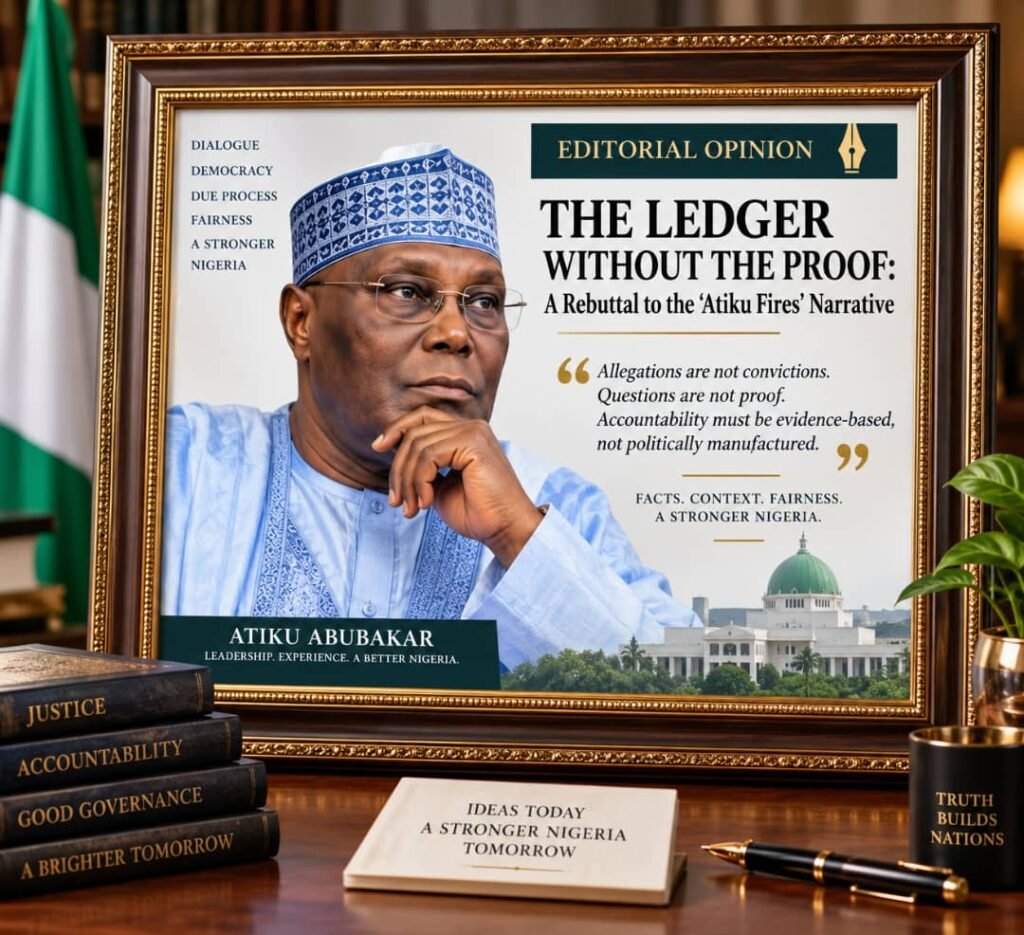
There is something profoundly misleading about an argument that begins by warning Nigerians not to confuse allegations with convictions and then spends thousands of words arranging allegations, controversies, institutional failures and inherited liabilities in such a way that the reader is invited to reach precisely that conclusion.
That is the fundamental problem with Dr. Bunmi Awoyemi’s essay, “Atiku Abubakar: The Fires of Yesterday, the Bills of Today.”
It is not a ledger.
It is a political charge sheet in which association is repeatedly substituted for causation, controversy for culpability and chronology for proof.
Let us examine it.
MAMBILLA: AN UNANSWERED QUESTION IS NOT A PROVEN CRIME
The $500,000 transfer involving Jennifer Douglas deserves scrutiny. There is nothing wrong with asking questions about it.
But the relevant ICC arbitration record does not establish that Atiku received a bribe, solicited a bribe, authorised a bribe or manipulated the Mambilla project.
What exists is testimony by Sunrise promoter Leno Adesanya about a payment he said was connected to a foreign-exchange transaction for Atiku. The arbitration tribunal did not accept his explanation because it lacked adequate corroboration.
That is a legitimate investigative lead.
It is not a finding of corruption against Atiku.
The distinction matters enormously.
A serious commentator should therefore say: this transaction warrants investigation if Leno Adesanya asserted it but could not prove it.
He should not rhetorically construct the next sentence as though the investigation has already produced the answer.
PTDF: THE SENATE REPORT IS NOT A CONVICTION
The same problem appears with the PTDF allegations.
A parliamentary investigation can expose serious concerns. It can recommend further investigation. It can identify transactions that require explanation.
But a Senate investigation without more does not automatically become a judicial determination of criminal liability.
If the author believes Atiku committed an offence, then the appropriate question is simple:
Where is the conviction?
If there is no conviction, say there is no conviction.
If there is evidence sufficient for criminal investigation, demand investigation.
But do not transform an investigative report into a criminal judgment by repetition. Most importantly, when court had dismissed the report of the investigation as non sequitur.
THE AMERICAN SENATE REPORT
The American investigation similarly deserves to be accurately described.
The fact that a U.S. congressional investigation examined suspicious financial transactions involving Jennifer Douglas and offshore entities is relevant historical material.
But “investigated” does not mean “convicted,” and “suspect transaction” does not mean “proven criminal proceeds.”
The author’s own opening principle should therefore apply consistently to his entire argument.
It cannot be:
“An allegation is not a conviction.”
Then, 5,000 words later:
“Here are all the allegations arranged to sound like a conviction.”
ALSCON: THE MOST IMPORTANT OMISSION
The ALSCON episode is perhaps the strongest example of how the article turns institutional history into personal culpability.
Yes, Atiku was Chairman of the National Council on Privatisation.
Yes, ALSCON became embroiled in a major legal controversy.
Yes, BFI submitted a $410 million bid while RUSAL submitted a conditional $205 million bid. The Supreme Court ultimately ruled in favour of BFI’s contractual claim against the Bureau of Public Enterprises.
Those are facts.
But where is the evidence that Atiku personally ordered the reversal, personally benefited from RUSAL’s acquisition, personally authorised an unlawful payment, or personally caused the subsequent litigation?
The article never establishes it.
Indeed, the litigation record shows the controversy involved the Bureau of Public Enterprises and the contractual dispute surrounding the government’s handling of the bidding process. The Supreme Court’s judgment was not a criminal conviction of Atiku.
That distinction is not cosmetic.
It is the entire argument.
THE ABACHA MONEY CLAIM
The attempt to connect ALSCON’s purchase price to repatriated Abacha funds is even more revealing.
If investigative reporting traced money through particular financial channels, that deserves examination.
But tracing money to a transaction is not the same thing as proving that Atiku personally controlled the money, authorised the transaction or benefited from it.
The author asks:
“Who lit the fire?”
But he has not demonstrated that Atiku lit this particular fire.
He has demonstrated that he was legally associated with an institution operating in the period by virtue of office.
That is not the same thing.
NITEL: A FAILURE THAT OUTLIVED MULTIPLE GOVERNMENTS
The NITEL argument is even more difficult to sustain.
The Bureau of Public Enterprises itself records that NITEL/MTEL went through multiple failed attempts at privatisation before the NCP eventually approved guided liquidation in 2012, against liabilities to creditors exceeding ₦300 billion.
That chronology matters.
The failure cannot simply be compressed into an “Atiku legacy” because Atiku once chaired the NCP.
If a national enterprise undergoes failed transactions under different governments, managers, advisers, bidders and institutional arrangements over many years, responsible analysis must identify which decision, by whom, caused which liability.
Otherwise, history becomes political bookkeeping.
NIGERIA AIRWAYS: AN OLD LIABILITY IS NOT AUTOMATICALLY ATIKU’S LIABILITY
The same applies to Nigeria Airways.
The Federal Government’s recent ₦18 billion settlement with former workers is real. The workers deserve their money, and the government’s settlement is a matter of public record.
But Nigeria Airways was liquidated more than two decades ago.
The fact that today’s government is settling an old obligation does not establish that Atiku personally created that obligation.
Otherwise, every government that pays inherited debt becomes the author of the debt.
That is not accountability.
That is chronological collectivisation of blame.
THE “FIRE SERVICE” METAPHOR DOES NOT PROVE THE FIRE
The author’s central metaphor is that Tinubu is the “fire service” dealing with fires inherited from the past.
Fine.
But a government settling inherited liabilities does not establish who caused them.
A fire brigade putting out a fire does not, by itself, identify the arsonist.
That requires evidence.
And if we are going to apply the metaphor honestly, we must apply it universally.
Nigeria’s present government is also inheriting debts, court judgments, pension obligations, infrastructure deficits, contractual disputes and institutional failures from governments of different political colours.
Would it therefore be intellectually defensible to attribute every current Nigerian liability to the politicians who occupied relevant offices at some earlier point without specifically demonstrating how they were officially or personally liable?
Of course not.
THE REAL PROBLEM WITH THIS ARTICLE
The article’s problem is not that it asks difficult questions.
Nigeria needs difficult questions.
Its problem is that it repeatedly asks questions in the language of conclusions.
“Who benefited?”
“Who authorised it?”
“Who lit the fire?”
Those are legitimate questions that require factual answers.
But questions without factual answers are not evidence.
And suspicion is not proof.
If the author wants the EFCC to investigate Mambilla, let the EFCC investigate it. Atiku himself has always invited the investigation.
If the PTDF transactions warrant forensic examination, let the records be examined.
If the offshore transactions disclose evidence of criminal conduct, prosecute whoever the evidence implicates.
If ALSCON requires further investigation, investigate the transaction.
But let the same standard apply to every Nigerian political actor, regardless of party.
That is the real test of principle.
ACCOUNTABILITY MUST BE EVIDENCE-BASED
There is nothing in this rebuttal that says Atiku should be above investigation.
He should not.
Neither should Tinubu.
Neither should Obi.
Neither should any former president, vice-president, minister, governor, legislator or politically connected businessman.
But there is an equally important principle:
Nobody should be convicted in the court of political rhetoric simply because an author has assembled enough figment of his imaginations in one article to create an atmosphere of guilt.
The proper sequence is:
allegation – investigation – evidence – finding – prosecution where justified – conviction where proven.
Not:
allegation – repetition – accumulation – insinuation – political conviction.
THE LEDGER MUST INCLUDE THE OTHER SIDE
The author repeatedly demands that Nigerians inspect “the ledger.”
Agreed.
But an honest ledger cannot contain only debits.
It must contain the evidence establishing responsibility for each debit.
It must distinguish between:
what Atiku personally did;
what an institution did;
what another official did;
what a contractor did;
what a subsequent government did;
and what remains merely alleged.
Without those distinctions, the ledger is not an accounting document.
It is an indictment written backwards.
THE FINAL ACCOUNT
The author is right about one thing: presidential candidates must be subjected to scrutiny.
Atiku’s record should be scrutinised.
His years as Vice-President should be scrutinised.
The NCP decisions of his era should be scrutinised.
His business history should be scrutinised.
His financial dealings should be scrutinised.
But scrutiny must be evidence-led, not inference-led.
If there is evidence of wrongdoing, produce it.
If there is a conviction, cite it.
If there is a judicial finding, identify it.
If there is merely an allegation, call it an allegation.
And if there is no evidence connecting an individual personally to a subsequent institutional failure, do not manufacture the connection merely because the political narrative would be more satisfying.
That is the essential weakness of the “fires of yesterday” argument.
It takes a complicated history of Nigerian privatisation, public-sector failure, litigation, pension obligations and successive administrations and attempts to reduce it to a morality play featuring one convenient protagonist.
Nigeria’s history is more complicated than that.
Its institutions are more complicated than that.
And accountability deserves better than that.
So yes:
Let the ledger be opened.
Let every transaction be examined.
Let every bank trail be followed.
Let every contract be scrutinised.
Let every politician answer legitimate questions.
But let the evidence speak for itself.
Because there is an enormous difference between saying:
“There are questions about this.”
and saying:
“This man caused it.”
The first is accountability.
The second requires proof.
And until that proof is produced, the grand narrative of “Atiku lit the fires and Tinubu is paying the bills” remains precisely what it should be treated as:
a political argument, not an established fact.
Alex Ter Adum, PhD
DDG
THE NARRATIVE FORCE