Aare Amerijoye DOT.B
Nyesom Wike may have spoken more truth than he intended this week. The problem is not that Nigerians look to people for help. The problem is that a serving public official could describe that desperation as a political advantage and appear to find nothing morally troubling about it. Asked whether hunger and insecurity would cost his principal the coming election, the Minister of the Federal Capital Territory argued that they would not. Nigerians, he explained, look to political leaders for food and support. In every family and community, he said, people look up to somebody in determining how they vote. If that was intended as political analysis, it was something much uglier in effect. It was a mockery of poor Nigerians.
It reduced hunger to a voting strategy, desperation to political leverage and poverty to an instrument that can be exploited at election time. The very people who should have been the central concern of government were spoken about as though their suffering were an asset on the political balance sheet. That is the whole indictment. Mary Catherwood once wrote, “There is no robbery so terrible as the robbery committed by those who think they are doing right.” There is something chillingly appropriate about that observation here. The robbery of the poor is not always committed by taking the little money in their pockets. Sometimes it is committed by taking something even more fundamental: their dignity, their agency and their right to be regarded as citizens rather than instruments of political calculation.
The poor Nigerian does not look up to a politician because he enjoys dependency. He looks up because the state has failed to build a society in which he can stand on his own. A hungry father who accepts a bag of rice is not necessarily endorsing the politician who brings it. A widow who accepts ₦10,000 is not surrendering her conscience. A jobless graduate who accepts transport money to attend a rally has not sold his citizenship. A struggling trader who accepts assistance has not signed away her right to demand accountability. These are citizens surviving in an economy that has made survival increasingly expensive.
And there is something profoundly insulting about looking at their desperation and concluding that it will make them politically predictable. Imagine telling a man who cannot afford food that his hunger is an electoral advantage for the government. Imagine telling the mother who cannot consistently feed her children that her poverty makes her vote easier to secure. Imagine telling the unemployed graduate that the absence of a job makes him politically useful. That is not empathy. That is contempt dressed up as political realism.
The fundamental question is therefore not whether Nigerians look up to somebody for assistance. Of course they do. The question is why, after years of government, so many Nigerians still need to look up to somebody at all. In a functioning society, the person a poor family looks up to should not necessarily be a politician. It should be an economy that provides opportunity. It should be a government that creates an environment where wages can buy food, businesses can survive, farmers can transport their produce safely, children can attend functioning schools and hospitals can treat patients without turning every illness into a financial catastrophe. The state should be the guarantor of dignity. Government should create citizens who can stand independently, not voters who must periodically stretch their hands towards politicians.
That distinction is fundamental. Because once poverty becomes a political resource, there is an uncomfortable incentive not to eliminate it. If a politician believes that hungry citizens will follow whoever feeds them during elections, then hunger ceases to be merely an economic problem. It becomes a political currency. And that is where the statement becomes particularly disturbing. A government should be terrified by the fact that its citizens are hungry. A government should be embarrassed that families cannot afford basic necessities. A government should be losing sleep over unemployment, insecurity, inflation and declining purchasing power. A government should be asking itself: What have we done wrong, and how do we fix it? Instead, Nigerians have been offered a different calculation: Will their suffering affect our votes? That is the mockery.
The poor are not statistics in an election projection. They are human beings. The woman selling tomatoes by the roadside is not an electoral number. The commercial driver battling fuel costs is not an electoral number. The farmer whose crops are threatened by insecurity is not an electoral number. The young Nigerian searching endlessly for employment is not an electoral number. The civil servant whose salary disappears under the weight of inflation is not an electoral number. They are citizens. And citizenship carries a right that no politician can confiscate: the right to judge government by the condition in which government has left them.
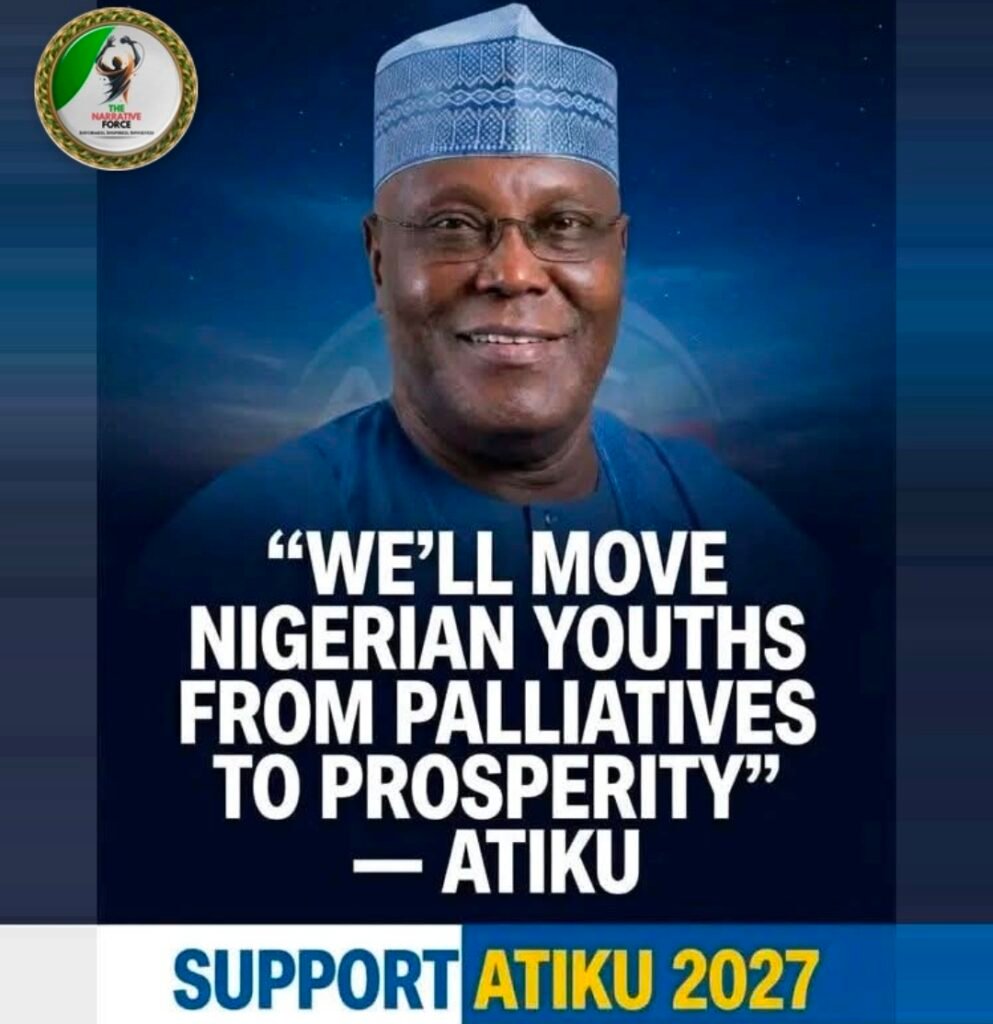
This is precisely where the contrast with Atiku Abubakar becomes politically significant. While some people in power appear comfortable discussing poverty as an instrument for securing votes, Atiku’s message is that the suffering of Nigerians cannot be treated as an electoral resource to be harvested. His political proposition is built around the need to rescue an economy in distress, restore opportunity and reduce the conditions that force citizens to depend on political patrons. The difference could not be clearer: one approach sees the suffering citizen as a problem to be solved; the other risks seeing the suffering citizen as a vote to be harvested.
Perhaps this is where the historical insight of Philippe Ariès becomes useful. Ariès spent much of his intellectual life examining how societies change the way they perceive experiences that are difficult, painful or uncomfortable, particularly suffering and death. His work showed how what societies choose to see, what they choose to conceal and what they choose to normalise can reveal much about the society itself. Nigeria must be careful not to reach a point where poverty is no longer treated as a national emergency but as an ordinary feature of political life; where hunger is no longer something to be ashamed of but something to be strategically managed; where insecurity is no longer a failure demanding correction but another variable in an election calculation.
That is the danger in the attitude reflected by the statement.
There is another dangerous assumption buried in the argument: that because poor Nigerians accept assistance, they must therefore vote for the person who provided it. That is an extraordinary underestimation of the Nigerian voter. Nigerians have collected food, money, rice, wrappers, transportation and all manner of inducements during elections and subsequently voted according to their own judgement. A bag of rice lasts for a few days. Bad governance lasts for years. A ₦10,000 gift may solve one immediate problem. Inflation returns the next morning. A politician can buy someone’s lunch without buying his conscience.
That is why the poor should never be mocked for accepting assistance. If anything, their desperation should indict those responsible for creating the conditions in which such assistance has become necessary. The person who gives the poor man food is not automatically his saviour. Sometimes, the most important question is why the poor man needed the food in the first place.
And if government has the resources to mobilise billions during elections, organise convoys, hold rallies, produce campaign materials and distribute political patronage, Nigerians are entitled to ask why that same political energy cannot be directed towards creating jobs, strengthening agriculture, securing communities and lowering the cost of living.
The Nigerian people are not asking for charity. They are asking for a country that works. They are asking for security. They are asking for affordable food. They are asking for jobs. They are asking for reliable electricity. They are asking for functioning schools and hospitals. They are asking for an economy in which hard work is rewarded rather than punished. They are asking for dignity. And dignity cannot be distributed in campaign bags.
This is why the statement should concern every Nigerian, regardless of political affiliation. Today, it may be used to explain why hunger will not hurt one political party. Tomorrow, another politician may use exactly the same logic to justify another election. Eventually, poverty becomes normalised as an instrument of political control. That is dangerous. Democracy cannot survive if politicians begin to see poverty as a dependable mechanism for securing votes. The purpose of democracy is not to keep citizens dependent on politicians. It is to give citizens the power to hold politicians accountable.
And there is one place where that accountability is supposed to become unmistakable: the ballot box. The voter who has been described as hungry has a vote. The voter who has been described as dependent has a vote. The voter who has been described as someone who must look up to a political benefactor has a vote. And that vote does not belong to the politician who brought the bag of rice. It belongs to the citizen.
This is where the political class repeatedly makes its greatest mistake. It assumes that because people are poor, they are foolish. It assumes that because people accept assistance, they are bought. It assumes that because people need help, they have surrendered judgement. They have not. The poor Nigerian may be hungry, but hunger does not destroy memory. The unemployed Nigerian may be desperate, but desperation does not permanently erase judgement. The struggling Nigerian may accept whatever assistance is offered, but that does not mean he has forgotten who made survival so difficult.
Indeed, sometimes poverty sharpens political memory. People remember when food became unaffordable. They remember when their businesses collapsed. They remember when their children could no longer find work. They remember when insecurity came to their doorstep. They remember promises. And they remember who made them.
So, if the argument was intended to reassure a political principal that hunger and insecurity would not affect electoral fortunes, Nigerians should hear something else in it. They should hear a warning about how some people in power now see them. Not as citizens whose welfare is the first responsibility of government. Not as human beings whose suffering should provoke urgency. But as voters whose desperation can be managed.
That is precisely why the statement deserves to be challenged. The poor are not political property. Their hunger is not an electoral asset. Their desperation is not a campaign strategy. Their dependence is not a government achievement. And their vote is not an inheritance belonging to whoever happens to control the machinery of power.
If anything, the greatest insult to a hungry Nigerian is to tell him that his hunger makes him politically safe to those responsible for governing him. Let nobody make that mistake. The hungry man still has a memory. The struggling woman still has a voice. The unemployed youth still has a choice. And on 16 January 2027, the Nigerian voter will have the most powerful instrument of democratic accountability: the ballot. No politician can eat it for him. No minister can cast it for him. And no government should ever be arrogant enough to assume it already belongs to them.
Atiku2027 #ADC #16January2027 #TheNarrativeForce #InformedInspiredInvolved
Aare Amerijoye DOT.B
Director General, The Narrative Force
thenarrativeforce.org
4 September 2026