How One Man’s Vanity Turned a Nation Into a Graveyard of Dreams
Aare Amerijoye DOT.B
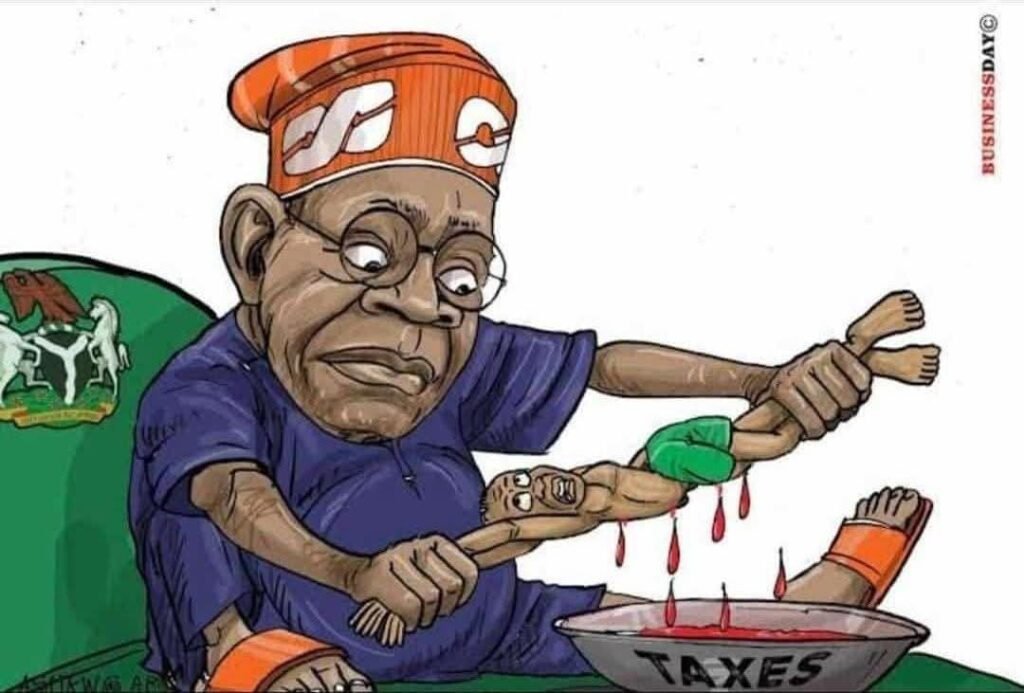
There is a particular species of ruler Africa has always known. He does not govern. He reigns. He is not moved by the arithmetic of the dead, because the dead do not attend his rallies. He is not troubled by the hunger of the poor, because the poor do not sit at his banquets. He is not shamed by the collapse of institutions, because institutions are useful to him only when they serve his survival. Bola Ahmed Tinubu is that ruler. And Nigeria, ancient, long suffering, and still on its feet, is paying the price in blood, in hunger, in darkness, and in despair.
This is not an editorial. It is a reckoning. Let us count the costs. Let us name the crimes. Let us refuse the sedation of euphemism. And let us do it with the receipts, because a man like this is undone not by adjectives but by evidence.
He is not moved by the arithmetic of the dead, because the dead do not attend his rallies.
I. THE EGO THAT REPLACED GOVERNANCE
Bola Tinubu spent decades constructing himself as the singular, indispensable genius of Nigerian politics. The Jagaban. The Godfather. His court fed the ego because the ego was profitable. Nobody told the emperor he was naked, because nobody around him could afford the price of honesty. Then came the presidency, and the ego swallowed the man whole.
A president ruled by ego cannot receive bad news. He cannot concede failure, because failure is an assault on the image he has spent a lifetime building. He cannot reverse course, because reversal is confession, and confession, to the ego driven ruler, is a species of death.
So the fuel subsidy was not removed after sober analysis concluded the moment was right. It was removed as a gesture, a flourish, a dramatic opening act on inauguration day, delivered off script before the ink on the oath had dried. The people paid for the performance with their livelihoods. When the naira collapsed and families began rationing garri, the ego forbade correction. When Nigerians said they were drowning, the palace told them they were merely wet. When they held up empty plates, the palace held up charts.
This is the government of the graph and the press release, of the glossy rebuttal issued from a foreign hotel while the homeland burns. It governs for the optics, never for the outcome.
The ego demanded a dramatic opening act. The people paid for the performance with their livelihoods.
II. BLOOD ON EVERY ROAD
While the ego preoccupied the palace, Nigeria bled out on the ground.
Consider the ledger, and consider that these are not opposition pamphlets but the findings of Amnesty International, the National Bureau of Statistics, and independent security monitors. In his first two years in office, Amnesty documented at least 10,217 people killed by gunmen across just seven states. Benue alone accounted for 6,896 of those graves. Plateau, 2,630. And the killing did not slow when the reports were filed. SBM Intelligence counted 5,091 Nigerians killed in the second quarter of 2026 alone, three months, more than 50 funerals a day. In a single fortnight this August, the security firm Nextier logged 445 casualties and 256 people abducted. Whole villages pay ransom now as if it were a tax. By one accounting, Nigerians have surrendered more than 2.23 trillion naira to kidnappers and their sponsors.
Put a human face on the statistics, because the ego cannot bear to. In April 2026, herder allied gunmen razed communities in Bokkos, Plateau State, killing 52 and driving nearly 2,000 people from their homes. In June, they came to Yelewata in Benue and turned a displacement camp into a slaughterhouse. The state government conceded 59 dead. Residents counted more than 100 and buried them for days. Some 500,000 people in Benue are now displaced, their farms abandoned, their harvest lost, their children in camps without sanitation or schooling. The Middle Belt, once the food basket of the federation, has become a corridor of terror. And in the Northeast, 13 years into the emergency, Boko Haram and its splinters have not been defeated. They have adapted, while new armies with new names, Lakurawa, Mamuda, have risen on this president’s watch.
Here is the verdict the world has already rendered on Nigeria’s security. In April 2026, the United States authorised the departure of non emergency staff and their families from its embassy in Abuja, and placed 23 of Nigeria’s 36 states under a Do Not Travel order. A president who cannot guarantee the safety of a diplomat’s child in his own capital has no business lecturing grieving villagers to look inward.
Insecurity and hunger are not two crises. They are one crisis in two uniforms. The farmer who cannot reach his field is the reason the market has no food, and the reason the food it has costs a fortune. The ego acknowledges the dead in a tweet, and the machinery moves on, because grief is an admission that something has gone wrong.
Insecurity and hunger are not two crises. They are one crisis in two uniforms.
III. THE SUFFERING THEY CALL REFORM
Now the numbers that live in every kitchen.
A litre of petrol that sold for about 185 naira in May 2023 now sells for more than 1,215 naira, and in July 2026 a single refinery briefly abandoned the naira altogether and priced the nation’s fuel in United States dollars, exposing how completely one man’s plant now dictates what every Nigerian pays at the pump. The naira, worth roughly 460 to the dollar when this government took office, sank to an all time low beyond 1,700 and trades today around 1,500 in the open market. And rice, the staple that fills the Nigerian pot, tells the same story of a people priced out of their own food: a 50kg bag that sold for under 25,000 naira in 2022 now costs 55,000 to 60,000 naira, and even the recent dip, driven by a flood of cheap imports, leaves it far beyond the reach of a household surviving on 70,000 naira a month.
Then the wage. The minimum wage was set at 70,000 naira. In 2019, the old 30,000 naira minimum wage was worth about 83 dollars. Today, the doubled 70,000 naira is worth about 42 dollars. The state nominally doubled the wage and quietly halved it. A single bag of that rice now devours most of a month’s minimum wage before a family has bought anything else. A pot of jollof for a family of five crossed 30,000 naira. And do not be soothed by the headlines announcing that inflation has cooled. Headline inflation easing to around 15 per cent in mid 2026 is a statistical mercy measured against the catastrophe of 2024. Food inflation still ran above 20 per cent year on year in July and was accelerating month on month. The rate slowed. The prices did not fall. The base simply reset upward and locked the poor out permanently.
The consequence is not abstract. The World Bank’s April 2026 assessment put Nigeria’s poverty rate at 63 per cent, roughly 140 million citizens below the poverty line, up from 56 per cent just two years earlier. The middle class that survived the Buhari years has been ground to powder. The opposition counts 767 manufacturing companies shut and 335 more in distress, the productive base of a nation switching off its lights. Patients ration insulin they can no longer afford. Children have stopped asking for things, because they have learned that asking only summons their parents’ shame.
This is not a transition. It is systemic impoverishment dressed in the borrowed grammar of technocracy.
The state nominally doubled the wage and quietly halved it.
IV. THE LAWFARE PRESIDENCY
In the middle of this wreckage, the machinery of the presidency is bent on a single objective: survival beyond 16 January 2027. And because the argument cannot be won on food or blood, the strategy is not to win the argument. It is to make the contest itself impossible.
Watch the pattern. In April 2026, the Independent National Electoral Commission struck the David Mark led National Working Committee of the ADC from its portal, siding, at the decisive moment, with confusion rather than with the ratified will of a registered party. What followed was not neutrality. It was a barrage: suit after suit, many filed by figures with curious proximity to the ruling party, each one designed less to prevail than to freeze the opposition’s structures and run down the clock against a deliberately compressed electoral timetable. Even the ADC’s own presidential candidate has named it plainly, calling it sponsored litigation, political intimidation, and the abuse of state power.
And yet the ambush failed. The Supreme Court restored the Mark led leadership. The Court of Appeal threw out an audacious order to deregister the ADC and four other parties, branding that judgment a nullity. A separate suit aimed at Mark’s chairmanship was dismissed, with costs. And on 15 July 2026, INEC itself confirmed that it would recognise the Mark led leadership’s candidates, clearing Atiku Abubakar and his running mate Rotimi Amaechi along with hundreds of others across 471 positions. The lawfare bought delay. It did not buy the outcome. The opposition walked through every trap and emerged with its ticket intact.
Understand what that desperation confesses. When an electoral commission can be made to behave like a department of the presidency, democracy does not merely weaken. It is put on trial. Tinubu knows the arithmetic that terrifies him. He won in 2023 with 8,794,726 votes, one of the narrowest mandates in the history of the Fourth Republic, while a divided opposition still gathered more than 14.5 million. Three years of suffering have not produced gratitude. They have produced fury. So the plan is not persuasion. The plan is to make the election uncontestable. It is the plan of a man who has mistaken the presidency for a personal inheritance, and who has fatally underestimated the people he intends to inherit.
The lawfare bought delay. It did not buy the outcome.
V. THE MASSES ARE NOT SLEEPING
The Nigerian people are not who they were in 2015, or 2019, or even 2023. The hunger is real, but it has not produced docility. It has produced clarity. A people who have lost almost everything have lost their fear along with it, and against the fearless, the machinery of intimidation has no teeth.
The EndSARS generation did not vanish. A generation that discovers its own power does not unlearn the lesson. It refines it. It organises. It waits for the moment when the numbers are too vast for even a compromised system to swallow. The young Nigerians who stood in the rain to vote, then watched their ballots edited in transmission, did not go home defeated. They went home with evidence. And evidence, in the hands of an organised people, is a weapon.
But fury requires a vessel, or it is only noise. That vessel is the African Democratic Congress. That candidate is Atiku Abubakar. As Vice President and chairman of the National Council on Privatisation, Atiku presided over an economy that grew from 58 billion dollars in 1999 to 270 billion dollars by 2007, and delivered peak growth of 15.3 per cent, the highest in the nation’s history. He architected the liberalisation of telecoms that carried Nigeria from fewer than 1 million landlines to a mobile market of more than 200 million lines, drove the consolidation that rebuilt the banks, and negotiated the 18 billion dollar Paris Club debt relief that lifted decades of debt off the nation’s neck. These were institutions that outlived the government that built them. Set that against a presidency whose signature legacy is 140 million citizens in poverty and a factory floor going dark. Between a man who built and a man who has dismantled, that is the entire election.
Let no one pretend the opposition marches as one. Obi and Kwankwaso have pitched their tent in the NDC, and the two platforms go to the polls as separate armies. The palace is staking its survival on that division, praying, as it did in 2023, that a scattered field hands it another minority victory. It is a fragile bet, and it breaks on the North.
No one has ever won the presidency of Nigeria without the North, the largest and most decisive bloc in the federation, and no southern campaign, however electric, has ever gathered the numbers to override it. In that arena the choice narrows to one man. Tinubu is a son of the South West. Obi is a son of the South East. Kwankwaso, for all his history, runs as a deputy on a southern led ticket, his strength concentrated in Kano. Atiku Abubakar is the only Northerner at the head of a ticket in this race, with networks that run through the North East and the North West alike, and as the APC’s own northern bloc fractures, its elder statesmen openly protesting the region’s marginalisation, those votes have one natural home. Atiku should not poll less than 9 million from the North, and that floor rises with every week of hunger.
And the North does not grieve alone. From the emptied villages of Benue to the shuttered factories of Aba, from Maiduguri to Warri, the same fury moves through a people who have buried their children and rationed their food. That fury belongs to no party. It is a tide, and a tide does not read manifestos. It finds the strongest channel and it rises. The ADC, anchored by the networks of Amaechi, El-Rufai, and Aregbesola, is the most formidable opposition platform since the coalition that ended a ruling party in 2015. The arithmetic never favoured the incumbent. It does not favour him now. The campaigns have already begun. The ballot falls on 16 January 2027.
A tide does not read manifestos. It finds the strongest channel, and it rises.
VI. THE VERDICT OF HISTORY
History is already writing its judgment on Bola Ahmed Tinubu, and the judgment is not kind. He took power and made the nation a carcass. He inherited a struggling economy from his own party’s Buhari and strangled it. He took a people already bent and broke their backs. He removed a subsidy without shielding the poor. He floated the naira without steadying the economy. He presided over the bloodiest peacetime stretch in living memory without a single serious strategic answer. He turned the machinery of election against the democracy he swore to defend. And he mistook the silence of the exhausted for the consent of the governed.
The Nigerian people have been patient. Patient through military rule and annulled elections. Patient through stolen oil and collapsed roads. Patient through insurgency and flood. But patience is not surrender. It is the compression of a spring, and on 16 January 2027 it will release with a velocity no incumbency machinery can absorb.
Tinubu can lean on INEC. He cannot lean on 230 million people.
He can capture institutions. He cannot capture history.
He can buy silence. He cannot buy time. And time, in a democracy fuelled by suffering, belongs to the poor.
Mr President may hold the palace. He does not hold the people. And in the end, the people are the only verdict that counts.
He can buy silence. He cannot buy time. And time, in a democracy fuelled by suffering, belongs to the poor.
Aare Amerijoye DOT.B
Director General
The Narrative Force
thenarrativeforce.org
21 August 2026