The Journey to 2027 Is Mature — Part One of Four
Why Atiku Abubakar is not merely the North’s candidate. He is Nigeria’s only pan-Nigerian one.
There is a moment in every presidential election cycle when the noise of commentary and the clatter of propaganda give way to something quieter, more precise, and far more decisive: the mathematics. In Nigeria’s 2027 presidential contest, that moment has arrived. What the mathematics reveal is not merely an advantage for Alhaji Atiku Abubakar of the African Democratic Congress. They reveal a structural inevitability rooted in something his opponents have never possessed and cannot manufacture: a genuinely national identity in a field of regional candidates.
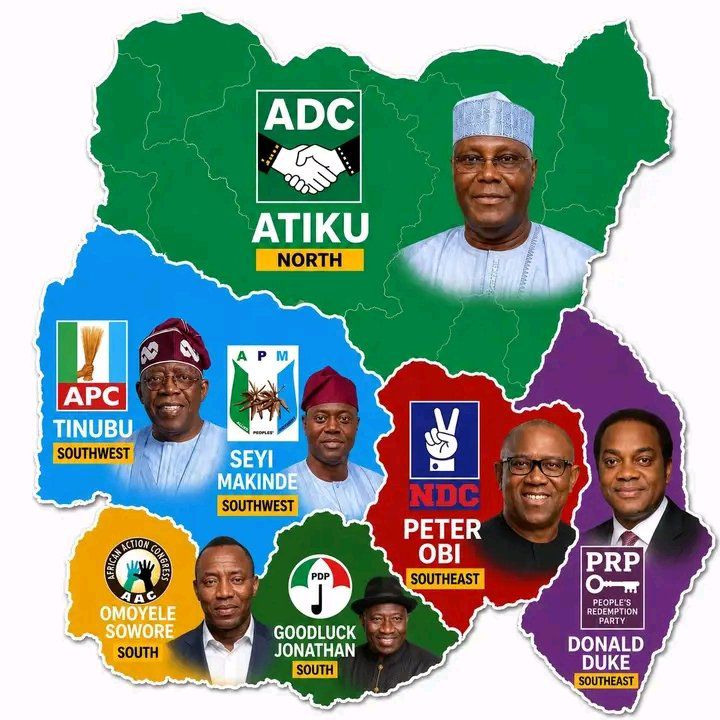
Every other major contestant in the 2027 presidential race is, at his electoral core, a regional figure. Bola Ahmed Tinubu of the APC is a South-West candidate. Peter Obi of the New Democratic Congress is a South-East candidate. Goodluck Ebele Jonathan, being positioned through a faction of the Peoples Democratic Party, is a South-South candidate. Governor Seyi Makinde of Oyo State, running under the African Peoples Movement, is a South-West candidate contesting the same territory as the incumbent president. Each of them commands a zone. None of them commands a nation.
Atiku Abubakar is different in kind, not merely in degree. He is the only candidate in the 2027 field whose electoral footprint, documented in INEC’s ward-level results from 2019 and 2023, is meaningfully distributed across all six geopolitical zones, all 36 states, and the FCT. That national reach is not campaign rhetoric. It is the documented verdict of two successive presidential contests in which he competed and polled across every corner of the federation. No other candidate on the 2027 field can make that claim with evidence.
It is from that pan-Nigerian foundation, and not merely from sectional arithmetic, that Atiku Abubakar’s 2027 victory is being constructed.
THE NORTH AS FLOOR, NOT CEILING
Understanding Atiku’s Northern advantage requires understanding what it is and what it is not. It is not the sum total of his appeal. It is the structural floor beneath a nationally distributed candidacy, the bedrock upon which a pan-Nigerian campaign is built. A candidate who commands the most electorally decisive geography in the federation while simultaneously maintaining meaningful presence across the South is not a regional candidate. He is a national candidate with a regional fortress.
And that fortress is formidable.
Nigeria’s six geopolitical zones carry the following approximate registered voter populations as established ahead of the 2023 general elections:
North-West: approximately 22.4 million registered voters, the single largest bloc in the country. Kano State alone accounts for over 5.9 million, making it the most vote-rich state in the federation.
North-East: approximately 10.3 million registered voters.
North-Central: approximately 12.1 million registered voters.
South-West: approximately 14.5 million registered voters.
South-East: approximately 7.8 million registered voters, the smallest geopolitical zone by voter registration.
South-South: approximately 9.6 million registered voters.
Total Northern registered voters: approximately 44.8 million, representing over 58 percent of Nigeria’s total voter population.
These are not projections. They are INEC’s documented registration figures.
Now consider the strategic implication of the 2027 field. Tinubu anchors the South-West. Makinde, as a sitting Governor of Oyo State running under a rival party, directly cannibalises that same South-West voter reservoir using the full weight of gubernatorial incumbency: state civil service relationships, developmental patronage networks, ward-level administrative reach, and four years of brand-building among the Oyo electorate. Obi anchors the South-East. Jonathan anchors the South-South. Southern candidates will spend the entire campaign season shredding each other’s support base, fragmenting and neutralising the South’s collective electoral weight, while Atiku, the pan-Nigerian candidate with the broadest national coalition, consolidates across 18 of 19 Northern states without a credible competitor.
Every other candidate wins a zone. Atiku wins a nation.
“Give me a place to stand,” said Archimedes, “and I shall move the world.” Atiku’s place to stand is every geopolitical zone in the federation. His fortress is the North. His reach is Nigeria. And from that combination, no opponent in the 2027 field can dislodge him.
THE ZONING COVENANT: HISTORY AS MATHEMATICS
The principle of rotational presidency is not constitutionally codified. It has, however, functioned as the practical operating architecture of Nigerian political power since 1999, and its moral weight on Northern voters in 2027 cannot be overstated.
The record speaks without ambiguity.
Olusegun Obasanjo, South-West, served two full terms from 1999 to 2007: eight years.
Umaru Musa Yar’Adua, North-West, died in office in 2010 after barely three years, robbing the North of its full constitutional mandate.
Goodluck Jonathan, South-South, completed Yar’Adua’s remaining term and won one full term of his own: five years from 2010 to 2015.
Muhammadu Buhari, North-West, served two full terms from 2015 to 2023: eight years.
Bola Tinubu, South-West, assumed office in May 2023 and continues.
The arithmetic is plain. The South has governed for a combined 17 years since 1999. The North’s tally stands at 11, and even that count is complicated by Jonathan’s emergency assumption of power following Yar’Adua’s incapacitation. The North’s first full mandate was cut by death. The South has now returned to power for the third time. By every calculation of equity and political covenant, the North’s claim in 2027 is a structural right that tens of millions of Northern voters carry as a living political consciousness.
What makes this zoning argument uniquely powerful in the context of Atiku’s candidacy is that it does not merely animate Northern voters. It validates a pan-Nigerian choice. Southerners who believe in the equity of rotational power, and there are tens of millions across the Middle Belt, the South-South, and even the South-West who do, find in the zoning argument not a Northern demand but a national covenant being honoured. Atiku is the beneficiary of both the Northern arithmetic and the national conscience simultaneously.
“History is not a burden on the memory,” said Lord Acton, “but an illumination of the soul.” Illuminated by history, the soul of Nigeria in 2027 points to one destination.
THE KWANKWASO PAPER THREAT
APC propagandists will invoke Rabiu Musa Kwankwaso’s movement to the New Democratic Congress as evidence of Northern fragmentation. The argument dissolves under basic geographical scrutiny.
Nigeria has 19 Northern states. Kwankwaso’s operational political machinery has one meaningful stronghold: Kano State. His 2023 presidential total of approximately 1.5 million votes was overwhelmingly concentrated in Kano, with negligible penetration across the remaining 18 Northern states. In Adamawa, Sokoto, Kebbi, Zamfara, Katsina, Borno, Yobe, Gombe, Taraba, Bauchi, Niger, Kwara, Benue, Plateau, Nasarawa, Kogi, and the FCT, his presence was either marginal or entirely inconsequential.
The proposition that Kwankwaso’s alignment with a South-Eastern presidential candidate will move the Hausa-Fulani voter of Sokoto, the Kanuri voter of Borno, the Tiv voter of Benue, or the Nupe voter of Niger State away from the North’s most experienced and most nationally credible presidential son is not political analysis. It is political fantasy.
Furthermore, the NDC’s primary electoral base is deeply southern. Peter Obi’s 2023 votes came overwhelmingly from the South-East, from young urban Lagos voters, and from scattered South-West Christian constituencies. These were never Atiku’s votes. The NDC does not eat into Atiku’s base. It eats further into a southern vote pool that is already cannibalising itself.
The Kwankwaso factor requires diligent ward-level mobilisation in Kano. It does not threaten the 18 other Northern states. And it does not threaten the southern dimensions of a pan-Nigerian coalition that was never built on NDC’s constituency in the first place.
THE CASE IS NATIONAL, NOT SECTIONAL
What distinguishes Atiku Abubakar’s 2027 candidacy from every other figure in the field is the breadth of its foundation. He does not campaign as the North’s candidate asking the South to accept him. He campaigns as Nigeria’s candidate, with a documented national electoral footprint, a governing record delivered at the apex of the Nigerian state, a coalition assembled from every geopolitical zone, and a structural Northern advantage that serves as the arithmetic floor beneath a genuinely national political enterprise.
The North holds 58 percent of Nigeria’s voter population and has unified behind him. Every major opponent is from the South. The South is divided between at minimum four competing candidacies. The one Northern challenger of consequence is confined to a single state. The zoning covenant points northward. And beyond all of that, the only candidate in the field who has polled meaningfully in the South-West, the South-South, the South-East, the North-Central, the North-East, and the North-West in the same election is Alhaji Atiku Abubakar.
Regional candidates win zones. National candidates win elections.
The journey to 2027 is mature. The North has chosen. Nigeria has chosen. And what Nigeria chooses, when its national conscience and its electoral arithmetic align behind a single figure, is not a result. It is a verdict.
Aare Amerijoye DOT.B, Director General, The Narrative Force, thenarrativeforce.org
May 2026.