
By Kunle Oshobi
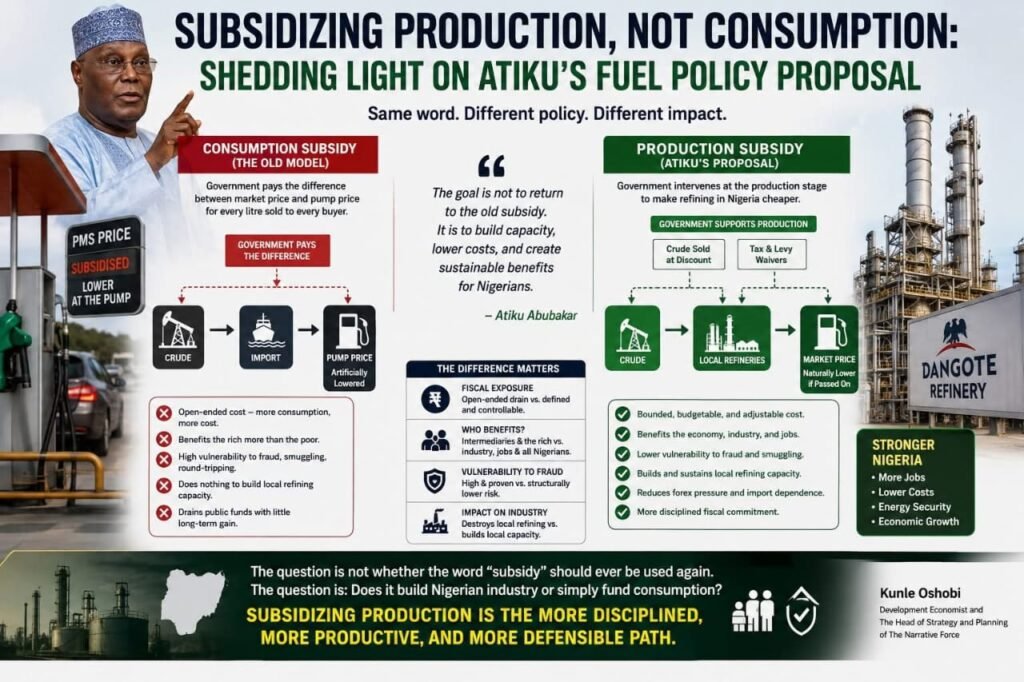
When Atiku Abubakar recently indicated that a subsidy would return under his administration, the announcement was, predictably, met with a mixture of alarm and relief, alarm from those who remember the fiscal drain of the old subsidy regime, and relief from Nigerians still adjusting to the cost of PMS at market price. Both reactions, however, miss the more important detail buried in the announcement: this is not a proposal to revive the subsidy Nigeria removed in 2023. It is a fundamentally different policy instrument, aimed at a different point in the fuel value chain. Understanding that distinction, between subsidizing consumption and subsidizing production, matters more than the word “subsidy” itself.
Two Different Policies Wearing the Same Name
Consumption subsidy is the model Nigeria operated for decades. Under this approach, government absorbs the difference between the market price of petrol and a lower, politically set pump price, paying that difference, directly or through the NNPC balance sheet, for every litre sold, to every buyer, regardless of income, need, or purpose. It is, by design, an open-ended commitment: the more fuel Nigerians consume (or the more that is smuggled across borders where subsidised Nigerian fuel undercuts neighbouring markets), the larger the bill. This is precisely what made the old subsidy regime fiscally unsustainable, consuming trillions of naira annually while disproportionately benefiting higher-income Nigerians who consume more fuel, and fuel-marketing intermediaries who captured much of the value through arbitrage, round-tripping, and outright fraud.
Production subsidy, by contrast, does not touch the price at the pump directly.
It intervenes earlier in the value chain, at the point where crude oil is converted into refined products. Atiku’s proposal, as outlined, would work through two levers: selling crude oil to local refineries at a lower price than international export parity, and waiving government taxes and levies that currently add to the cost of refining within Nigeria. The effect is to lower the cost of producing PMS, diesel, and kerosene domestically, which, if refiners pass the savings through, brings down the market price of fuel without government committing to an open-ended cash subsidy on every litre sold at the pump.
Why the Difference Matters
The distinction is not merely technical. It changes who benefits, how the policy is funded, and how vulnerable it is to abuse.
Fiscal exposure.
A consumption subsidy’s cost scales with national demand, an unpredictable, politically difficult number to forecast or control. A production subsidy’s cost is tied to a defined volume of crude allocated to refiners at a discount, and a defined set of tax waivers, both of which are budgetable, adjustable policy levers rather than an open tap.
Who actually benefits?
Consumption subsidies famously benefit whoever buys the most fuel, historically Nigeria’s wealthier households and businesses running generators and fleets, while a disproportionate share of the subsidy value has, over the years, ended up with importers and marketers rather than ordinary Nigerians. A production subsidy flows into domestic refining capacity itself: infrastructure, capacity utilisation, and jobs within Nigeria, rather than into the pockets of import intermediaries.
Vulnerability to fraud.
The old subsidy regime’s greatest scandal was never the policy’s intent but its execution, round-tripping, phantom import claims, and cross-border smuggling that exploited the gap between Nigeria’s subsidised price and market prices elsewhere in the region. A production-side subsidy, tied to verifiable crude allocation and refinery output rather than retail sales volume, is structurally harder to exploit in the same way.
Effect on local industry.
This may be the most consequential difference. A consumption subsidy does nothing to build Nigeria’s refining capacity, indeed, for years it made local refining uneconomical relative to importing already-subsidised fuel. A production subsidy does the opposite: it makes refining crude oil into finished products within Nigeria more commercially attractive, at a moment when Nigeria finally has the domestic refining capacity, led by the Dangote refinery’s roughly 650,000 barrels-per-day capacity, alongside a growing number of modular refineries, to actually take advantage of it.
The Economic Case for Subsidizing Production
It builds the industry Nigeria has spent decades trying to build. For most of Nigeria’s history as an oil producer, the country exported crude and imported refined products, sending value-added downstream jobs and industrial capacity abroad in the process. A policy that makes domestic refining cheaper than exporting crude and re-importing fuel finally aligns Nigeria’s fuel policy with the goal every administration has claimed to want: value addition at home rather than abroad.
It reduces Nigeria’s exposure to foreign exchange volatility.
Every litre of fuel currently imported must be paid for in dollars, placing continuous pressure on Nigeria’s forex reserves and the naira. Shifting more of the country’s fuel supply to domestic refineries, fed by domestically sold crude, reduces that import bill and the exchange-rate pressure that comes with it.
It creates jobs beyond the pump.
Refining capacity utilisation supports jobs in engineering, logistics, maintenance, and the broader petrochemical value chain, a very different economic footprint than a consumption subsidy, which supports consumption itself but adds nothing to productive capacity.
It is more fiscally disciplined, not less.
This is the point most likely to be missed in the political noise around the word “subsidy.” A defined crude allocation at a discounted price, combined with specific tax waivers, is a bounded fiscal commitment that can be costed, budgeted, and adjusted, a sharp contrast to the blank cheque that consumption subsidies became.
It will bring down prices for ordinary Nigerians, the outcome people actually want.
Critics of any subsidy proposal are right to worry about a return to fiscal recklessness. But the objection to the old subsidy was never that Nigerians deserved to pay less for fuel, it was that the mechanism for achieving that was fiscally reckless and badly targeted. A production-side subsidy aims at the same outcome, cheaper fuel, through a mechanism built around domestic industrial capacity rather than open-ended consumption support.
Conclusion
The word “subsidy” carries heavy political baggage in Nigeria, and understandably so, given what the old regime cost the country. But not all subsidies are the same policy wearing different names. A consumption subsidy pays for fuel Nigerians have already bought, with no natural ceiling on cost and a long history of capture by intermediaries. A production subsidy invests in the capacity to make that fuel cheaper to produce in the first place, with a definable fiscal cost and a direct link to building Nigeria’s domestic refining industry. As Nigeria’s refining capacity comes fully on stream, the more relevant policy question is not whether the word “subsidy” should ever be used again, but whether the next subsidy, if there is one, is designed to build Nigerian industry or simply to fund consumption. On that question, subsidizing production is the more disciplined, more productive, and more defensible path.
Kunle Oshobi is a Development Economist and The Head of Strategy and Planning of The Narrative Force