Aare Amerijoye DOT.B
THE ARITHMETIC OF ANGER
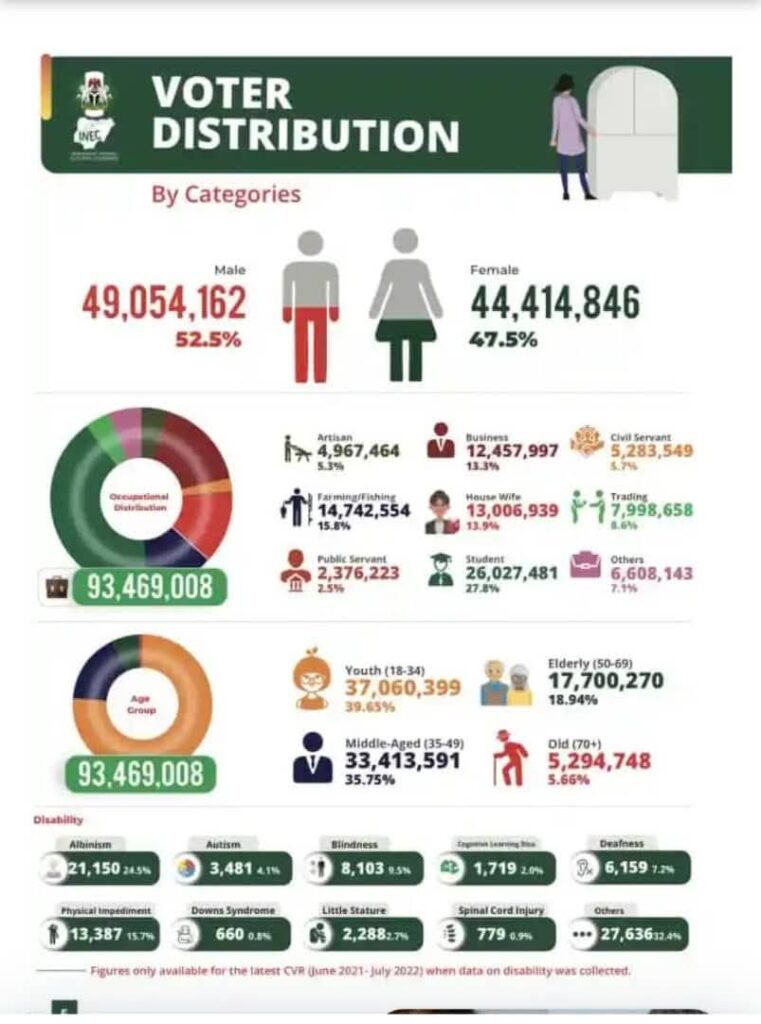
93,469,008.
That is not a statistic. It is a verdict. It is the accumulated rage, hunger, desperation, and defiance of nearly one hundred million Nigerians who looked at their country, looked at their government, and decided to register their anger through the ballot. Every digit in that electoral roll represents a life disrupted, a dream deferred, a family broken on the wheel of Tinubu’s catastrophic misgovernance. The number does not sit quietly in an INEC ledger. It breathes. It votes. And in 2027, it will settle accounts.
THE PVCs ARE LOADED
Ahead of the 2023 presidential election, 87,209,007 Permanent Voter Cards were collected. Lagos led with 6,214,970. Kano followed with 5,594,193. Kaduna contributed 4,164,473.
These are not administrative figures. They are mobilisation intelligence. They are the precise coordinates of a democratic uprising waiting for the correct general to give the order. And the general has a name.
THE SILENCE THAT MUST NEVER RETURN
Only 24 million Nigerians voted on 25 February 2023. A paltry 26.71 per cent turnout. In a country burning from Sokoto to Calabar with documented, quantifiable, daily grievance, nearly 70 million registered voters stayed home.
That silence was not indifference. It was a scream so profound it swallowed itself. The scream of a people so serially betrayed by political promises that they could not bring themselves to believe in one more. That silence gifted Nigeria its current catastrophe. It must never return.
Voter apathy is not a social inconvenience. It is a weapon the establishment deploys against the masses. In 2027, that weapon must be seized, disassembled, and destroyed.
THE DEMOGRAPHIC MAP OF FURY
The numbers tell a story the Tinubu administration does not want told and cannot afford to have heard.
Youths aged 18 to 34 constitute 37,060,399 registered voters, representing 39.65 per cent of the entire electorate. They are the largest single demographic bloc in Nigerian electoral history. They are also the most unemployed, the most indebted, the most educated, and the most enraged. A generation that completed university degrees into a recession engineered by incompetence. A generation that entered the workforce only to find the entry points barricaded by cronies and cabals.
Students alone number 26,027,481, accounting for 27.8 per cent of the total electorate. They are stranded between perpetual strikes, scandalous tuition hikes, and a future already mortgaged to mismanagement before they could sign the papers.
The middle-aged bracket, 35 to 49, numbers 33,413,591 and constitutes 35.75 per cent of registered voters. The productive backbone of the real economy. Small business owners watching their margins evaporate daily. Civil servants whose salary alerts arrive too late to outwit the inflation that devoured the value before the credit landed.
Women, representing 47.5 per cent of registered voters at 44,414,846 strong, carry the heaviest daily burden of Tinubu’s policy failure. The 13,006,939 housewives who stand in the market and confront prices that climb with every passing week are not a voter category. They are human beings systematically impoverished by a government that cannot distinguish between governance and performance art.
Artisans number 4,967,464. Traders: 7,998,658. Farmers and fishermen: 14,742,554. The informal economy that kept Nigeria alive through every previous failure watched the fuel subsidy removal detonate their operating costs overnight. They watched the naira collapse into a currency that buys less each morning than it did the evening before. They watched a president who exempted himself and his cabinet from the shared sacrifice he demanded of the masses, preaching endurance from a presidential fleet whose monthly operating costs exceed the annual salary of a thousand Nigerian teachers.
They have endured enough.
50 MILLION REASONS THE ADC MUST WIN
Here is the political geometry that should terrify the APC and electrify every member of the African Democratic Congress.
Even granting every recognised political party a generous ward-level membership of 1,000 committed loyalists across all 8,090 wards, the entire universe of organised party membership across Nigeria does not exceed 40 million. That still leaves over 50 million registered voters pledged to no party machine, indebted to no political patron, waiting not for handouts but for a reason. A reason that speaks to their hunger. A reason that names their enemies correctly. A reason that arrives bearing not slogans but solutions.
The African Democratic Congress is that reason.
The ADC is not another vehicle for the same recycled elite under a new flag. It is the structured political home of Nigeria’s coalition of the aggrieved. Where Peter Obi’s 6,101,533 voters, Kwankwaso’s 1,496,671 nationally verified supporters, Aregbesola’s grassroots constituency, Amaechi’s executive networks, El-Rufai’s reform credentials, and Tambuwal’s political depth have converged under one canopy with Atiku Abubakar at the head.
The arithmetic of 2027 already favours this coalition beyond reasonable contest. The ceiling of available votes, comprising Atiku’s 6,984,520 in 2023, Peter Obi’s 6,101,533 and Kwankwaso’s INEC-verified 1,496,671, already stands at 14,582,724, a figure that dwarfs Tinubu’s INEC-certified 8,794,726 by nearly six million votes before a single additional vote is counted. The task of the ADC is not to conjure votes from thin air. It is to convert that ceiling into a floor. Add the youth bloc that stayed home in 2023 and is now incandescent with three additional years of documented grievance. Add the traders, the farmers, the artisans, the housewives who have endured Tinubu for three additional years beyond the point of tolerance. The outcome is not a projection. It is an inevitability, provided the ADC campaigns with the ferocity this moment demands.
LAGOS, KANO, KADUNA: THE BATTLEGROUNDS OF LEGITIMACY
Lagos is a city held hostage. Over 6.2 million PVCs collected. A megalopolis of immense ambition and industry, strangled by a system engineered to extract wealth from the many and funnel it upward to a political dynasty that has treated the city as a private inheritance for three decades. The suffocating traffic, the rising crime, the collapsed drainage, the shanties beneath the gleaming towers: Lagos is Tinubu’s most intimate policy failure. It is also his most exposed political flank.
Kano’s 5.5 million PVCs and Kaduna’s 4.1 million represent the North’s sustained investment in democratic change. Both cities groan under insecurity that the Tinubu administration has not merely failed to reverse but has presided over with visible disinterest. Both cities hold millions of Kwankwaso supporters who are now, through their principal’s formal alignment with the ADC in March 2026, the ADC’s most formidable northern asset.
Each geopolitical zone carries its unique wound. They share one infection. And the ADC is the treatment.
THE INDICTMENT STANDS UNCONTESTED
Let the record be read without interruption or editorial mercy.
Fuel prices have multiplied severalfold since May 2023. The naira has been systematically debased to levels that erase whatever gains wage earners claim. Electricity tariffs were hiked on a population whose supply has not improved by a single reliable hour. Food inflation breached 40 per cent and the administration’s response was photo opportunities and press releases signed by ministers who do not buy their own groceries. Security deteriorated from Borno to Plateau, from the Middle Belt to the Niger Delta, while the National Security Adviser held press conferences. The Central Bank lurched between contradictory monetary positions: a currency unification policy that collapsed the naira, interest rate decisions that strangled access to credit, and a foreign exchange regime that simultaneously punished manufacturers, importers, and ordinary Nigerians saving in their own currency. Supplementary appropriation bills were rushed through the National Assembly without adequate legislative scrutiny, expanding federal expenditure commitments well beyond the original budget envelope approved by Nigerians’ elected representatives.
And through it all, the presidency communicated not with the suffering people but with its own mythology.
This is the government the ADC and Atiku Abubakar are asking Nigeria to replace. The case requires no embellishment. The facts are the prosecution.
THE VERIFIED ALTERNATIVE
Atiku Abubakar is not an experiment. He is a verified quantity in a country that has been sold too many untested and catastrophically costly experiments.
As Vice President from 1999 to 2007, Atiku presided over an economy that grew from a GDP of $58 billion to $270 billion, a 365 per cent expansion achieved through deliberate policy, not commodity luck alone. Under his watch as Chairman of the National Economic Council, Nigeria recorded 15.3 per cent single-year GDP growth, a figure no subsequent administration has approached or dared to claim. He did not theorise about privatisation and economic reform. He implemented it. He did not promise private sector engagement. He spent four decades building and leading private enterprises that employ Nigerians at scale today.
Around Atiku, the African Democratic Congress has assembled a coalition of governance assets without precedent in Nigerian opposition politics. David Mark brings institutional authority and legislative gravitas spanning three decades. Rauf Aregbesola brings twelve years of frontline executive experience and a grassroots mobilisation network across the South-West that the APC spent years trying to neutralise, and failed. Rotimi Amaechi brings project execution credentials established across two successive terms in Rivers State. Nasir El-Rufai brings federal executive experience as FCT Minister and a documented record of urban reform that earned him national recognition long before the politics of Kaduna. Rabiu Kwankwaso brings the most organised grassroots mobilisation infrastructure in the North-West, with 997,279 INEC-verified votes from Kano alone in 2023. Aminu Tambuwal brings cross-regional credibility that broadens the coalition’s reach southward and across the Middle Belt.
These are not political decorations. They are governance assets. The ADC is not merely a party. It is a coalition government in waiting.
THE CAMPAIGN THE MOMENT DEMANDS
The harvest is ready. The only question is whether the harvesters are equal to the task.
Atiku Abubakar and the ADC must immediately launch an aggressive, nationally coordinated voter sensitisation campaign. Not press releases. Not high-table conferences. Ward-level, market-level, bus-park-level, street-corner engagement with the 50 million uncommitted voters who hold the keys to 2027 in their hands.
The message must be simple, relentless, and uncompromising: silence in 2027 is not neutrality. It is a vote for the continuation of hunger, insecurity, and institutional decay. Every Nigerian who stays home on election day makes a choice, and that choice has a name. It is called Tinubu’s second term.
The 37 million youth bloc alone, mobilised at a modest 60 per cent participation rate, generates more votes than the entirety of Tinubu’s 2023 certified total. The mathematics of 2027 already favours the ADC. But mathematics does not cast a ballot. People do. And people must be reached, spoken to, persuaded, and activated.
Each constituency requires a tailored communication strategy. What the fuel price increase means in concrete terms for the artisan in Onitsha. What collapsed purchasing power means for the trader in Katsina. What perpetual strikes mean for the student in Ibadan. What soaring food prices mean for the housewife in Maiduguri. The ADC must not speak to Nigerians in the aggregate. It must speak to each Nigerian in the specific language of their specific wound.
THE MAN WHO KNOWS THE ROAD
Elections, when they function as they should, transfer legitimacy from the failed to the able. 2027 is Nigeria’s most consequential transfer point since the return to democracy in 1999.
From the hungry artisan in Aba to the angry trader in Ibadan, from the frustrated student in Zaria to the exhausted housewife in Uyo, from the displaced farmer in Plateau to the unemployed graduate in Lagos, the convergence of their pain, their expectation, and their building determination forms the most powerful political coalition in Nigerian history. It cannot be purchased. It cannot be intimidated into silence. It can only be inspired into action.
The African Democratic Congress provides the structure. Atiku Abubakar provides the leadership, the record, and the vision. Together, they provide Nigeria the only credible, tested, and verified alternative to a government that has failed every demographic it promised to serve.
The wrath of the masses is not a slogan. It is a force accumulating daily, ward by ward, market by market, kitchen table by kitchen table, classroom by classroom. In 2027, under the banner of the ADC, that force will find its harvest.
His name is Atiku Abubakar.
Aare Amerijoye DOT.B
Director General
The Narrative Force
thenarrativeforce.org
25 April 2026