Akin Samuel KAYODE
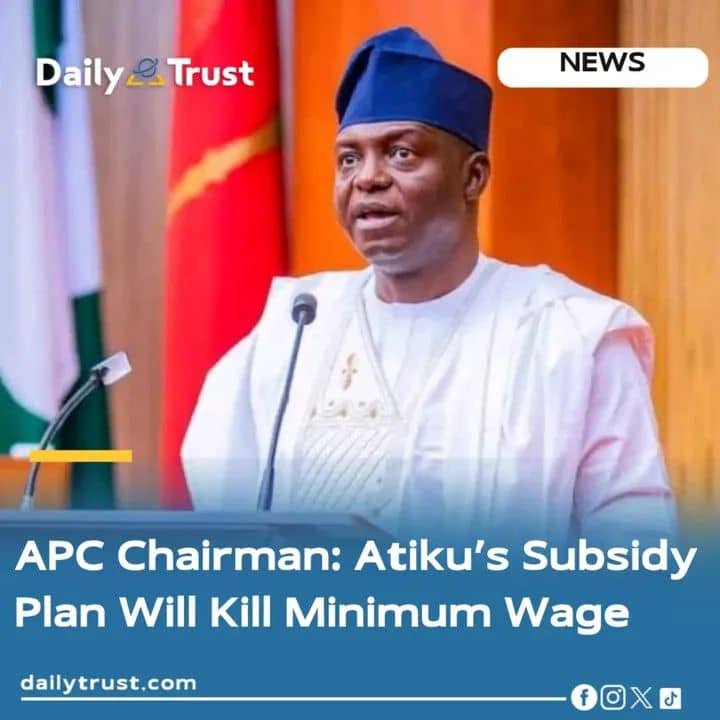
The warning by the National Chairman of the All Progressives Congress, Professor Nentawe Goshwe Yilwatda, that Atiku Abubakar’s proposed return of petrol subsidy could plunge Nigeria back into fiscal difficulties and weaken governments’ ability to sustain the minimum wage deserves serious economic interrogation. Fiscal discipline matters, but an economy cannot be declared successful merely because government finances improve on paper. The real test is whether ordinary citizens can afford food, transport, housing and productive livelihoods.
The figures provide important context. Nigeria’s headline inflation stood at 15.91 per cent in June 2026, while food inflation was 17.52 per cent. The national minimum wage remains ₦70,000. The question is therefore not simply whether government can sustain the wage, but what that wage can actually buy. A worker can receive a higher nominal salary and still become poorer when food, transportation, rent and essential services consume an ever greater share of his income.
This is the fundamental weakness in reducing the debate to subsidy versus fiscal responsibility. An economy exists to serve the people, not the other way around. If fiscal consolidation leaves citizens struggling, businesses under pressure and young people without jobs, government must explain not only what it has saved, but what those savings have delivered. Fiscal prudence is a means to prosperity, not a substitute for it.
To be clear, Atiku is not proposing a return to the old, opaque subsidy regime. His current Atiku Economic Recovery Plan, AERP, proposes a targeted, capped, transparently budgeted and independently audited intervention focused on domestic refining and production, with measurable conditions and an exit mechanism. The objective is to reduce energy costs, strengthen Nigerian refining capacity and shift support from imported fuel towards domestic production.
That distinction matters. Atiku’s proposal can be debated, challenged and scrutinised, but it should not be dismissed simply by invoking the failures associated with the old subsidy system. A properly designed intervention can protect consumers during an economic transition while government simultaneously tackles waste, leakages and structural weaknesses. The relevant question is not whether the word “subsidy” sounds politically uncomfortable, but whether a controlled intervention can produce measurable economic benefits at an acceptable fiscal cost.
Atiku has also made his position unmistakable. In August 2026, he reaffirmed his commitment to restoring a targeted subsidy, arguing that lower energy costs could reduce transportation and production expenses while restoring purchasing power. His position is therefore clear and should be debated on its merits, not caricatured. The burden is on both sides to demonstrate the economic consequences of their preferred approach.
Atiku’s evolution on the issue should equally be acknowledged. He previously supported a phased approach to subsidy removal, including negotiations with labour. His present position represents a policy adjustment in response to the economic consequences of the current policy environment. That change can be scrutinised. But political consistency must be demanded on all sides. In January 2012, then opposition leader Bola Ahmed Tinubu himself criticised an abrupt subsidy removal and argued that government should first address corruption in the petroleum sector and provide adequate alternatives for citizens.
The APC’s fiscal argument should also be tested against its own numbers. Finance Minister Taiwo Oyedele said subsidy removal generated ₦15.8 trillion in resources for the Federation between June 2023 and December 2025, with about ₦5.4 trillion accruing to the Federal Government and ₦10.4 trillion distributed to states and local governments. That is a significant fiscal gain, and the government is entitled to defend it. But it creates the more important question: what measurable improvement has the ordinary Nigerian received from the resources mobilised?
Oyedele has further explained that increased Federal Government expenditure included approximately ₦9.39 trillion for wage adjustments and allowances, ₦9.37 trillion for external debt servicing and ₦6.5 trillion for strategic infrastructure. The issue, therefore, is not that the money simply disappeared. The real issue is whether these expenditures have generated sufficient productivity, infrastructure, purchasing power and economic opportunity to justify the burden citizens have carried since subsidy removal.
That brings us directly to Professor Yilwatda’s minimum-wage argument. The government cannot measure wage sustainability only by its ability to transfer ₦70,000 to workers. Wage sustainability is purchasing-power sustainability. If the worker receives his salary but cannot adequately feed his family, afford transportation or meet basic obligations, then the nominal wage alone cannot be presented as evidence of economic wellbeing. The sustainable answer lies in expanding productive capacity, employment and real incomes.
This is where Atiku’s wider economic programme deserves attention. His approach seeks to expand production, attract investment, strengthen domestic industries, support private enterprise, improve infrastructure, reform institutions and create productive employment. The petroleum component fits into that broader strategy: lower energy costs, encourage domestic refining, improve supply and use targeted intervention as a bridge towards greater production rather than a permanent substitute for it.
Professor Yilwatda and the APC are free to challenge Atiku’s numbers, assumptions and implementation strategy. They should. But if the APC believes his model is fiscally irresponsible, let it demonstrate precisely why and present a superior mechanism for lowering energy and transportation costs without further impoverishing households. The strongest defence of an economic policy is not an attack on its opponent; it is demonstrable success.
The human reality should remain at the centre of the debate. The hungry Nigerian does not experience fiscal consolidation as a spreadsheet. The unemployed graduate does not eat government revenue figures. The farmer experiences policy through the cost of moving produce to market. The worker experiences it through purchasing power. The entrepreneur experiences it through the cost of energy, transport and credit. These are the indicators that determine whether economic reform is working in the lives of citizens.
As Nigeria moves towards the 16 January 2027 presidential election, the APC should therefore spend less energy castigating Atiku’s economic proposals and more energy defending its own record with measurable outcomes. If Atiku is wrong, expose the weakness in his numbers. If his subsidy model is unsustainable, provide a better model. If the APC’s approach is superior, demonstrate that superiority in the lives of Nigerians. Let policy compete with policy, evidence with evidence and performance with performance.
Enough of the rhetoric. Enough of reducing a complex economic question to the word “subsidy”. Nigerians are hungry, businesses are under pressure, young people need jobs and workers need purchasing power. The 2027 debate should not be about who can produce the most elegant explanation for hardship; it should be about who has the more credible plan to end it.
Let the APC defend its record. Let Atiku defend his AERP. Let the numbers be examined. Let the policies compete. And let Nigerians decide which economic vision can give them not merely a healthier government balance sheet, but a healthier economy, greater opportunity and a better life.
Akin Samuel KAYODE.
Member, The Narrative Force.