Aare Amerijoye DOT.B
Every four years Nigerians are asked to gamble on promises. In January 2027 they will not need to gamble. One candidate on that ballot has a record so long, so documented and so independently attested that the only honest question left is why the country waited this long.
Long before the titles, before the Villa, before the party wars, Atiku Abubakar was a mid level Customs officer in Lagos with no godfather, no royal pedigree and no inheritance. What he had was character. And the men who worked beside him in those years have left behind a body of testimony that no propaganda machine can now erase.
A man’s conduct when he holds small power tells you exactly what he will do with great power.
THE OFFICER WHO WOULD NOT TAKE THE MONEY
Consider Peter Okocha, a young businessman trying to break into clearing and forwarding at Apapa. He went to the Customs Area Administrator expecting the ritual every Nigerian knows: the delay, the hint, the envelope. Instead his papers were signed and returned to him. No demand was made.
Okocha’s account, recorded in the biography of Atiku Abubakar, is that the officer was kind, helpful and humane, and that he was struck by the discovery that the man was not corrupt. Atiku went further. He advised Okocha to formalise his operation, obtain a proper Customs licence and incorporate a company. That company became Chrismatel.
That is the whole philosophy in one encounter. Do not merely refuse the bribe. Build the person in front of you into a legitimate enterprise that employs others.
THE ADMINISTRATOR WHO CLEANED THE PORTS
At Apapa in the era of unbridled import fraud, Atiku met a system where containers arrived filled with sand instead of the essential commodities they were licensed for, and where fully paid government cargoes vanished into private hands. Scams of that character were routine and everyone understood that resisting them was a way to lose a job.
He restored order to the ports. He barred idlers and unauthorised operators who had no business inside the zone. He built and furnished a proper office for the Area command instead of accepting the shabby room his predecessors had tolerated. He met and exceeded revenue targets at every post he headed, and his personnel file was filled with commendations for it.
Then came 1984 and the fifty three suitcases. Customs officers on night duty at the Lagos airport refused to allow the luggage of a returning ambassador’s party to bypass screening, and were threatened by armed soldiers for their trouble. When the story broke and the government went hunting for scapegoats, enormous pressure was mounted on Atiku to deny that the incident had ever happened.
He refused to lie. He said plainly that he would rather surrender his uniform than deny an incident his own officers had risked their lives over. Top office holders from his own state leaned on him. He did not move.
He chose his officers over his career, and his conscience over his comfort.
The verdict of history was delivered by the Finance Minister of that regime, Onaolapo Soleye, a man who did not know Atiku personally. Reviewing the facts, he concluded that it would be unfair to punish an officer for standing by his men. No query. No sanction. An impeccable service record left intact. Years later Atiku chaired the wedding reception of Soleye’s son and publicly thanked him for his fairness.
THE OFFICER THE AMERICANS RESPECTED
In the same period Nigeria was becoming a transit corridor for hard drugs moving between South America, South East Asia, Europe and the United States. Atiku and his colleagues built a drug interdiction policy at the Murtala Muhammed International Airport that led to the arrest of hundreds of traffickers and the routine seizure of cocaine, heroin and cannabis.
The United States Drug Enforcement Administration officer in Lagos, John Pope, was so impressed that he arranged for Atiku to attend a two month executive programme on drug enforcement in the United States in 1985, taking him to Washington, Chicago and the southern border interdiction operations. The Nigeria Customs Service would later establish its own dedicated enforcement unit to coordinate anti smuggling work nationally.
Let the point be made without decoration. A foreign drug enforcement agency examined the work of a Nigerian Customs officer at the busiest trafficking corridor in West Africa, and its verdict was to invest in him. That is the record, and it stands on its own.
THE BUILDER WHO CREATED WORK FOR OTHERS
Atiku did not wait for government to make him. In 1981 he took a bank loan and started the Gesse Derdirabe Farm on two thousand five hundred hectares off the Yola to Numan road, growing maize and cotton. He became the largest maize farmer in the whole of Gongola State, producing over ten thousand bags of maize a year for the domestic market. When policy shifts made large scale farming unviable, he restructured rather than collapsed, and he continued to move agricultural equipment and inputs into the country for the use of ordinary farmers.
His greatest commercial insight came from a casual conversation at Apapa with an Italian shipping man, Gabriel Volpi. Reading the collapse in oil prices and the shrinking volume of imports in the early nineteen eighties, Atiku predicted that the maritime traffic everyone was relying on would dry up and that the future of Nigeria lay in oil and gas logistics. He was right. The container services venture that followed grew into one of the most consequential logistics enterprises in the country.
A president who has read a market correctly before will read an economy correctly again.
THE MAN HIS COMMUNITY ALREADY VOTED FOR
The most powerful testimony in the entire record is not about money at all. It is about how he treated people who could do nothing for him.
Across Jada, Ganye, Toungo and Mayo Belwa he assisted individuals with jobs, with money and with material support. He sponsored strangers for medical treatment inside and outside the country. He capitalised small businesses for people who had no collateral. He built and equipped schools and mosques. He honoured invitations to weddings, funerals, naming ceremonies and graduations that more important men ignored.
Crucially, in a region where patronage flowed along ethnic and religious lines, he refused to discriminate. That single choice won him the admiration of countless non Fulani communities and built a political network that no rival could replicate. His own summary of the method was disarmingly simple: he shared what he had with people.
At the Murtala Muhammed Airport he raised the funds to build a mosque so that Muslim staff would no longer pray on makeshift ground. The completion of that mosque encouraged the Christian community to build a church beside it. Two houses of worship, standing together, on ground he helped clear.
WHAT THE PALACE SAW IN 1982
On 19 November 1982, at the age of thirty six, Atiku Abubakar was turbaned Turaki Adamawa by the Lamido, Aliyu Musdafa. Over forty aircraft flew guests into Yola. The airport had never seen such traffic since it was built in 1939.
He had no royal blood. He had no inheritance. What he had was a reputation. The Lamido’s own son, Jamilu, explained that his father simply liked the young man, describing him as humble, respectful and kind. The Lamido told the press that he had conferred the title on a good man. Atiku’s own recollection was that the Lamido saw in him the promise of the future.
That was forty four years ago. Adamawa saw it. Gongola saw it. The Customs Service saw it. The Americans saw it. Nigeria’s own political class has spent four decades pretending not to see it.
The years since have been argued over at length, and they will be argued over again between now and January. Nothing in this article asks anyone to set that debate aside. The argument here is narrower and, for that reason, harder to dismiss. Before there was a national platform to win, before there was a single vote at stake, this is how the man conducted himself. Those years were not performed for an electorate. They are the closest thing Nigeria has to evidence gathered before the trial began.
THE NETWORK THAT WAS NEVER BUILT FOR AN ELECTION
Now consider what all of that means in the arithmetic of January.
The northern vote is the largest single bloc in this election, and Atiku Abubakar is the only presidential candidate contesting it who is of the North. That fact alone is significant. What makes it decisive is the second fact, which is that his standing there was not manufactured in a campaign office.
Reread the record above. Jada. Ganye. Toungo. Mayo Belwa. Adamawa and Taraba. Individuals put through school. Strangers sponsored for treatment. Traders capitalised with no collateral. Weddings attended, funerals attended, graduations attended, over four decades, in communities that had nothing to offer in return. That is not a support base. That is a debt of gratitude spread across two generations, and it has never once been fully mobilised on his behalf.
Structures can be bought in a season. Goodwill of this kind cannot be bought at all.
The battleground map for January runs through Adamawa, Bauchi, Sokoto, Kano, Kaduna, Katsina, Zamfara, Gombe, Yobe, Kebbi, Plateau, Benue and Rivers, and beyond them across the full spread of thirty six states and the Federal Capital Territory that the Constitution requires. In 2023 that northern arithmetic was fractured, and it was fractured substantially from within. Governors who ought to have delivered their states worked instead against the ticket they had been elected under.
That particular betrayal cannot be repeated in the same form in 2027, because the coalition has been rebuilt around a different centre of gravity and the men who did it are no longer positioned to do it again. The candidate is the same. The arithmetic underneath him is not.
THE ANSWER TO THE RELIGION QUESTION
Every northern candidacy in modern Nigeria is attacked on the same ground. The charge is that a northern Muslim president will govern for a section rather than for a country. It is the most reliable weapon in the arsenal of his opponents and it will be deployed again between now and January.
The answer is not a press release. The answer is a mosque and a church standing beside each other at the Murtala Muhammed Airport, built because one man raised funds so that his Muslim staff would not have to pray on bare ground, and because the completion of that building encouraged his Christian colleagues to raise their own.
The answer is a Fulani man in Adamawa who, in an era when patronage moved strictly along ethnic and religious lines, deliberately refused to move it that way, and who won the loyalty of non Fulani communities precisely because he would not discriminate between them.
He solved Nigeria’s hardest question in one airport compound in the nineteen eighties, and he solved it by building rather than by speaking.
Let those who intend to run the religion campaign in 2027 explain that record away. They will find it difficult, because it was laid down forty years before there was any political advantage in laying it down.
WHAT THE COUNTRY ACTUALLY GETS
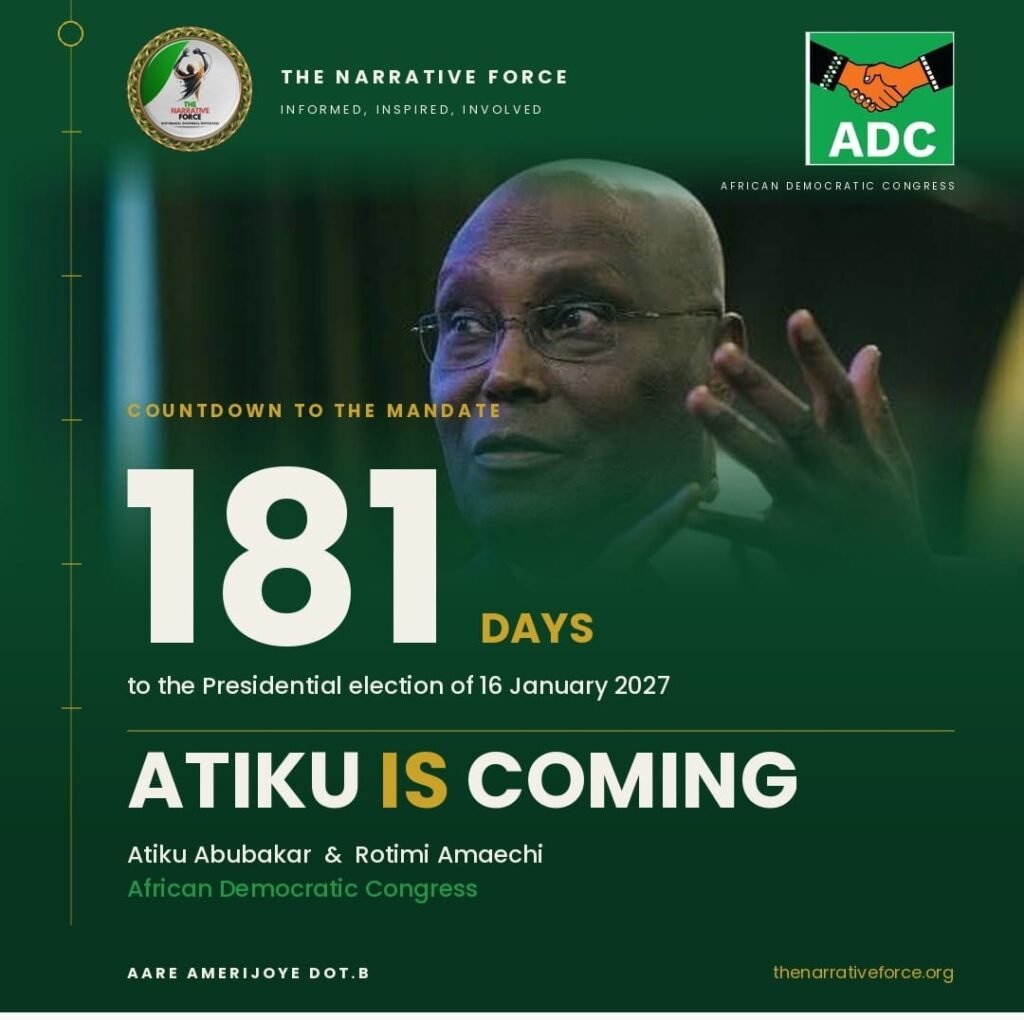
The African Democratic Congress goes into 16 January 2027 with Atiku Abubakar of Adamawa and Rotimi Amaechi of Rivers. North and South. Muslim and Christian. A ticket that answers the sectional question in its own composition before a word is spoken.
What the country gets from it is not a promise. It is a demonstrated method.
On the economy, a man who read the collapse of the import trade before the economists did, who backed his own judgement with his own capital, and who built enterprises that outlived the conditions that created them. Nigeria does not presently need a president who can theorise about the private sector. It needs one who has met a payroll.
On corruption, a man whose file at the Customs Service carried commendations rather than queries, who exceeded revenue targets at every post he held, and who is on record turning away money he could have taken with no consequence whatsoever. A country losing trillions to opacity is entitled to prefer a man with that history to a government that cannot account for what it has spent.
On security, a man who built an interdiction regime that arrested hundreds of traffickers, and who did it by organising officers, protecting them when they were threatened, and giving them cause to believe their command would stand behind them. That is precisely the failure at the heart of the present crisis. Nigerian security personnel are dying in conditions of institutional abandonment. Atiku Abubakar has already demonstrated, under a military government, that he will take the professional risk of standing with his own people.
On national cohesion, the record set out above, which requires no elaboration.
THE CHOICE IN JANUARY
Nigerians have been asked before to believe in a man on the strength of what he said he would do. That method has now been tested to destruction, and the country is living in the results.
This time the evidence came first. It was gathered over four decades, in ports and farms and palaces and airport terminals, by witnesses who had no stake in a 2027 election because no such election existed when they gave their accounts. A businessman whose papers were signed for nothing. A finance minister who found no query in the file. An American officer who chose to invest in him. A Lamido who conferred a title on a man with no royal blood. Communities across two states who were fed, schooled and treated long before anyone needed their votes.
On 16 January 2027 the choice is not between two sets of promises. It is between a record and a rumour.
He refused to deny what happened with those suitcases. The papers were signed without a bribe. The mosque and the church were built side by side.
That is the man. That is the ticket. That is the mandate.
Aare Amerijoye DOT.B
Director General, The Narrative Force
thenarrativeforce.org
20 July 2026