Aare Amerijoye DOT.B
There are elections that are contested, and there are elections that are concluded long before a single ballot is cast. Nigeria’s 2027 presidential election belongs to the second category. The verdict is being written right now, in the bus parks, the market stalls, the lecture halls and the farmsteads of a wounded nation. The only question left is who will harvest it. The answer is Atiku Abubakar.
THE ARITHMETIC OF ANGER
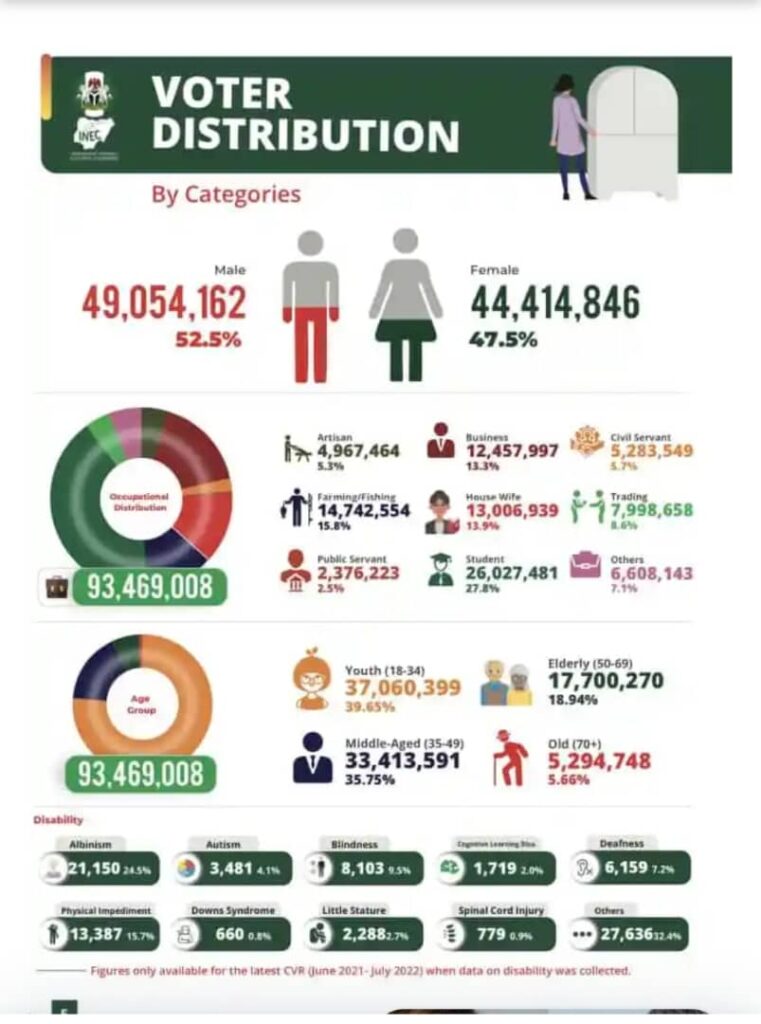
In 2023, the Independent National Electoral Commission unveiled the single most explosive document in Nigeria’s political life: a register of more than ninety three million voters, precisely ninety three million, four hundred and sixty nine thousand and eight souls. By 2027 that register will swell further still. Do not mistake it for a spreadsheet. It is a seismograph. It is a map of fury, frustration and ferocious expectation, and every line of it trembles against the incumbent.
Of that number, eighty seven million, two hundred and nine thousand and seven Permanent Voter Cards were collected before the last presidential election, leaving just over six million uncollected. Lagos led the charge with more than six million, two hundred thousand cards collected, Kano followed with nearly five million, six hundred thousand, and Kaduna with over four million, one hundred thousand. These are not statistics. These are armies in waiting. These are millions of hands that reached out for the instrument of their own liberation and are now waiting for a reason to use it.
THE SILENCE THAT WILL BECOME A ROAR
And yet, on the twenty fifth of February 2023, only about twenty four million Nigerians voted. Less than twenty seven in every hundred registered voters showed up, one of the most dismal turnouts in our democratic history. Nearly seventy million Nigerians stayed home.
Read that again. Seventy million.
That silence was not apathy. It was a verdict withheld. It was disillusionment, exhaustion and a bitter conviction that the system had nothing left to offer. Tinubu did not win the hearts of Nigeria in 2023. He merely profited from her despair. He squeezed through the narrowest of openings while the giant slept.
In 2027 the giant will not sleep, because for four brutal years this government has been shaking it awake. Every fuel queue is an alarm bell. Every empty pot is a campaign poster. Every jobless graduate is a mobiliser the opposition never had to recruit.
Seventy million Nigerians stayed silent in 2023. Tinubu’s government has spent four years giving every one of them a reason to speak.
This is why a comprehensive nationwide voter sensitisation crusade is not optional for Atiku Abubakar, the people’s candidate. It is the spearhead of victory. Deploying the most gifted communicators in the land, the campaign must speak to Nigerians in their own tongues and their own pain, and say plainly: your silence at the ballot box is a signature on your own suffering. Abstention is complicity. Every uncollected card is a surrendered weapon. Every unused vote is a vote for four more years of hunger.
THE COALITION OF THE WOUNDED
Look closely at who these voters are, and you will see why the incumbent cannot survive them.
Youths between eighteen and thirty four dominate the register, more than thirty seven million strong, nearly forty per cent of the entire electorate. The middle aged, thirty five to forty nine, add another thirty three million plus. Students alone number more than twenty six million, over a quarter of all voters. This is a generation that has watched its dreams devalued faster than the naira. They are not undecided. They are unappeased.
The artisans, nearly five million of them, watch their workshops die in instalments under crushing energy costs. The traders, almost eight million, count their losses in a currency that buys less every market day. The farmers and fishermen, more than fourteen million, till and trawl under the shadow of bandits and the burden of broken roads. Together they are the spine of the informal economy, and that spine has been bent double by an administration that taxes everything and protects nothing.
The housewives, thirteen million of them, fight a daily war against food prices no salary can chase. The students drift between strikes, galloping fees and a future mortgaged to incompetence. More than five million civil servants and over two million public servants, who once dreamt of retiring with dignity, now serve as hostages to delayed salaries and shrinking pensions. Even the eighty five thousand Nigerians living with disabilities who registered in the last continuous registration exercise have been repaid with exclusion and abandonment.
Add them together. This is not a demographic. This is a coalition of the wounded, and it is the largest political force ever assembled on Nigerian soil. No incumbent in our history has faced a front this broad, this bitter and this awake.
LAGOS, KANO, KADUNA: THE TRIPOD OF REVOLT
Lagos, Kano and Kaduna are not mere administrative units. They are the three legs of the coming upheaval.
Lagos, with its six million plus collected cards, is a city state suffocating in traffic, insecurity and an economy engineered for a tiny elite. Kano, with five and a half million cards, and Kaduna, with more than four million, were once the beating commercial and intellectual hearts of the North. Today they groan under insecurity, joblessness and ethno religious tension.
Each region nurses its own affliction, but all of them share one common denominator: an aloof, incompetent and self congratulating administration in Abuja. And history teaches one lesson without exception. When pain becomes universal, revolt becomes inevitable. The ballot box is simply revolt by lawful means.
THE PARTY MACHINES CANNOT SAVE HIM
Here is the calculation the ruling party dares not perform in public. Grant every political party five hundred committed members in each of the country’s eight thousand and ninety wards. That yields roughly four million, four hundred thousand loyalists per party. Multiply it across four major parties and you still command barely eighteen million partisans, against more than seventy two million unaffiliated, disillusioned and furious voters.
The machines do not decide 2027. The masses do. The structures the ruling party boasts of are sandcastles standing before a tide. Elections are not won by party faithful chanting in stadiums. They are won by the woman in the market who cannot remember the last time meat entered her soup, and by the young man whose certificate has become a souvenir of wasted years.
The party structures command eighteen million. The angry and unattached command seventy two million. That is not a contest. That is a countdown.
WHY ATIKU WINS
To my mind, in the eyes of Nigeria’s poor masses, the problem of this country has never truly been where the president comes from or which region produces him. The crisis is the character of the occupant: managerial deficiency, avarice, megalomania, bigotry, a violent instinct and sheer inexperience in the art of governing a complex federation. These words are not mine alone. They echo what Nigerians mutter in bus parks, market stalls and village squares from Sokoto to Calabar.
And it is precisely on this ground that Atiku Abubakar stands unassailable.
He is not merely a candidate. He is a mission and a movement. He is the stabilising answer to a destabilised country: tested experience against trial and error, economic pragmatism against economic improvisation, humility against arrogance, a builder of enterprise and employer of thousands against a wrecker of livelihoods. He has managed men, money and institutions at the highest level, and he arrives with a formidable corps of technocrats ready to dismantle, brick by brick, the architecture of confusion that this government calls policy.
From the hungry artisan in Aba to the embattled trader in Ibadan, from the stranded student in Zaria to the heartbroken housewife in Uyo, Atiku is the rallying point this moment has been waiting for. He is the voice that articulates their anger and the hand that holds the blueprint of their redemption. The alternative Nigerians seek is not another costume change by the same deceivers. It is the man who knows the road, has walked the road, and is ready to march a nation down it.
THE HARVEST IS READY
The 2027 presidential election will be a referendum on hunger, on insecurity, on competence and on compassion. On every single count, the incumbent stands condemned by his own record, and the verdict has already formed in seventy million silent hearts. The task before us is not persuasion. The masses persuaded themselves long ago, at the fuel pump and the food market. The task is mobilisation. Wake the sleeping seventy million, and the result announces itself.
So let the campaign begin, not with slogans but with solutions, not with fanfare but with focus, not with noise but with a nation’s accumulated fury finally given direction. The anger of the masses is ripe on the stalk. The harvest of 2027 is ready, and the reaper is already in the field.
His name is Atiku Abubakar. And by the grace of God and the will of a wounded people, he wins.
Aare Amerijoye DOT.B
Director General
The Narrative Force
thenarrativeforce.org
10 June 2026