How Atiku Built Nigeria’s Greatest Economy — and What Tinubu Has Done to It Since
Aare Amerijoye DOT.B,
There is a moment in every national conversation when the noise must stop and the numbers must speak. Nigeria has reached that moment. Not because politicians have demanded it. Not because the media has decreed it. But because the gap between what Nigerians are living and what they are being told has grown so wide, so deep, so unconscionable, that silence itself has become a form of treason.
So let the numbers speak.
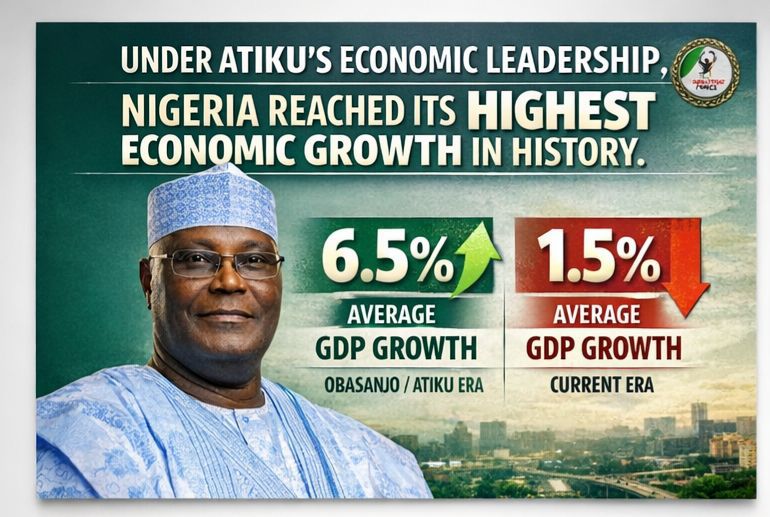
Between 1999 and 2007, under the economic stewardship of Vice President Atiku Abubakar, Nigeria recorded an average GDP growth rate of 6.5 per cent per annum. Six point five per cent. The highest sustained average in the entire history of this republic. In that same period, Nigeria’s GDP exploded from approximately 58 billion dollars to 270 billion dollars. Every sector touched. Every Nigerian, in some measure, lifted. Those are not campaign promises. Those are World Bank figures. That is the incontrovertible arithmetic of governance done right.
Nigeria’s GDP exploded from $58 billion to $270 billion. That is not rhetoric. That is the record.
Now compare. Under the administration currently strangling this country, average GDP growth has collapsed to 1.5 per cent (National Bureau of Statistics, 2023 to 2025). One point five per cent. In a nation of 220 million souls. In a continent bursting with possibility. In an era of unprecedented global digital opportunity. One point five per cent. That number does not merely indict a government. It indicts a governing philosophy. It indicts the reckless, ideologically bankrupt experiment being conducted daily on the bodies and bank accounts of ordinary Nigerians who never volunteered to be anybody’s laboratory subjects.
The naira, which Nigerians once carried with dignity, has been flogged into near-worthlessness. A bag of rice that cost four thousand naira now demands seventy thousand. Petrol burns a fresh hole in every pocket every single day. Hospitals are emptying not because Nigerians are healthy but because they can no longer afford the prescriptions. Schools are bleeding teachers not because knowledge has run dry but because the political will to reward it has completely evaporated. This is not reform. This is organised suffering dressed in the language of policy.
And yet that carnage is not even the full story.
Nigeria’s highest growth rate in history. Atiku’s watch. It has never been touched since.
Fifteen point three per cent. The highest single-year economic growth rate ever recorded in Nigeria’s history. Achieved not by accident but by deliberate, visionary, evidence-driven leadership. Atiku liberalised the telecommunications sector and ignited a revolution that put mobile phones in the hands of the poorest market woman in Kano and the most remote farmer in Borno. He attracted foreign direct investment at a time when Nigeria was still shaking off the chains of military dictatorship. He reformed the customs service, rationalised bloated institutions, and proved beyond argument that economic management was too consequential a matter to be surrendered to ethnic calculation or partisan loyalty.
The result was fifteen point three per cent. History-making. Unrepeated. Unmatched. And today, the inheritors of power who promised Nigerians renewal and renaissance have delivered one point five per cent — then had the audacity to appear on national television and demand gratitude for it.
Enough.
The 2027 election is not a contest between parties. It is not a rivalry between regions or religions. It is a referendum on competence. A reckoning between an era that produced Nigeria’s greatest economic growth in recorded history and an administration that has delivered its most punishing contraction in living memory. Between a Vice President who grew this economy at 6.5 per cent and a President who has shrunk it to 1.5 per cent. Between the builder and the wrecker. Between the record and the ruin.
You cannot mortgage a nation’s future and call it reform. You cannot impoverish a people and call it policy.
The Narrative Force does not ask Nigerians to vote on sentiment alone. We ask you to vote on the evidence. We ask you to hold these numbers up to the light, press them against your own lived experience, and ask one simple question: which direction must this country travel?
The numbers have already answered.
The question is whether Nigeria will listen.
Aare Amerijoye DOT.B
Director General ,
The Narrative Force (thenarrativeforce.org),