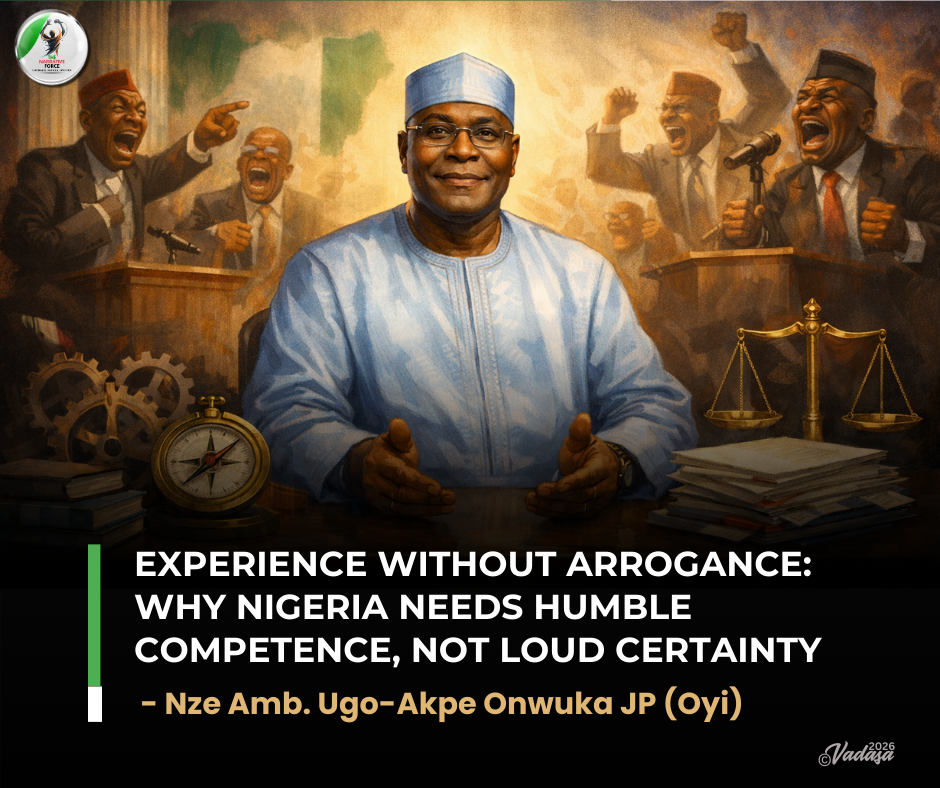
– Nze Amb. Ugo-Akpe Onwuka JP (Oyi)
Nigeria’s leadership problem is often misunderstood. It is not simply a shortage of ideas or energy. It is a crisis of temperament. Too often, authority is exercised with bravado rather than balance, certainty rather than reflection, and volume rather than vision.
In a complex and fragile federation, this style has proven costly. What Nigeria needs now is not loud certainty. It needs humble competence. Humble competence is the kind of leadership that understands the limits of power, listens before acting, and learns even while leading. It is confidence without contempt, experience without arrogance. This quality is rare in politics, yet it is exactly what moments of national strain demand.
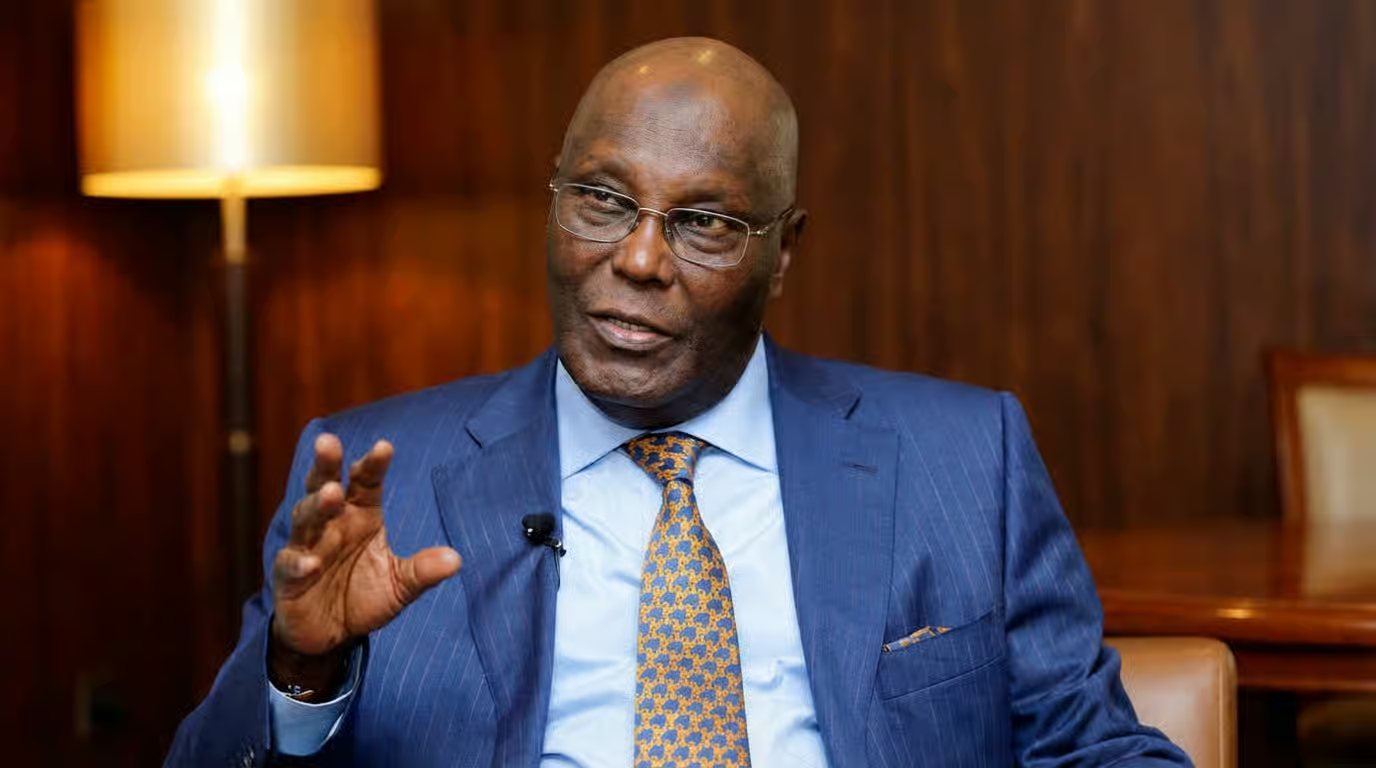
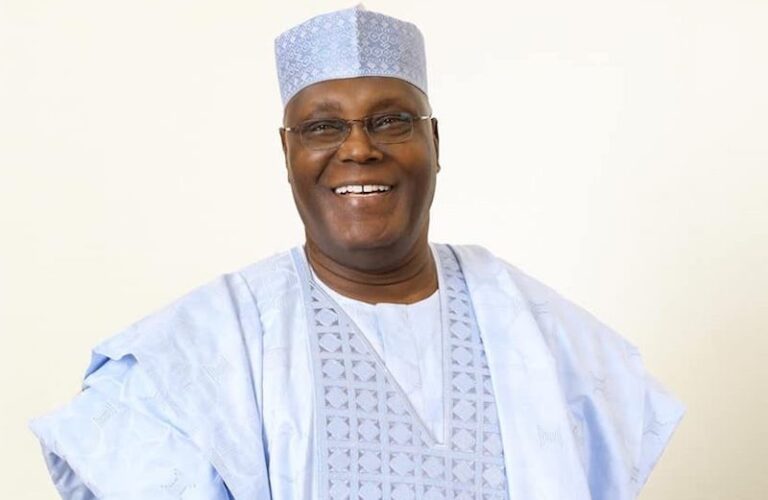
Atiku Abubakar GCON embodies this disposition.
His long public life has exposed him to victory and defeat, praise and criticism, influence and restraint. These experiences have shaped a leader who understands that governance is not about dominating opponents, but about managing complexity. Having seen how easily power can overreach, Atiku approaches leadership with caution, consultation, and respect for process.
This posture matters in Nigeria’s current climate. Economic hardship has sharpened public anger. Insecurity has heightened fear. Social divisions have deepened mistrust. Leaders who respond to these pressures with forceful certainty often inflame rather than calm. By contrast, leadership that acknowledges limits, explains choices, and corrects mistakes builds credibility.
Atiku’s record reflects this understanding. His advocacy for restructuring, economic liberalization, and institutional strengthening has been consistent, yet open to dialogue and adaptation. He does not present policy as personal decree, but as national conversation. This willingness to engage rather than impose is a mark of humility, not weakness.
During his time as Vice President, Atiku operated within a system still recovering from military authoritarianism. The temptation to centralize power and bypass institutions was strong. Resisting that temptation required restraint and respect for democratic norms. Those instincts remain relevant today, as Nigeria confronts the dangers of executive overreach and institutional erosion.
The African Democratic Congress, ADC, provides a platform that reinforces this leadership style. Coalition politics demands humility. It requires listening, compromise, and shared ownership of decisions. It does not reward arrogance or unilateralism. Atiku’s comfort within such a framework reflects his understanding that Nigeria’s rescue will be collective, not personal.Humble competence also has economic implications. Markets respond not to bluster, but to predictability and trust. Investors seek leaders who respect contracts, consult stakeholders, and admit errors. Atiku’s pro-market philosophy is grounded in this realism. Growth is not commanded, it is cultivated.Nigeria has suffered from leadership that mistakes noise for strength. The results are visible in policy reversals, institutional confusion, and public cynicism. Reversing this trend requires a different kind of authority, one that is calm, measured, and informed by experience.
Atiku Abubakar offers that alternative.He is not the loudest voice in the room. He does not claim infallibility. Instead, he presents leadership as responsibility, not performance. In a nation weary of excess confidence and exhausted by improvisation, this approach is refreshing.Nigeria’s future depends on leaders who can combine knowledge with humility, conviction with openness, and experience with learning. Humble competence may not thrill crowds, but it builds nations.In this defining moment, Atiku Abubakar represents the kind of leadership Nigeria urgently needs.- Nze Amb. Ugo-Akpe Onwuka JP (Oyi)