By Kunle Oshobi
The debate over Atiku Abubakar’s proposal to restore a targeted petrol subsidy has, in the last few weeks, been reduced by his critics to a single, simplistic question: is he for or against subsidy? That framing misses the point entirely, and it misses the deeper economic philosophy that the proposal is actually built on.
Atiku’s position on fuel is not a stand-alone policy. It is one application of a broader conviction that has run through his economic thinking for years: that the fastest, most sustainable way to grow the Nigerian economy is to bring down the cost of doing business, not to squeeze more revenue out of citizens and businesses who are already struggling to stay afloat.
One Philosophy, Many Fronts
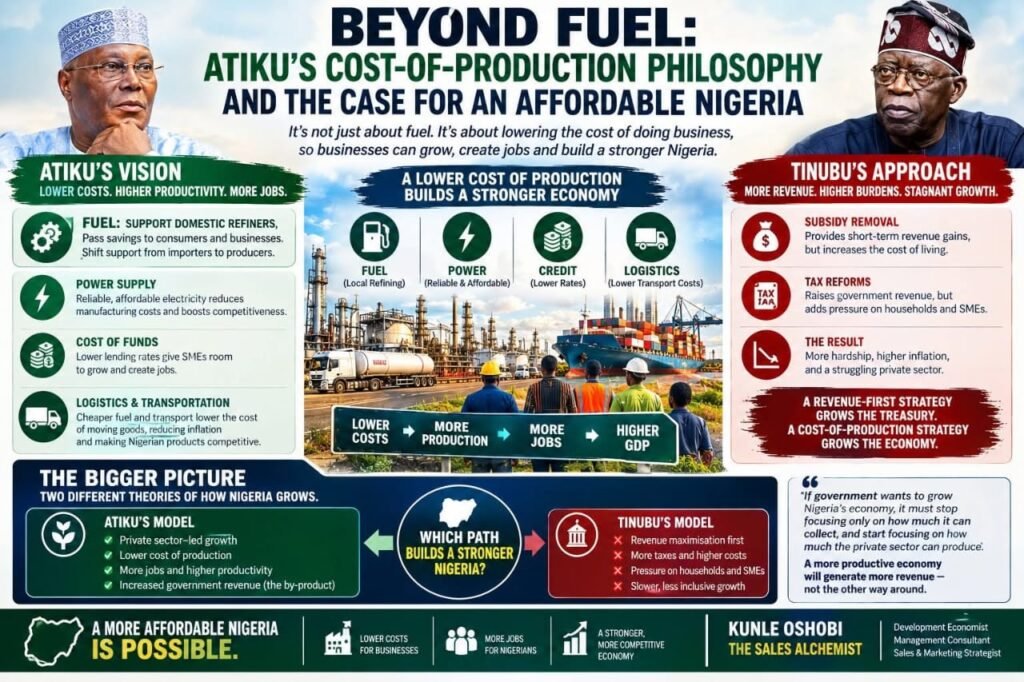
Look past the fuel pump and the pattern becomes clear. Atiku’s proposed intervention on petrol is explicitly structured around production rather than consumption, shifting support from fuel importers to domestic refiners, on the condition that the savings are passed directly to consumers and businesses. But the same logic extends well beyond fuel:
Power supply: unreliable and expensive electricity forces manufacturers to run on diesel generators, adding a cost burden that gets passed straight into the price of everything they produce. Fixing this is treated not as a welfare issue but as an industrial competitiveness issue.
Cost of funds: with lending rates that have made borrowing prohibitively expensive for small and medium enterprises, access to affordable credit is treated as a precondition for productivity growth, not an afterthought.
Logistics and transportation: the cost of moving goods from farm to market, or from factory to shelf, feeds directly into the price of food and consumer goods. Bringing down fuel and transport costs is, in this light, as much an anti-inflation tool as it is a subsidy question.
Taken together, these are not isolated giveaways. They form a single, coherent argument: government’s primary economic job is to lower the cost of producing and moving goods and services, because that is what ultimately determines whether businesses can grow, hire, and compete.
Growing the Pie, Not Just Slicing It Differently
This is where the contrast with the current administration’s approach becomes sharp. The Tinubu government’s economic strategy since 2023 has leaned heavily on removing subsidies and reforming the tax system to raise government revenue quickly, a strategy that has indeed swelled federation account receipts, but has done so largely by transferring cost burdens directly onto households and small businesses already squeezed by inflation and a depreciating currency.
Atiku’s camp has pointed to what it sees as a glaring inconsistency in that approach: a government willing to extend tax credits, concessions and de-risking incentives to attract billions of dollars in oil-sector investment, while treating any comparable relief for ordinary households and struggling businesses as fiscally irresponsible. If de-risking investment is sound economics, the argument goes, de-risking survival, and by extension, de-risking production, should be too.
The philosophical difference, then, is not simply about whether subsidies are good or bad in the abstract. It is about where government believes growth comes from. One approach treats government revenue as the starting point, to be maximised first, on the assumption that a stronger treasury will eventually translate into a stronger economy. The other treats a productive, cost-competitive private sector as the starting point, the view being that when businesses can produce and move goods more cheaply, they expand, formalise, hire more people, and generate more taxable economic activity. Government revenue, on this view, is not the engine of growth; it is the eventual by-product of it.
Why This Matters Beyond the Pump
Critics are right to demand rigour on implementation, and to their credit, Atiku’s team has tried to answer this by proposing a capped, transparently audited, production-side intervention rather than a return to the opaque importation subsidy of the past, with built-in exit conditions tied to measurable outcomes rather than an arbitrary calendar date.
But the implementation details, however important, should not obscure the larger strategic bet being made here: that Nigeria’s growth problem is fundamentally a cost-of-production problem, and that solving it, on fuel, power, credit, and logistics simultaneously, will do more to expand the economy, and ultimately government revenue itself, than any amount of additional taxation on a private sector that is already struggling to stay solvent.
That is the debate voters should be having heading into 2027, not simply “subsidy or no subsidy,” but which theory of how Nigeria actually grows they find more convincing.
Kunle Oshobi is the Head of Strategy and Planning, and Chairman, Narrative Command of The Narrative Force.