Aare Amerijoye DOT.B
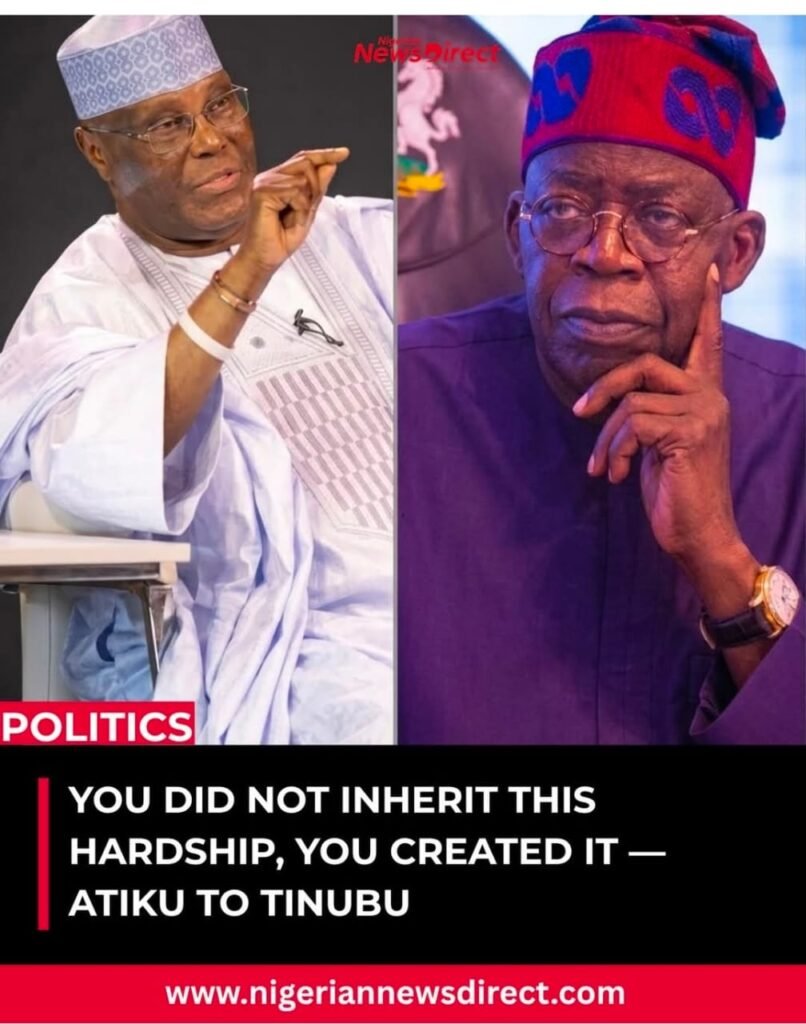
There is a species of Nigerian commentator who has made a career out of one sentence. Atiku sold Nigeria. That is the whole library. That is the entire scholarship. Strip away the adjectives, the borrowed indignation and the manufactured grief, and what remains is a single recycled sentence carried from column to column, from platform to platform, from one paid handle to the next, by men who have never in their lives opened a single privatisation file.
They do not argue. They incant. And they incant loudest whenever the ADC candidate opens his mouth to describe what has been done to the Nigerian economy, because the one thing they cannot survive is a conversation about the present.
So let this be said plainly, and let it be said once, in a form that any Nigerian can carry into any argument on any street or any timeline in this country.
They are not defending Nigeria. They are hiding behind her.
THE ACCUSATION THEY CANNOT SPELL
Ask the loudest of them a simple question. Name the company. Name the date. Name the transaction. Name the price paid, the reserve price set, the competing bidders, the file number, the gazette. Name the enterprise that passed from the Federal Republic of Nigeria into the personal hands of Atiku Abubakar.
They cannot. Not one of them. In more than twenty years of this accusation, across two decades in which the men who hate him have held the security services, the anti graft agencies, the courts, the treasury and the entire coercive apparatus of the Nigerian state, not one of them has produced that name.
What they produce instead is atmosphere. A tone. A knowing sneer. The suggestion that everybody knows, delivered by people who know nothing, to an audience they hope will not check.
An accusation that has been in the mouths of hostile governments for twenty years, and has never once become a charge sheet, is not a scandal. It is a slogan.
WHAT PRIVATISATION ACTUALLY WAS, AND WHO ACTUALLY BEGAN IT
Privatisation in Nigeria did not begin with Atiku Abubakar. It did not begin with the PDP. It did not begin in 1999. It began under military rule with Decree 25 of 1988, and the law that governed the second phase, Decree 28 of 1999, was enacted by the military before a single vote was cast in the Fourth Republic.
By the time civilian government returned in 1999, the inheritance was not an industrial estate. It was a mortuary. Enterprises that had swallowed billions and delivered neither service nor dividend. A national telephone monopoly that could not give a country of more than 100 million people even half a million working lines. Ports that ate cargo. A steel complex that had never rolled commercial steel after decades of funding.
The reform that followed was not a jumble sale. It was a statutory process with a legal spine, and the propagandists cannot describe any part of it because they have never looked.
Privatisation is not one act. It includes public offers, private placements, concessions, management contracts, deferred offers, guided liquidation and outright asset sales. The professional pamphleteer knows only the last of these, which is why he uses the word sold for every transaction, in the way a man who owns only one tool calls every problem a nail.
You cannot indict a process you cannot describe.
THE OFFICE HE ACTUALLY HELD, AND WHY THEY NEVER MENTION IT
Here is the part they run from, because it is law and not opinion.
Under the 1999 Constitution, section 153(1) and the Third Schedule, the National Economic Council is chaired by the Vice President of the Federal Republic. Under the Public Enterprises (Privatisation and Commercialisation) Act 1999, the National Council on Privatisation is chaired by the Vice President, and the Bureau of Public Enterprises was constituted as the secretariat answering to that Council.
So Atiku Abubakar did not seize the privatisation process. He was placed at its head by the Constitution and by an Act of the National Assembly, in the full glare of the Nigerian public, and he presided over it through a Council of ministers and technocrats with a Bureau reporting to it, under rules published in advance and a policy inherited from the military.
That is the man they call names. A Vice President discharging a duty the law itself assigned to his office, through a body whose membership and decisions sat on the public record.
And in February 2025, at a condolence visit for Chief Edwin Clark, with Atiku present in the room, Nasir el-Rufai said publicly that nobody gives Atiku credit for economic policymaking under that administration, and that much of what they did was done under his leadership. That is not our claim. That is the man who ran the Bureau himself, saying it with his own mouth, and saying it while he was still a member of the All Progressives Congress, from inside the tent that manufactures this lie. He left the APC for the Social Democratic Party weeks later, and came to the African Democratic Congress after that. The testimony was given from the other side of the aisle, before any alliance existed to explain it away.
The propagandists never quote him on that. They quote him on nothing at all, because they have not read him either.
THE FIVE FILES: WHAT ACTUALLY HAPPENED TO THE COMPANIES THEY WEEP OVER
Every few weeks the same funeral procession is paraded through the Nigerian internet, and every corpse in it is laid at one man’s door. Let us open the files, one after the other, since they never will.
FILE ONE. NEVER PASSED INTO PRIVATE HANDS, AND STILL FEDERAL PROPERTY TODAY.
Ajaokuta Steel never left the Federal Government. It was concessioned in 2003 to Solgas, terminated in 2004 for non performance, then concessioned in 2004 to Global Infrastructure Nigeria Limited, and in May 2007 that concession was converted into a share purchase agreement. The Yar’Adua government terminated the contracts in 2008 for alleged breach, and after years of arbitration both Ajaokuta and the National Iron Ore Mining Company reverted to the Federal Government of Nigeria. Nothing stood. The plant has sat in government hands for the better part of two decades since Atiku left office, and it still rolls no steel.
No Nigerian refinery ever passed into private hands. Stakes in Port Harcourt and Kaduna were sold to the Bluestar consortium in May 2007, and the Yar’Adua government annulled both transactions and refunded the money. Warri was not part of that transaction at all. All four refineries went back to the Federal Government, stayed with the Federal Government, and the country went on importing petrol while they stood cold.
The NNPC was never privatised. The Nigerian Railway Corporation was never sold. The Nigerian Security Printing and Minting Company was never sold. The seaports were never sold: terminals were leased under concession while the Nigeria Ports Authority retained ownership of every wharf.
And NEPA, the grievance dearest of all to them, was not privatised by Atiku Abubakar. The successor companies of the Power Holding Company of Nigeria were handed over to buyers in November 2013, six years after he had left office, by an administration he was not part of.
NITEL, the corpse they carry most often, was never finally disposed of by him either. The management contract with Pentascope was cancelled in 2005. The sale to Transcorp was revoked in 2009. The company was finally sold to NATCOM in 2014, two administrations after he left office, and what the buyer received by then was a shell.
FILE TWO. ALREADY COLLAPSED BEFORE HE EVER SAT IN THAT CHAIR.
Nigeria Airways was not sold to anybody. It was insolvent, grounded, overstaffed and drowning in debt years before 1999, and it was finally wound up in 2003 as a carcass, not auctioned as an asset.
The vehicle assembly plants they mourn, Volkswagen of Nigeria, Leyland, Steyr, ANAMMCO, belong to the wreckage of the 1970s and 1980s, when oil money made importing easier than manufacturing. Where residual federal shares in them were divested later, what the buyer received was a plant that had stopped producing long before. That collapse is older than most of the people now shouting about it.
FILE THREE. NEVER NIGERIAN GOVERNMENT PROPERTY IN THE FIRST PLACE.
Michelin, Dunlop, Exide, ISO Glass. Not one of them was a federal enterprise. Not one of them could be privatised, because Nigeria never owned them. They were private companies that ended operations here, over the cost of producing in an economy where a factory must generate its own electricity, and the last of them long after 2007. To list them in a privatisation charge sheet is not bias. It is illiteracy.
FILE FOUR. ACTUALLY PRIVATISED, AND EARNING FOR NIGERIA TODAY.
This is the file they hope you never open.
Eleme Petrochemicals, now Indorama, one of the largest fertiliser producers on the African continent and a foreign exchange earner. NAFCON, now Notore. The cement sector, six enterprises of which sit on the Bureau’s own privatisation list, in a country that has gone from importing cement to exporting it. The oil marketers, Unipetrol, National Oil and African Petroleum, alive today as Oando, Conoil and Ardova. Savannah Sugar. Nigerdock. Peugeot Automobile Nigeria, privatised in 2006 and still assembling vehicles in Kaduna. The residual federal holdings in the banks. The port terminals, whose cargo throughput and turnaround times transformed after concession.
And running alongside the programme, the liberalisation of telecommunications. The sector reform that made it possible was driven through the same National Council on Privatisation that Atiku Abubakar chaired, with the Bureau reporting to that Council as the engine room, and the Bureau lists telecommunications reform among its own achievements to this day. The licensing itself was run by the Commission, as it should have been. But the decision to break a dead state monopoly, to open the sector to competition and to let Nigerians choose their own carrier was taken at that Council table, by the man who sat at its head.
The result is the single largest change in the daily life of ordinary Nigerians in fifty years. A country of fewer than half a million landlines became one of the fastest growing mobile markets on earth. The trader, the farmer, the artisan, the student, the okada rider and the market woman all got a telephone, and an entire digital economy was built on top of it.
Every Nigerian holding a phone today is holding the dividend of a reform Atiku Abubakar presided over. The men abusing him on that same phone, over that same network, are using his handiwork to call him a thief. Let them explain that one.
FILE FIVE. GENUINELY CONTESTED, AND NAMED HERE WITHOUT FLINCHING.
ALSCON. Delta Steel. Daily Times. NICON. The paper mills. Every one of them passed through the Bureau, through advertised bids, through technical and financial evaluation. Every dispute since has been fought in the courts, in international arbitration and before Senate committees, in the open, for years.
And after all of it, after four administrations, after probes and panels and hearings, not one charge has ever been laid against Atiku Abubakar over any of them.
A man cannot be charged with selling what was never sold, nor with killing what was already dead.
THE SCORECARD THEY WILL NEVER SHOW YOU
Now to the number, and it does not come from us.
In 2018, receiving the House of Representatives Committee on Privatisation, the Director General of the Bureau of Public Enterprises, Alex Okoh, gave the Bureau’s own assessment. Of the privatised enterprises the Bureau had monitored, 63 per cent were performing and 37 per cent were not. And the reason he gave for the underperformers was not fraud in the sale but the challenging operating business environment in Nigeria, in which businesses have closed down or relocated to neighbouring countries.
Read that again slowly, because of who said it and when. That is the Federal Government’s own privatisation agency, speaking under an APC administration, eleven years after Atiku Abubakar left office, scoring its own programme at 63 per cent and laying the failures at the door of the Nigerian business environment rather than the transactions.
The Bureau’s portfolio at that point ran to roughly 142 enterprises across the whole programme, spanning agriculture, automobiles, banking and insurance, cement, energy, hotels, oil and gas, paper, solid minerals, steel and aluminium, sugar, marine transport, power and telecommunications. The bulk of that portfolio was executed under the Council that Atiku Abubakar chaired. This was not a boutique operation. It was the disposal of an entire generation of state industry.
Sixty three per cent, across that spread, on that scale, out of that inheritance.
Now let any honest Nigerian answer one question. What national initiative in the history of this country has ever returned 100 per cent? Not one policy, not one budget, not one government programme, not one reform anywhere on earth has ever achieved perfection. A hospital does not save every patient. A school does not graduate every pupil. A farmer does not harvest every seed he plants. The test of a public programme is not whether it was flawless. The test is what it inherited, what it returned, and whether anybody has done better since.
He inherited carcasses and returned a portfolio in which almost two out of every three enterprises are working. He did it under statute, through a Council, with published rules, in public.
That does not deserve a lynching. It deserves credit. Say it plainly: Atiku Abubakar deserves the gratitude of this country for that record, and the men who abuse him for it have never in their lives delivered 63 per cent of anything.
THE BUYERS THEY HATE, AND THE PROCESS THEY PRETEND DID NOT EXIST
In his own published account of those years, the pioneer Director General of the Bureau set out what actually happened to the assets that were sold. Buyers submitted technical and financial proposals. Bids were evaluated. The highest qualified bidders emerged.
That is the entire scandal. Somebody bid highest and won.
So let the accusers finish their own sentence for once. What exactly is the complaint? That the process should have gone to the lower bidder? That the Federal Republic should have collected less money for her own property? That due diligence should have been abandoned so the outcome would please a columnist twenty years later?
If a specific buyer offends them, let them name him and say what rule he broke. If a specific price offends them, let them produce the valuation and the reserve price and show the gap. That is what an argument looks like. What they offer instead is the sound of a man being scandalised in public, hoping the noise will pass for evidence.
And note who was at the wheel in the final months, because those months are where their loudest examples sit. A former Director General of the Bureau told the Senate that the rift between the President and his Vice frustrated the exercise, and another has been reported as saying they were ordered to ignore the Vice President. That rupture belongs to 2006 and 2007 and to nothing before it. For seven years the Council worked as the statute intended, and the Bureau’s own scorecard is the record of those years. The Bluestar refinery transactions they scream loudest about were executed in May 2007, at the very tail of the administration, when the break between the two men was total and public and the chairman of the Council had been cut out of it.
THE ONE THEY CANNOT ANSWER
Here is the sentence that ends the argument on any timeline in Nigeria.
The current administration’s own spokesman has publicly blamed the labour movement for forcing the cancellation of the sale of the Port Harcourt and Kaduna refineries to the Bluestar consortium, noting that seventeen years after that cancellation none of the four government owned refineries worked, while one of the promoters of that same consortium went on to build the largest single train refinery in the world.
So the government now attacking Atiku Abubakar over privatisation says out loud that the country would have been better off if that privatisation had been allowed to stand.
They are not against the policy. They are against the man. And they have admitted it in writing.
WHAT THAT ADMINISTRATION ACTUALLY LEFT BEHIND
Nigeria’s Gross Domestic Product grew from 58 billion dollars in 1999 to 270 billion dollars in 2007. The country negotiated her way out of the Paris Club debt trap and freed her revenues from the grip of external creditors. Telecommunications were liberalised and a dead monopoly became one of the fastest growing mobile markets on earth.
The EFCC and the ICPC were created in those years. The anti corruption agencies today’s government uses were built by the administration these propagandists call corrupt. The very machinery required to prosecute Atiku Abubakar is machinery Atiku Abubakar helped bring into existence.
Sit with that. For twenty years an agency he helped establish, staffed and directed by his political enemies, funded by governments that would have paid any price to convict him, has not produced a charge.
THE TWO DOORS
Here is the cleanest test any Nigerian can apply, and it needs no economics degree.
Atiku’s own published account is that when an administrative panel was raised against him in 2006, he held constitutional immunity and could have hidden behind it. He waived it. He opened his office to the investigators, among them the then Attorney General of the Federation, the Director General of the Bureau of Public Enterprises and the then Chairman of the EFCC. Nothing was found. Every one of those men is alive today and free to contradict a single line of it. Let them come.
That same EFCC chairman who led that investigation is today the National Security Adviser to this government. The file has sat with the incumbent’s own security chief for years. Still no charge.
And Atiku has never stopped saying it publicly. Bring your evidence. Come and look.
Now look at the other door. A concluded civil forfeiture matter in the Northern District of Illinois in 1993, in which 460,000 dollars was forfeited and no criminal charge was ever brought, has been met not with an invitation to inspect but with lawyers on two continents working to keep records shut, resisting disclosure in an American court over academic records and moving against the release of federal agency documents under freedom of information proceedings.
One man says come and look. The other pays to keep the door closed.
Every Nigerian understands that difference without being taught. It is the difference between a man with nothing in the room and a man with something behind the door.
WHY THEY SCREAM ABOUT 2003 INSTEAD OF 2026
Ask yourself why the noise always runs backwards.
Because forwards is unbearable for them. Forwards is the market woman calculating whether to buy rice or transport. Forwards is the graduate on a motorcycle he does not own. Forwards is the classroom without a roof, the ward without a drug, the highway without a soldier, the farm without a farmer because the farmer is afraid of his own bush.
They cannot argue about today, so they must manufacture a yesterday. Every time the ADC candidate raises a question about hunger, insecurity or the fate of money the government says it saved, the same battalion is deployed with the same twenty year old sentence, hoping the country will look backwards while the present burns.
That is not commentary. That is crowd control.
They do not want a debate about the past. They want an escape from the present.
WHAT ATIKU IS ACTUALLY OFFERING
Now leave them behind, because the case for Atiku Abubakar does not depend on them.
He is the only challenger in this race who has run the economic machinery of this federation and left it larger than he met it. Not commented on it. Not theorised about it. Chaired the statutory councils, took the decisions, carried the consequences, and left behind a bigger economy, a lighter debt burden, a working telecommunications market, functioning anti corruption institutions and a privatisation programme that the government’s own agency still scores at 63 per cent.
And he has done what no other candidate has been willing to do. He has published his plans before the vote, in writing, so Nigerians can examine the man and his intentions before they are asked to trust him with anything.
The economic recovery plan he is running on is a committed working document, not an atmosphere. It moves support away from importation and middlemen and toward production and Nigerian refining capacity, capped, targeted, budgeted openly and independently audited, so that what the country spends can be traced to something the country receives. It insists that money taken from the pockets of the poor be accounted for to the poor, and that whoever has taken what belongs to Nigerians must return it.
Note the direction of travel, because it is everything. One man reversed himself in office, after the mandate was already in his hand, and the country was given no vote and no warning. The other refines his method in public, before any mandate exists, in a document you are free to read, interrogate and reject on 16 January 2027.
A working document you may examine and reject is not the same thing as a decree you must survive.
TO EVERY ATIKU SUPPORTER, EVERY ADC MEMBER, EVERY NIGERIAN WHO IS TIRED OF LIES
This section is for you, and it is an instruction.
They will come again tomorrow. They come every single day, in the same words, under every post, in every group, on every timeline, because repetition is the only weapon they own. Stop being ambushed by a lie you have already answered a hundred times. Stop replying with anger. Anger is what they are shopping for.
Reply with the file. Reply with the five files. Reply with the number.
Ask them to name the company Atiku Abubakar sold to himself. One name.
Ask them to show the transaction. The date, the price, the valuation, the competing bids, the gazette.
Tell them Ajaokuta never stayed sold, that the 2007 transfer was terminated in 2008, and that it has been back in federal hands for years without rolling steel.
Tell them no refinery ever passed into private hands, that the 2007 sale was annulled and the money refunded, and that this government’s own spokesman now says the country would have been better off if it had been allowed to stand.
Tell them NEPA was handed over in November 2013, six years after he left office.
Tell them NITEL was finally sold in 2014, two administrations later.
Tell them Nigeria Airways was already dead when he took the chair, and that Michelin and Dunlop were never Nigeria’s to sell.
Tell them the Bureau of Public Enterprises itself, under an APC government in 2018, scored the enterprises it monitored at 63 per cent performing, and blamed the failures on the Nigerian business environment.
Then ask them the question that ends it: what national programme in Nigeria’s history has ever scored 100 per cent, and where is your charge sheet after twenty years, four administrations, every agency of state and unlimited motive?
And when they change the subject, as they always do, take them where they never want to go. Ask what a bag of rice cost in 2015 and what it costs today. Ask what a litre of petrol cost and what it costs now. Ask how many Nigerians sleep away from the farms their parents farmed. Ask what happened to the money.
Copy this. Screenshot it. Save it in your notes. Send it to the group. Post it under their next lie. Do not argue with propaganda. Bury it in facts.
A lie repeated daily is only strong until one person answers it with a document.
THE LAST WORD
The men who write to attack Atiku are not confused. Confusion can be corrected. They are committed, and there is no argument that reaches a man who is paid not to be reached.
But they are not the audience. The audience is the Nigerian who has been fed one sentence for twenty years and never once been shown the other side of the file. To that Nigerian, The Narrative Force says only this: check it yourself. Every claim here is on the public record, in the Constitution, in the Act, in the Bureau’s own submissions to the National Assembly, in the accounts of the men who ran the process, in the growth figures of the years in question.
We do not ask you to take our word. We are an advocacy organisation and we say so openly. We are for Atiku Abubakar and the African Democratic Congress, and we sign our name to it. Apply the same test to the people shouting at you. Ask them who they are, who sent them and who pays them, and watch how quickly the conversation ends.
Winning the narrative before the election is the preoccupation of The Narrative Force. No Nigerian should reach the queue on 16 January 2027 without having met the case for Atiku Abubakar, and without having seen for himself how little there was ever behind the noise.
On 16 January 2027, the pamphleteers will have no votes to cast on your behalf. You will.
Atiku2027
ADC2027
TheNarrativeForce
InformedInspiredInvolved
Aare Amerijoye DOT.B
Director General, The Narrative Force
thenarrativeforce.org
8 September 2026