By Alex Ter Adum, PhD
Nigeria stands before a historic petroleum opportunity that previous generations of political leaders could only have imagined.
For more than 36 years, we have exported crude oil and imported the refined products derived from that same crude. We have earned dollars by exporting our raw petroleum, then spent scarce foreign exchange buying back refined petrol, diesel, aviation fuel and other products after other countries had captured the refining, processing, employment and industrial value.
Atiku wants to end that model in 2027.
The emergence of the Dangote Refinery, the near completion of the BUA Refinery, the ongoing rehabilitation of government refineries and the growing number of modular refineries have fundamentally changed Nigeria’s petroleum equation. The country now has the beginnings of a domestic refining ecosystem capable of transforming Nigeria from a crude-exporting economy into a refining and petroleum-products powerhouse.
This is precisely why the Atiku Economic Recovery Plan (AERP) Subsidy Petroleum Reform Plan deserves serious national consideration.
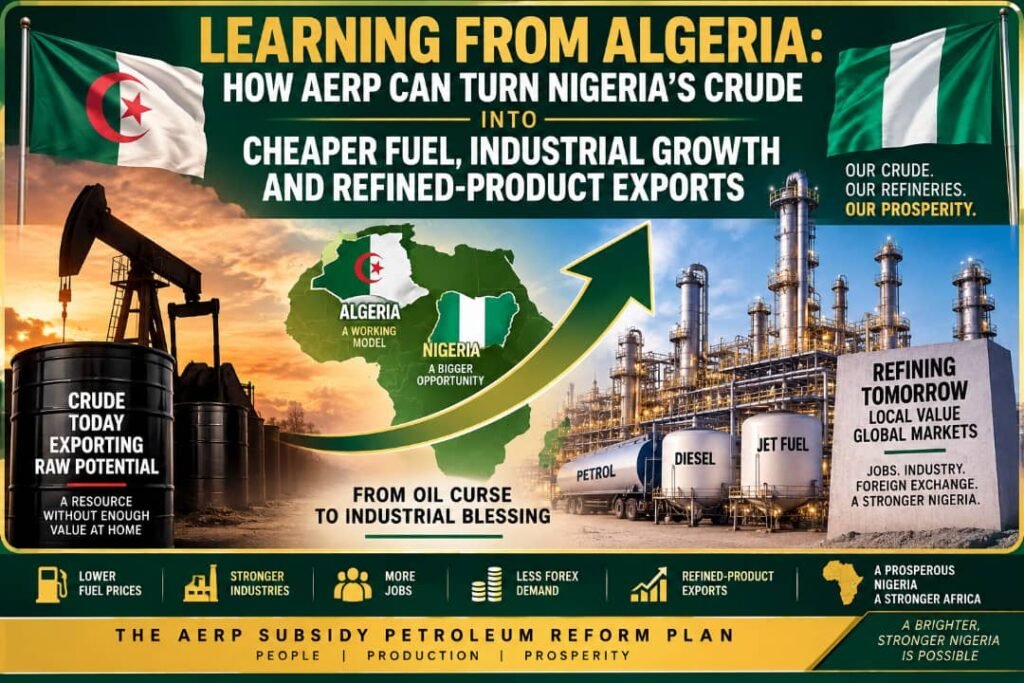
And perhaps the most instructive African example is Algeria.
What Algeria has done, and what Nigeria can learn.
Algeria like Nigeria is one amongst the six OPEC members from the continent of Africa after the 7th Angola pulled out in 2024. The country has an established domestic refining industry second to Nigeria by name plate capacity. Its Ministry of Commerce states that under Executive Decree No. 07-60 of 11 February 2007, the administered price at which crude intended for the national market enters Algerian refineries is 12,043.39 Algerian dinars per tonne for refineries other than Adrar, and 11,006.06 dinars per tonne for the Adrar refinery. The same decree establishes administered prices for refined petroleum products.
This is important because it demonstrates a principle that Nigeria’s policy debate has often treated as though it were revolutionary or impossible:
A petroleum-producing country can deliberately make crude feedstock available to domestic refineries at an administered price in order to support domestic refining and domestic petroleum-product supply.
Using the current exchange rate of approximately ₦10.30 to one Algerian dinar, the standard Algerian refinery crude-transfer price of 12,043.39 DZD/tonne is approximately ₦124,000 per tonne. Depending on crude density and the conversion factor used, that is roughly ₦17,000 per barrel, or around $13 per barrel.
That is an extraordinarily low administered feedstock price compared with today’s international crude market, where Brent recently traded around $96 per barrel.
This does not mean Nigeria should mechanically reproduce Algeria’s entire subsidy architecture. Algeria also operates broader administered energy prices. But the central lesson is compelling:
If the state can support domestic refining by reducing the cost of crude feedstock, it can intervene at the point of production rather than merely subsidising consumption.
That is the conceptual foundation of AERP’s proposed “subsidy follows the barrel” approach.
And look at the result at the pump
As of 5 September 2026, Algeria’s reported national petrol price is approximately 47 dinars per litre, while diesel is approximately 31 dinars per litre. At today’s exchange rate, those translate to roughly:
Petrol: ₦484 per litre
Diesel: ₦319 per litre
Nigeria, by contrast, is seeing petrol around ₦1,300–₦1,370 per litre in many markets, while diesel is around ₦1,800 per litre in some markets.
The comparison must be treated carefully because pump prices are affected by taxation, exchange rates, logistics, subsidy levels, crude quality and other factors. Nevertheless, the magnitude of the difference illustrates the potential value of a domestic-refining strategy.
Nigeria is now better positioned than Algeria
There is an even more remarkable fact.
Algeria’s installed local refining capacity is about 663,500 barrels per day. Nigeria’s position is potentially much larger. Dangote’s refinery has demonstrated processing capability of about 700,000 barrels per day, while Nigeria’s four state-owned refineries have combined nameplate capacity of 445,000 barrels per day, although their actual operational status and throughput vary considerably and they are still comatose. But other private refining assets with a potential 300,000 barrels per day name plate are likely to be available by the second quarter of 2027. Ramping the potential capacity to 1 million barrels per day.
In other words, Nigeria now possesses a domestic refining capacity base that can potentially exceed Algeria’s by a substantial margin.
And Dangote is not finished.
The refinery has announced plans to expand to approximately 1.4 million barrels per day. Reuters reported this week that the planned expansion is central to the company’s strategy as it prepares for its Nigerian initial public offer (IPO).
Imagine what that means.
Nigeria could move from being Africa’s largest crude-producing country to becoming Africa’s dominant refining centre.
Our OPEC position makes the opportunity even more compelling.
Nigeria and Algeria are both OPEC members, but Nigeria’s current OPEC production level is substantially higher.
For September–December 2026, the relevant OPEC+ production level for Nigeria is approximately 1.5 million barrels per day, while Algeria’s required level is approximately 1.007 million barrels per day under the current framework.
Nigeria therefore has both the crude resource and a larger production allocation.
The tragedy would be to continue exporting that advantage in its least processed form.
The objective should be simple:
Export less crude. Refine more crude. Export more refined products.
AERP would turn subsidy from consumption support into production support.
This is the intellectual strength of the AERP Subsidy Petroleum Reform Plan.
Rather than returning to the old regime of indiscriminate petroleum-product subsidies, the AERP subsidy reform proposal seeks to design a transparent, capped and performance-based domestic-refinery feedstock support mechanism.
The government could establish a benchmark crude price equivalent to the annual crude sales budgetary benchmark and a maximum subsidy discount per barrel to local refineries. The discount would apply only to crude demonstrably delivered into qualifying Nigerian refineries.
No refinery intake, no subsidy.
No verified production, no subsidy.
No domestic supply obligation, no subsidy.
And every barrel should be electronically traceable from wellhead → terminal → refinery → depot → truck → retail outlet.
That is the difference between an intelligent production subsidy and an uncontrolled consumption subsidy.
But what about the Federation Account Allocation Committee (FAAC) potential revenue loss?
This is perhaps the incumbent government’s strongest argument against reimagining the subsidy architecture: “ If we sell crude to domestic refineries at a discount, the government loses revenue and FAAC receives less .”
That argument is incomplete because it counts the immediate accounting cost while ignoring the wider economic return.
Suppose government sacrifices part of the notional value of crude sold to a Nigerian refinery.
What does Nigeria receive in return?
Refinery employment.
Corporate taxes.
VAT and other taxes where applicable.
Port activity.
Transportation.
Storage.
Engineering services.
Petrochemical development.
Reduced fuel imports.
Reduced foreign-exchange demand.
Lower logistics costs.
Higher industrial productivity.
Greater domestic consumption.
And, ultimately, foreign exchange earned from refined-product exports.
FAAC should not be the only lens through which petroleum policy is evaluated.
A naira that appears to be lost in crude-feedstock revenue can generate multiple naira of economic activity elsewhere in the economy.
The question is therefore not simply, “How much crude revenue did FAAC receive?”
The better question is:
“How much total national economic value did Nigeria create from each barrel?”
That is the economic revolution AERP seeks to pursue.
Smuggling is not an argument for abandoning reform.
Another familiar objection is smuggling.
But technology has fundamentally changed the fight against petroleum diversion.
Nigeria now has the capacity to deploy digital metering, electronic product tracking, GPS-enabled transportation, depot reconciliation, refinery production monitoring, electronic invoicing and real-time volume accounting.
A subsidy attached to verified refinery intake and verified domestic delivery is much easier to police than an opaque system that simply subsidises the final litre.
Furthermore, Nigeria’s neighbours are themselves beginning to recognise that domestic refining is an industrial-security issue.
Ghana has revived Tema Oil Refinery and is expanding Sentuo’s capacity from 40,000 to 100,000 barrels per day. Its government openly says the objective is to reduce petroleum-product imports, retain value domestically and strengthen the country’s industrial economy. Niger had since 2025 signed a $1.9 billion agreement for a 100,000-barrel-per-day refinery at Dosso, with a three-year construction schedule, while Chad is pursuing a second refinery designed to double its refining capacity. Nigeria therefore cannot assume that its neighbours will remain dependent on imported Nigerian petroleum products indefinitely.
This is the direction Africa is moving.
Nigeria should therefore not allow fear to make us the exception.
Our neighbours are also likely going to tackle cheap fuel smuggling from Nigeria to protect their emerging refining industries, while Nigeria should position itself as the regional refining and petroleum-products hub.
Trust Nigerian entrepreneurs
Perhaps the most important lesson is that Nigeria must stop assuming that the government alone must build the petroleum industry.
Dangote has invested billions and is expanding by investing more.
BUA is investing.
Modular refinery entrepreneurs are investing.
Private capital is entering the midstream.
These entrepreneurs are effectively saying:
“We believe Nigeria has a petroleum future.”
The government’s responsibility is to create the policy environment in which that confidence is rewarded rather than frustrated.
The worst response would be to frighten these investors away with unpredictable policy, crude shortages, excessive regulatory uncertainty or a refusal to rethink the subsidy architecture.
Instead, the government should say:
If you refine Nigerian crude in Nigeria, create Nigerian jobs and supply Nigerian consumers, Nigeria will support the competitiveness of your production.
That is what a strategic petroleum policy looks like.
Atiku’s opportunity: from oil curse to industrial blessing.
This is where Atiku Abubakar’s proposition deserves to be distinguished from conventional political thinking.
The debate should not be reduced to whether Atiku is “for subsidy” or “against subsidy.” Or why has he changed from pro subsidy removal in 2023, to pro subsidy return in 2027?
That is intellectually lazy.
The real question is:
What should Nigeria subsidise, and what economic outcome should the subsidy produce?
A subsidy that encourages imports is fundamentally different from a subsidy that makes Nigerian refining competitive.
The first exports jobs and foreign exchange.
The second creates jobs, retains foreign exchange and builds industrial capacity.
That is why the Atiku AERP represents a more modern way of thinking about Nigeria’s petroleum economy.
Atiku’s proposition is to move Nigeria from consumption subsidy to production support; from crude export to value addition; from import dependence to refining self-sufficiency; from foreign-exchange consumption to foreign-exchange generation; and ultimately from crude exporter to refined-product exporter.
That is not simply a petroleum policy.
It is an industrialisation strategy.
If Dangote achieves its planned 1.4 million barrels-per-day Nigerian capacity, alongside the country’s other refineries and modular plants, Nigeria could possess sufficient refining capability not only to meet domestic petroleum-product demand but to generate a substantial exportable surplus.
And that is the vision Nigeria should embrace.
After 66 years of independence, our national pride should not be that we can export millions of barrels of crude oil.
Our pride should be that we can take our crude, refine it here, employ Nigerians here, build industries here, save foreign exchange here, lower the cost of living here, and export the finished products to the world.
Algeria has shown that domestic crude-feedstock support can be part of that architecture.
Nigeria has something Algeria does not have on the same scale: a larger production base, a huge domestic market, a rapidly expanding private refining ecosystem and the world’s largest single-train refinery already operating on Nigerian soil.
What we need now is political courage and economic imagination.
That is the promise of the AERP Subsidy Petroleum Reform Plan.
Atiku Abubakar’s greatest proposition is therefore not simply to reduce the price of petrol.
It is to change the economic meaning of every barrel of Nigerian crude.
From barrel exported → to barrel transformed.
From crude → to industry.
From foreign exchange drain → to foreign exchange earner.
From import dependence → to refining independence.
From oil curse → to industrial blessing.
Nigeria has waited 66 years for this opportunity.
We should not allow fear to make us waste it.
Alex Ter Adum, PhD
-AA MOVEMENT FOR A BETTER NIGERIA –