Aare Amerijoye DOT.B

Picture the scene, because it is the truest portrait of Nigeria under the All Progressives Congress.
A gleaming black limousine, waxed to a mirror shine, glides down the road. On its bonnet sits the national coat of arms. On its door rides the emblem of the ruling party. Inside, cushioned and cooled, sit the men and women of power. And all around the car, on the bare ground, kneel rows of hollow-eyed children in rags, ribs showing, holding out empty plates and bowls, begging for something, anything, to eat.
That is the country: opulence behind tinted glass, hunger kneeling in the dust. And it is from the comfort of that limousine that the APC National Chairman, Professor Nentawe Yilwatda, has chosen to speak.
WHAT THE CHAIRMAN ACTUALLY SAID
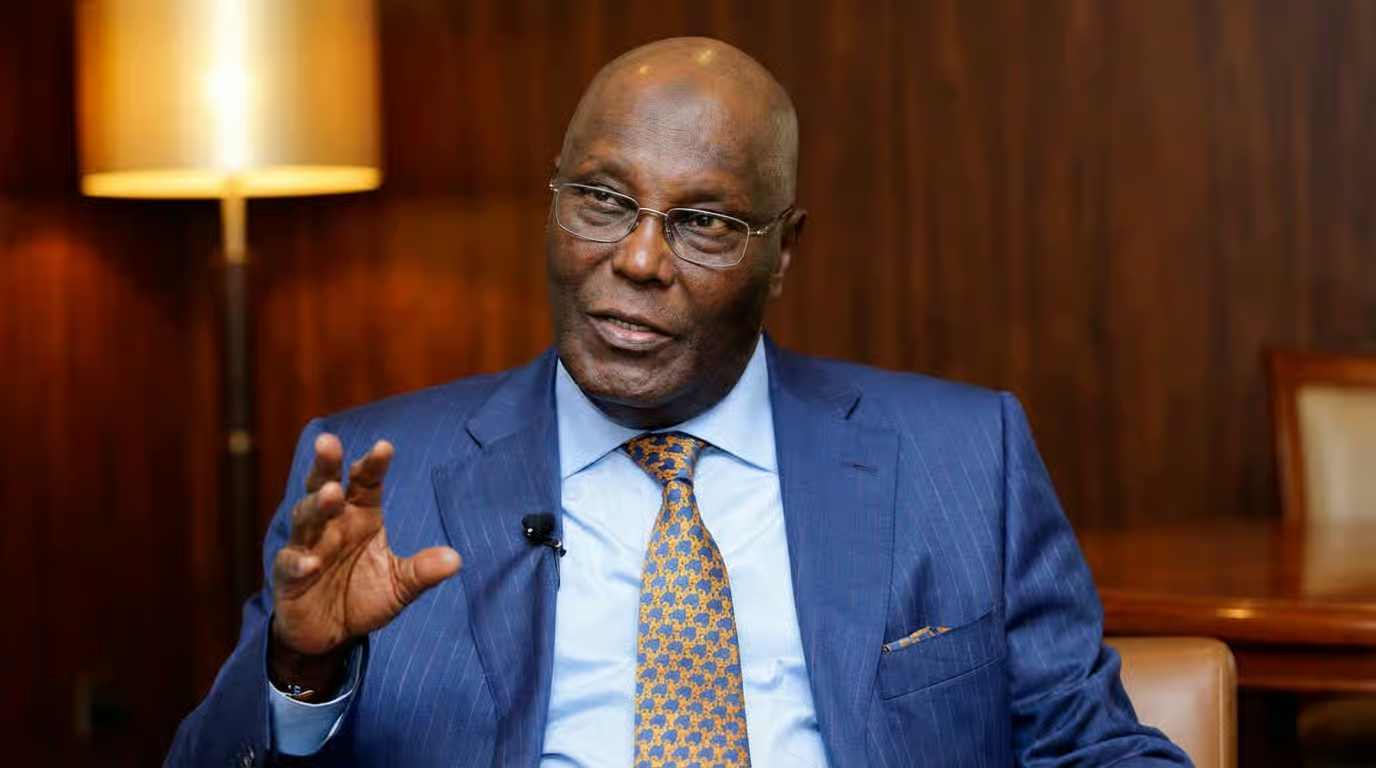
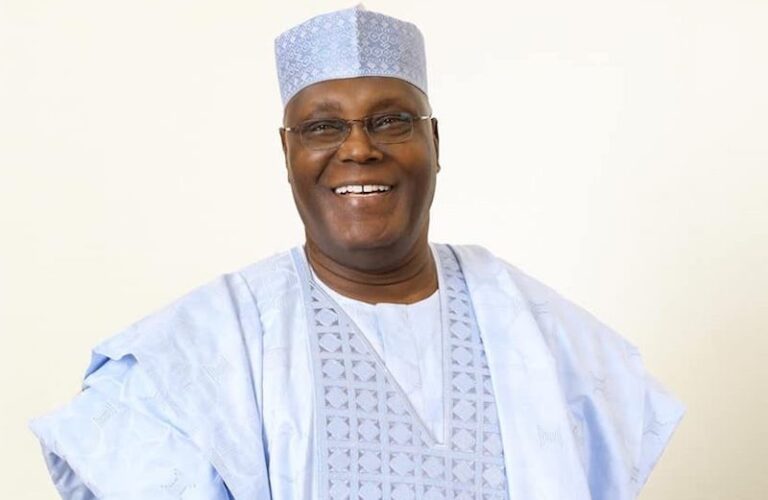
Professor Yilwatda’s charge is now on record. He looked at the ADC candidate, Atiku Abubakar, who has pledged to restore support to the suffering masses, and he called it a desperate, troubling u-turn. He warned that desperation for power must not be allowed to endanger the economy. He asked why the former Vice President should propose such a thing only months before an election, and he insisted that the subsidy removal was difficult but necessary.
Every one of those claims collapses the moment it meets the facts. Let me answer plainly, then hand you the figures, all your own government’s, and let the empty plates judge.
FIRST, WHAT ATIKU ACTUALLY PROPOSED
You have deliberately misrepresented the man. Atiku is not proposing to raise the old importation racket from the dead. Under the recovery plan his campaign has published, the proposal is a targeted, capped, transparently budgeted and independently audited production subsidy: support moved from importers to Nigerian refineries, from middlemen to barrels a citizen can count, and every naira the masses were told to bleed for pursued, recovered and returned. That is not desperation. It is design, a hand reaching back toward the children on the ground.
Your President’s hand reached the other way. On his very first morning, with three careless words and no plan filed, he tore the subsidy away and left the poor to the flames, palliatives promised to the wind. So spare us the lecture on u-turns. As leader of the ACN in January 2012, Bola Tinubu himself rose to condemn an abrupt subsidy removal as a tax on the backs of the poor. As President in May 2023 he did the very thing he had cursed, only harder, and refused to bend when the people screamed.
One man refined his method toward the people. The other reversed himself against them, and you call the first desperate.
AND WHY NOW, YOU ASK?
You ask why Atiku speaks now, months to an election. Look through your tinted window, Professor. He speaks because the children are hungry now, and because the 15.8 trillion naira your own minister says was saved is missing from their plates. A drowning man does not schedule his cry for a convenient season.
You question the opposition’s preparedness to govern. Then let the records decide. Under Obasanjo and Atiku, the economy grew from 58 billion dollars in 1999 to 270 billion dollars by 2007, nearly a fivefold rise, for a population of about 115 million. That population is now more than 220 million, and your party has met the surge not with growth but with collapse. Now the figures. Count them with me.
RECORD REVENUE, RECORD HUNGER
This is not a poor government but a rich one presiding over a starving people, the limousine and the empty plates in one frame. By the government’s own reform scorecard, unveiled by the Finance Minister, Taiwo Oyedele, on 20 August 2026, the Federation shared a record 3.007 trillion naira in July 2026 alone, 281.7 per cent more than the 786 billion of May 2023. State allocations have practically doubled. The treasuries have never been fuller.
And yet the World Bank’s own April 2026 update records poverty climbing from 56 per cent in 2023 to 61 per cent in 2024 to 63 per cent in 2025, about 140 million human beings below the line, a figure PwC projects at 141 million. Some 133 million endure multidimensional poverty. Food inflation stood at 20.31 per cent in July 2026 by the Bureau’s own count, rising for 6 straight months, and the poorest now surrender up to 70 per cent of whatever they earn simply to eat. The suffering is mapped onto geography: a poverty rate of about 87 per cent in Sokoto against 4.5 per cent in Lagos, 57.4 per cent across the north against 21.2 per cent in the south. And it wears a woman’s face, for women make up nearly 63 per cent of the hungry.
Never in our history has so much money flowed to government while so much hunger flowed to the people, in the very same years.
THE WORKER’S WAGE NOW BUYS A BAG OF RICE
Go to the plate itself. Your government raised the minimum wage to 70,000 naira and demanded applause, then let it vanish at the market. A single 50kg bag of rice now costs around 61,000 naira. One bag, and the month’s wage is gone. By SBM Intelligence’s count, one pot of jollof for a family of five already costs about 30,435 naira. Petrol sells between 1,230 and 1,299 naira a litre in Abuja as I write, and transport fares have leapt by more than 300 per cent since the subsidy was torn away, so that a civil servant on the minimum wage can spend nearly the whole of it just commuting to the office. And still, several state governments have delayed or resisted paying even that 70,000 naira.
Now the sum the APC prays no worker performs. Two decades ago, under Obasanjo and Atiku, a wage of 7,500 naira, at about 120 naira to the dollar, was worth roughly 60 dollars. Today, 70,000 naira, at an official rate near 1,346 to the dollar, is worth barely 50 dollars, and the naira has crumbled from 120 to the dollar to past 1,405 on the street. They multiplied the figure and destroyed the value.
THE 15.8 TRILLION THAT NEVER REACHED THE TABLE
Where did the windfall go? Your scorecard confessed that subsidy removal and the naira float mobilised 15.8 trillion naira between June 2023 and December 2025: 5.4 trillion to the Federal Government, 10.4 trillion to the states and councils. Then the same government borrowed an extra 11.9 trillion naira in the same window. The savings were real; the palliatives, a few lorries of rice and thin cash transfers, were a joke against the scale of the pain. The money never reached the children on the ground.
A NATIONAL BUDGET HANDED TO THE RICH
And the leak you never mention. The Comptroller-General of Customs, Bashir Adeniyi, told the National Assembly that import duty waivers reached 34.54 trillion naira in 2025 alone, 61.8 per cent of the entire 54.99 trillion naira budget, nearly 5 times the 7.28 trillion naira Customs actually collected, with lawmakers putting the pure revenue leakage at around 8 trillion naira a year. About 60 per cent of it, some 20.4 trillion naira, went on duty-free military hardware even as the killing fields widened.
Set that beside the past you will not discuss. Across the whole Obasanjo and Atiku era, total waivers came to roughly 165 billion naira, and that government moved to seal the tap: in 2000 Obasanjo stripped his own ministry of the power to grant them, and by 2005 he suspended them outright to plug the leak.
One government caught the leak and closed it. This one widened it more than 200 times over and called the flood a stimulus.
A state so broke it borrows to pay salaries gave away two-thirds of its budget to the powerful, then told the child in the dust to endure.
A FEAST LAID FOR FORTY MEN
The inequality is written into the budget as policy. The top 1 per cent of Nigerians take about a quarter of all national income, and one earner in that 1 per cent commands as much as 37 people in the bottom half. Roughly 60 per cent of billionaire wealth flows from inheritance, monopoly or crony connection, while only 40 of the very wealthiest were found to be compliant taxpayers. The fortune of four Nigerian billionaires could carpet Lagos in 500 naira notes, and the richest man among them would need 42 years, spending a million dollars a day, to run through his pile. That is the class your waivers shield, while the wage earner is taxed at the pump on every litre.
THE DEBT THAT DEVOURED THE ROADS
The deadliest confession sits in the very scorecard the APC is celebrating. Between June 2023 and December 2025 the government spent 10.61 trillion naira on additional debt service against just 6.47 trillion naira on infrastructure, a gap of 4.14 trillion naira. The debt itself rose from 87.38 trillion naira in June 2023 to 159.35 trillion by March 2026, nearly doubling. In the first quarter of 2026 alone, domestic debt service hit 3.14 trillion naira, up 20.3 per cent in a year, and of every 100 naira spent servicing that debt, about 95 went on interest. The debt-service-to-revenue ratio now sits near 50 per cent.
You can see where the money did not go. Of Nigeria’s roughly 200,000 kilometres of road, about 63 per cent remains untarred. Vanguard’s own investigation branded the federal highways roads of horror, and the Senate has raised alarm over more than 2,000 abandoned federal road projects. The road budget was pushed to a record of about 3.24 trillion naira on paper, yet by real accounts barely 5 to 9 per cent of it was ever released, while trillions are lavished on a showpiece coastal highway for the cameras. The Infrastructure Concession Regulatory Commission puts the nation’s infrastructure stock at just 35 per cent of GDP against the 70 per cent of developed economies, and the bill to fix the gap at 2.3 trillion dollars, even as the government cut its 2026 infrastructure allocation.
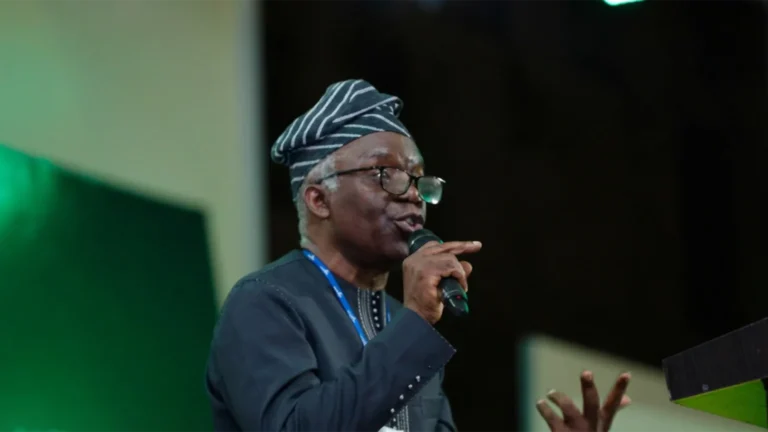
And this is no distant abstraction, Professor. It is at your own doorstep. Here in Ekiti, Senator Babafemi Ojudu, himself an APC chieftain and a former presidential aide, has raised the alarm over the Federal Government’s own exit roads, demanding to know how the 95.98 billion naira Akure to Ado-Ekiti dualisation delivered only a single rehabilitated carriageway before the contractors and their equipment quietly vanished from site. His verdict was blunt: Nigeria, he said, has happened to that road. And tellingly, his own party rounded on him for daring to say it aloud.
Even as he spoke, a section of the federal Ifaki, Oye, Ilupeju and Kabba corridor caved in, trapping tankers for days and choking the movement of goods in and out of the state. Worse still, these broken stretches where vehicles must crawl have become the favourite hunting grounds of kidnappers, so that a bad road no longer merely costs you time, it can cost you your life. When a ruling party attacks its own senator merely for pointing at a collapsed road, the road is broken beyond any argument.
THE GRID IN PERMANENT DARKNESS
The power sector tells the same story. The electricity value chain is choking on debt that reached about 6.8 trillion naira by early 2026, and in April 2026 some 69 per cent of the grid stood offline. The national grid collapsed 12 times in 2025, and twice again in a single week in January 2026, one of those failures landing on the very day the government was signing a 501 billion naira bond meant to settle power-sector debt. The lights went out on the ceremony to keep them on, over transmission lines that are in places more than 40 years old.
THE ILLUSION OF JOBS
When they tell you unemployment has fallen, understand the sleight of hand. The rate dropped from 33.3 per cent in late 2020 to about 4.3 per cent in 2024, not because jobs appeared, but because the Bureau redefined work: anyone who labours even one hour a week for pay is now counted as employed. Behind the flattering number, about 93 per cent of Nigerian workers are trapped in the informal sector and only some 14.4 per cent hold paid employment, with millions more underemployed and states like Abia carrying localised joblessness near 18.7 per cent. They did not create the jobs. They redefined the word.
THE HEALERS ON THE DEPARTURES BOARD
Even the doctors have joined the children in fleeing what this government has built. The government’s own State of Health of the Nation Report 2025 records that 20,966 Nigerian health workers relocated abroad in a single year, among them 3,919 doctors, 7,487 nurses and midwives, and thousands of laboratory scientists, pharmacists and physiotherapists. Of 95,456 registered doctors, only 60,551 still hold active licences. Between May 2023 and April 2026, 4,691 Nigerian-trained doctors joined the United Kingdom’s register alone, and about 16,000 nurses followed in 2025, some 57,000 over five years. The result is a nation where, against the World Health Organization’s benchmark of roughly one doctor to 600 people, a single doctor may now serve several thousand, where Lagos has about 7,000 doctors for nearly 30 million residents, where northern states like Bauchi and Katsina fall to 0.7 doctors per 10,000, and where those who remain buckle under burnout rates estimated between 69 and 85 per cent.
AND THE SICKNESS THEY CANNOT AFFORD
The bodies left behind are breaking. The Association of Psychiatrists of Nigeria and the WHO estimate that between a fifth and a quarter of Nigerians, as many as 50 to 65 million people, now live with some form of mental distress, and Sapien Labs’ 2025 report found about 41 per cent of young adults in psychological crisis, in a country served by fewer than 300 psychiatrists. Hypertension, once a disease of the affluent old, now afflicts an estimated 30 to 40 per cent of adults, driven by the cheap high-salt survival diet that poverty dictates. Cholera and Lassa fever spike where clean water has become a luxury, and for the catastrophic illnesses the poor cannot pay at all: reports from regional dialysis centres describe most kidney patients abandoning treatment within the first week because they pay out of pocket. Illness in APC Nigeria has become a financial death sentence.
SO WHO IS DESPERATE, PROFESSOR?
Return with me to the limousine and the empty plates.
A worker whose whole wage buys one bag of rice. A currency worth a tenth of what it was. Poverty at 63 per cent while allocations hit records. 140 million poor. 34.54 trillion naira waived to the wealthy. 4.14 trillion naira more on debt than on roads. A grid that failed 12 times in a year and once on the very day of its own bailout. 20,966 healers gone in twelve months. These are not our opinions. They are your scorecard, the World Bank, the Bureau of Statistics, the Customs Service, the Senate and your own ministries, testifying in one damning voice.
The desperation on display today is not a man offering to fill those empty plates. It is a ruling party that emptied the worker’s pocket, filled the treasury, waxed its limousine, then looked the hungry child in the eye and called him desperate for lifting up his plate.
The limousine will drive on, Professor. But the plates remain. And in January, it is the hands holding those plates that will cast the votes.
TheLimousineAndTheEmptyPlates #RecordRevenueRecordHunger #APCFailedNigeria #ADC2027
Aare Amerijoye DOT.B, Director General, The Narrative Force, thenarrativeforce.org
24 August 2026