
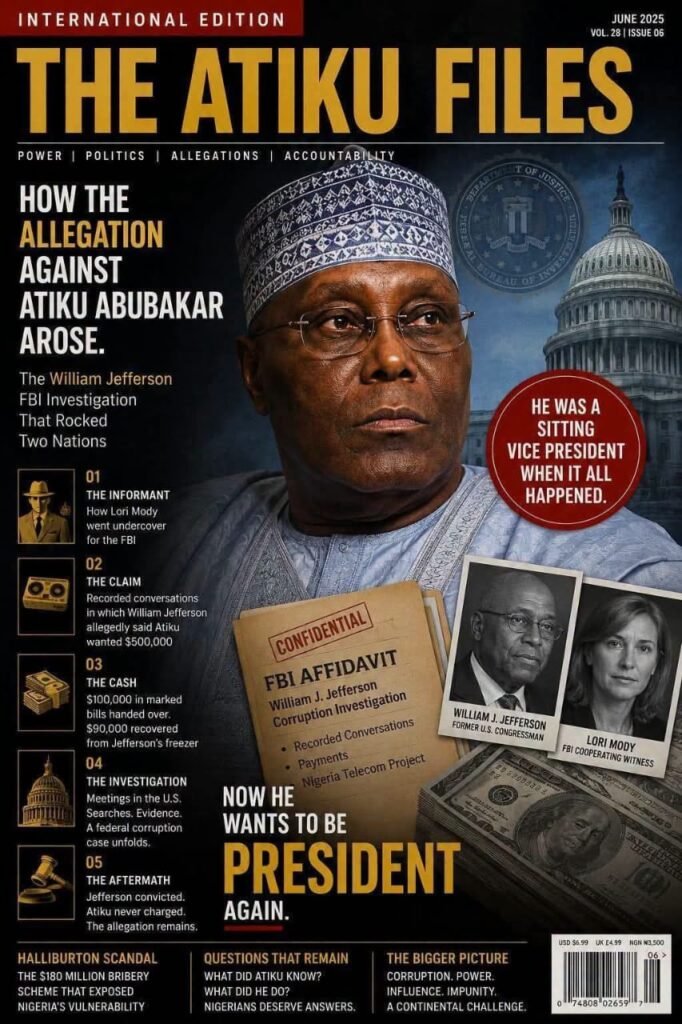
The recent attempt by supporters of the Tinubu administration to resurrect the William Jefferson corruption investigation as a political weapon against former Vice President Atiku Abubakar is not an exercise in legal analysis but in political damage control. It coincides conspicuously with renewed public scrutiny of President Bola Ahmed Tinubu’s historic forfeiture proceedings in the United States. Rather than address the legal issues arising from those proceedings, some commentators have sought to manufacture a false equivalence between two fundamentally different matters. That comparison collapses the moment it is subjected to legal scrutiny.
The law is not governed by political convenience. It is governed by facts, evidence and judicial determinations.
The William Jefferson matter and the U.S. proceedings involving Bola Ahmed Tinubu are not legally comparable. They occupy entirely different legal planes.
In the Jefferson case, former Congressman William Jefferson was the person investigated, indicted by a federal grand jury, prosecuted before a competent court, tried, convicted and sentenced under the American criminal justice system. Whatever findings the court made were made against Jefferson because he was the accused person standing trial. Atiku Abubakar was not.
Atiku Abubakar was never indicted, never arraigned, never prosecuted, never placed on trial, and never convicted by any court in the United States or Nigeria in connection with the Jefferson prosecution. Those are not political opinions; they are indisputable legal facts.
American criminal law is founded upon the Fifth Amendment guarantee of due process and the principle that criminal liability is personal. Passing comments or purported allegations made by prosecutors in proceedings against one defendant does not become a judicial finding against another individual who was never adjudged indicted with any prima facie evidence to warrant him to stand trial before the court. Prosecutors may make allegations in an indictment, but allegations remain allegations unless proved beyond a reasonable doubt against the person charged.
Similarly, Section 36(5) of the Constitution of the Federal Republic of Nigeria, 1999 (as amended), provides that every person charged with a criminal offence shall be presumed innocent until proven guilty by a court of competent jurisdiction. The Nigerian Supreme Court has repeatedly affirmed that criminal guilt cannot be inferred from suspicion, speculation or public opinion. Suspicion, no matter how strong, cannot replace proof beyond all reasonable doubt.
This constitutional safeguard exists precisely to prevent what is now being attempted against Atiku Abubakar: conviction by propaganda instead of conviction by law.
There is a world of legal difference between an investigation, an indictment, a trial and a conviction. Those are distinct stages of the criminal justice administration process, each carrying different legal consequences. To deliberately blur those distinctions is to mislead the public.
Indeed, in Atiku’s case, none of those essential ingredients of criminal liability materialised. There was no grand jury indictment against him. There was no criminal information filed in any American court naming him as a defendant. There was no arraignment. There was no trial. There was no verdict. There was no conviction. There was no sentence.
If years of investigation by the United States Department of Justice, the Federal Bureau of Investigation and other law enforcement agencies did not produce sufficient evidence to indict Atiku Abubakar, political commentators certainly cannot manufacture guilt nearly two decades later.
It is equally significant that no Nigerian anti-corruption agency has secured any conviction against Atiku arising from the Jefferson matter. The Economic and Financial Crimes Commission (EFCC), the Independent Corrupt Practices Commission (ICPC) and other law enforcement agencies have never obtained a judicial finding establishing his criminal liability in relation to those allegations.
The attempt to equate Atiku’s position with President Tinubu’s U.S. forfeiture proceedings is therefore legally unsustainable. Whatever opinions people may hold about those forfeiture proceedings, they involved actual judicial proceedings in which a court made enforceable orders regarding specific funds. By contrast, the Jefferson prosecution produced no judicial finding whatsoever against Atiku Abubakar. The law does not permit one person’s prosecution to become another person’s conviction.
Our legal system does not recognise guilt by association. It rejects guilt by rumour. It rejects guilt by political repetition. Courts decide criminal responsibility, not newspaper headlines, social media campaigns or partisan spokespersons.
Those attempting to revive the Jefferson allegations today appear less interested in justice than in creating a diversion from uncomfortable public debate. The timing speaks for itself. Rather than confront contemporary questions with contemporary facts, they seek refuge in allegations that never matured into criminal charges against Atiku.
The rule of law demands higher standards than political rhetoric. It requires evidence, due process and judicial determination.
As matters stand today, Atiku Abubakar remains, in the eyes of both American and Nigerian law, a free citizen who has never been indicted, never tried and never convicted in connection with the Jefferson case. That is not a political slogan; it is the legal record.
Political opponents are entitled to criticise Atiku Abubakar’s policies, ideology or ambitions. What they are not entitled to do is rewrite legal history. Courts speak through their judgments, not through political talking points. Until a competent court holds otherwise, the law presumes Atiku innocent. That presumption is not a favour; it is a constitutional guarantee.
Those who seek to erase that guarantee in pursuit of partisan advantage do violence not merely to Atiku Abubakar’s reputation, but to the very foundations of constitutional democracy and the rule of law.
Alex Ter Adum, PhD
DDG THE NARRATIVE FORCE