Aare Amerijoye DOT.B
Every generation produces a diagnosis of Nigeria’s disease without naming the pathogen. Analysts, historians and commentators have given this nation clean and clinical autopsies for decades. They identify the wounds. They trace the bleeding. But they consistently stop short of naming the surgeon capable of closing them. That omission must be corrected. Nigeria is not merely in a fix. Nigeria is in a Tinubu.
Let us be precise about the inheritance.
Nigeria’s economic catastrophe began when petroleum displaced agriculture as the engine of national survival. The Gowon era turned a farming nation into a rentier state. Cocoa, groundnut, palm oil and cotton were not merely crops. They were the economic sovereignty of a people. When crude oil made them redundant, Nigeria did not gain wealth. It lost self-sufficiency. It traded productive labour for dependency on a single commodity controlled by external markets and internal thieves.
Bola Tinubu is the logical and catastrophic terminus of that trajectory.
He did not build a productive economy in Lagos. He captured a revenue flow. Internally Generated Revenue in Lagos State grew not because Tinubu created industry but because he institutionalised extraction by design. The Land Use Charge Law, radically expanded under his administration, converted ordinary home ownership into a recurring liability. The Lagos State Internal Revenue Service was restructured not to broaden the tax base through economic growth but to intensify collection from a population that was already producing at subsistence level.
Multiple levies were imposed on the same commercial activities through different agencies, each one politically connected, each one feeding a patronage chain that terminated at the same address. That is not development. That is the oil rentier model replicated at sub-national level, with Tinubu as the sole beneficiary.
Nigeria went from cocoa to crude. Lagos went from crude to Tinubu. The logic is identical. The victim is always the ordinary citizen.
THE ETHNIC QUESTION TINUBU CANNOT ANSWER.
Ethnocentrism is a foundational pathology of the Nigerian state. The Yoruba, Hausa and Igbo have been manipulated across generations into seeing themselves as competitors rather than compatriots. That manipulation did not happen by accident. It happened because politicians profit from that refusal to cohere.
Tinubu’s entire 2023 presidential campaign was a masterclass in ethnic mobilisation disguised as democratic contest. “Emi lokan” was not a policy statement. It was an ethnic declaration of entitlement. It told the Yoruba nation that power had come home, that the presidency was a communal inheritance, that arithmetic did not matter because destiny had spoken.
And what has it produced? The naira collapsed to over 1,500 to the dollar at its lowest point in February 2024, from roughly 460 at inauguration. Inflation touched 34 percent. Petrol prices that stood at 189 naira per litre under the subsidy regime exceeded 1,000 naira per litre across most of the country at their peak — a threshold ordinary Nigerians were never consulted about and from which household budgets across every geopolitical zone have not recovered.
The poor, whether Yoruba, Hausa, Igbo, Ijaw, Kanuri or Tiv, have all been detonated by the same policy bomb. Ethnic entitlement delivered ethnic punishment to every tribe simultaneously. That is Tinubu’s only genuinely federal achievement. He has impoverished Nigeria without discrimination.
THE CIVIL WAR LESSON TINUBU REFUSES TO LEARN
The Nigerian civil war was the product of deep divisions, colonial manipulation, a fragile trust already destroyed by the 1966 coups, and the consequent collapse of any shared national imagination. Over one million Nigerians perished. The nation was fractured in ways that 56 years of awkward cohabitation have not fully repaired.
What does it mean, then, when a sitting president governs as though those lessons were written for other people?
In October 2020, Nigerian security forces opened fire on unarmed protesters at the Lekki tollgate. The administration that presided over Lagos that night emerged directly from the political structure Tinubu built and handed to a successor. Not one person was prosecuted. Not one command was traced publicly to its source. Not one family received a state acknowledgement of wrongdoing.
Tinubu’s response to that massacre, as he campaigned for the presidency two years later, was to minimise, deflect and move on. That is the template he brought to Aso Rock.
The pattern has not changed. It has only grown more brazen. In a video released in April 2026, President Tinubu appeared before Nigerians not with policy, not with accountability, but with accusation. He blamed a foreign political communications firm for his mounting domestic difficulties. He went further. He publicly identified former Vice President Atiku Abubakar, a legitimate democratic opponent exercising his constitutional right to contest for office, as an enemy.
A sitting president naming a political rival as an enemy is not a statement of governance. It is a confession. It tells a watching nation that power has reduced its occupant to paranoia, and that the instruments of the state are being quietly reconfigured not to serve 220 million citizens but to protect one man’s tenure from the verdict of a democratic ballot. Legitimate concerns about the government’s failure to protect ordinary Nigerians from hunger, inflation and insecurity were dismissed as a conspiracy to remove him. That is not the language of a man who governs. It is the language of a man who knows he cannot defend his record and has therefore decided to criminalise the act of demanding it.
His appointments have been among the most demonstrably lopsided in Nigeria’s post-military history — measurable in the disproportionate allocation of security, finance and strategic economic ministries to a single geopolitical bloc, a concentration of patronage that invites direct comparison with the most exclusionary tendencies of the military era and that has no defensible basis in federal character or constitutional practice.
The South-East, home to over 20 million Nigerians across five states, has been systematically excluded from the core security and economic decision-making architecture of his government. The message that exclusion sends to a region that has not forgotten Biafra is not subtle. It is a provocation dressed as administration. And it is a provocation that resonates not only in the South-East but in every zone that watches Abuja’s patronage map and finds itself absent from it.
A president who cannot govern all of Nigeria has no right to govern any of Nigeria.
THE BRIDGE: WHAT FAILURE REVEALS
Tinubu’s record, taken in full, is not merely a catalogue of policy errors. It is a structural indictment. Every failure points to a specific capacity that was absent. The naira collapse points to the absence of orthodox monetary discipline and insulation of the Central Bank from political interference. The poverty explosion points to the absence of any social protection architecture worthy of the name.
The ethnic skew in appointments points to the absence of any genuine commitment to federal character. The Lekki silence points to the absence of democratic accountability. The April 2026 video points to the absence of the most elementary quality required of a statesman: the composure to face legitimate democratic opposition without retreating into the language of warfare.
Each of those absences has a corresponding presence in Atiku Abubakar’s record and programme. That correspondence is not coincidental. It is the difference between a man who has governed and a man who has extracted.
ATIKU ABUBAKAR: THE DIAGNOSTIC OPPOSITE
What Nigeria requires is a sovereign national conference. It requires leaders who make proper decisions and execute them without sentiment. It requires patriotism over nepotism, communal spirit over ethnic supremacy, and genuine economic production over internal rent-seeking.
Every one of those requirements points to Atiku Abubakar.
Atiku has staked his political career on restructuring, the only honest response to the structural failures that have defined six decades of Nigerian governance. A federal arrangement that concentrates resource control at the centre and then allows one man to allocate or withhold at will is not a federation. It is an empire with elected decoration.
Atiku’s restructuring agenda returns fiscal federalism to its constitutional promise. It allows states to control their resources, develop at their own pace, and compete for investment without waiting for Abuja’s benevolence. That is the agricultural-era wisdom updated for the 21st century. Let each zone produce. Let each zone profit. Let the centre coordinate rather than confiscate.
During Atiku’s tenure as Vice-President, Nigeria’s GDP grew from 58 billion dollars to 270 billion dollars. The growth rate peaked at 15.3 percent. Foreign direct investment entered the country at volumes not seen before or since. That was not magic. That was the consequence of a government that understood that productive economic activity, not petroleum dependency, is the foundation of national stability.
Tinubu inherited an oil state and made it a debt state. Atiku helped build a productive state from near-nothing. The record is not even close.
The most recent evidence of Atiku’s calibre arrived without choreography and without the machinery of a state press conference. In a productive phone call with a senior and influential member of the United States Congress — as confirmed by a verified Washington-based source — former Vice President Atiku Abubakar received a personal invitation to visit Capitol Hill as the Congressman’s guest. He accepted graciously. He did not grandstand. He did not issue a triumphalist press release. He simply made clear what any man of genuine national purpose would make clear: that Nigeria requires his presence at home, and that he would visit Washington soon.
That response, disciplined, measured, nationally grounded, reflects the temperament of a statesman shaped by experience and guided by duty rather than vanity. It carries the quiet hallmark of the world’s most consequential leaders. While the sitting president, in a moment of paranoid self-pity, points accusatory fingers at foreign firms and declares a democratic rival his enemy, the man who should be president is receiving personal invitations into the legislative chambers of the world’s most powerful democracy. The contrast does not require commentary. It is self-executing.
THE REAL FIX
Nigeria is in a fix. But fixes require correct diagnoses and capable hands.
The correct diagnosis is that Nigeria has been governed, since the oil boom, by men who treat the state as a personal revenue stream. Every ethnic group has produced its version of this pathology. The Gowon era, the Babangida era, the Abacha era and now, most ruinously, the Tinubu era share one common feature.
Each produced a leader who confused national resources with personal inheritance and called the confusion governance.
The capable hands are those that have demonstrated, in office, under pressure, with verifiable results, that they can grow an economy, hold a diverse nation together, and govern for all rather than for faction.
Atiku Abubakar is not a perfect man. No honest political advocate will make that claim. But in a contest between a man whose economic record is documented growth and a man whose economic record is documented collapse, the choice is not a political preference. It is a clinical necessity.
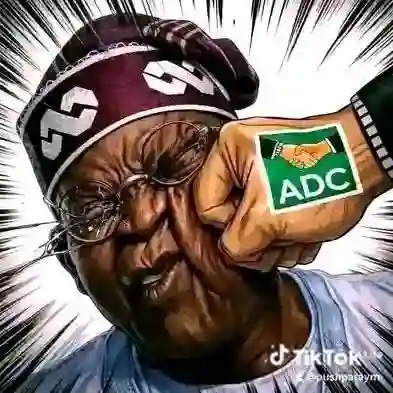
The surgeon is identified. The theatre is prepared. The patient, 220 million Nigerians bleeding from inflation, debt, exclusion and despair, is on the table. The ADC presidential primary will confirm the appointment. The 2027 election will hand over the scalpel.
Nigeria has refused the operation before. It chose sentimentality over surgery in 2023 and the wound has since turned septic. The question now is not who can fix Nigeria. The question is whether Nigeria still has the will to be fixed.
The answer must be yes. The surgeon is available. The time is 2027.
Aare Amerijoye DOT.B,
Director General,
The Narrative Force,
thenarrativeforce.org
1 May 2026