Aare Amerijoye DOT.B
The Number That Built a Presidency
Eight million, seven hundred and ninety-four thousand, seven hundred and twenty-six.
Say it slowly. Let it settle. Because that number — 8,794,726 — is the entire foundation upon which the current presidency rests. That is the vote total that installed an administration, declared a mandate, and asked a nation of two hundred and twenty million people to endure petrol at N1,200, a naira in freefall, and a food inflation rate that has made hunger a daily political event in the homes of ordinary Nigerians.
In a country with over 93 million registered voters, that figure represented barely 9.4 per cent of the entire electorate. It did not emerge from a sweeping national endorsement. It did not emerge from the overwhelming will of a united people choosing their leader. It emerged from the most extraordinary act of mathematical fragmentation in Nigeria’s democratic history — four major candidates splitting a collapsed voter turnout across six geopolitical zones, leaving the man with the most pieces of a shattered whole to claim the title of winner.
That is not a mandate. That is an accident of arithmetic. And accidents do not repeat themselves on demand.
The central strategic question for 2027 is therefore precise, clinical and unavoidable: can the coalition that produced 8.79 million votes under those extraordinary, unrepeatable conditions be reconstructed again?
The answer, when the arithmetic of Nigeria’s geopolitical voting structure is laid bare, is no. Not politically. Not structurally. And certainly not mathematically.
What the 2023 Electoral Map Actually Revealed
Beneath the celebrations in Bourdillon and the declarations in the early hours of 1 March 2023 lay a truth that the noise of victory was designed to obscure. Nigeria had not spoken with one voice. Nigeria had fractured into four competing regional blocs, and the man who understood that fracture most efficiently had harvested the debris.
The APC took 8.79 million. The PDP took 6.98 million. Labour Party took 6.10 million. The NNPP took 1.49 million. Four parties. Four coalitions. One electorate divided against itself.
Add those figures together and you arrive at the real story: 23.36 million Nigerians voted, and 14.57 million of them -,nearly 63 per cent of everyone who turned out — voted against the man who was declared the winner. Tinubu’s victory was not the choice of Nigeria. It was the residue left when Nigeria’s opposition failed to consolidate.
That condition , three opposition forces simultaneously fragmenting, simultaneously cannibalising each other’s base, simultaneously allowing a minority coalition to walk through the gap , is not a political strategy anyone plans. It is a structural accident. And the political landscape of 2026 makes its repetition structurally improbable.
The Realignment That Cannot Be Stopped
Between 2023 and 2026, something irreversible has happened. Economic hardship has performed the organising work that political parties could not. Petrol subsidy removal, naira devaluation, food inflation and the daily assault of a cost-of-living crisis that has no parallel in Nigeria’s civilian history have done what no opposition strategist could accomplish at a negotiating table: they have converted passive dissatisfaction into active political migration.
The fragmented opposition of 2023 is consolidating. The resentments of four separate voter blocs are converging on a single political address. And the 2026 acceptance analysis across Nigeria’s six geopolitical zones is the documentary evidence of that convergence.
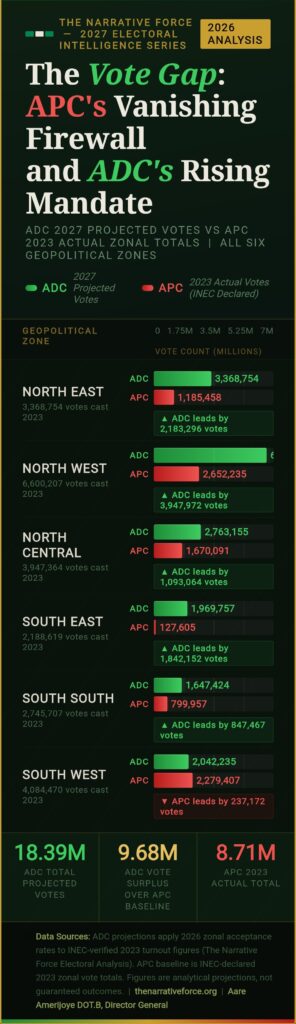
The sentiment data tells us the following. In the North East, ADC acceptance stands at approximately 72 per cent. In the North West, approximately 63 per cent. In the North Central, approximately 58 per cent. In the South East, approximately 78 per cent. In the South South, approximately 58 per cent. And in the South West , Tinubu’s own zone, the zone that built him , ADC acceptance has reached approximately 42 per cent.
These are not vote counts. They are political seismographs, recording the tremors of a tectonic shift in Nigerian electoral sentiment. And when those seismograph readings are applied to the verified INEC vote totals from 2023, the picture they produce is not merely instructive. It is damning.
The Zone-by-Zone Demolition
North East , 3,368,754 votes cast in 2023. ADC acceptance: approximately 72 per cent. ADC projected yield: approximately 2.42 million votes.
This is the zone Atiku Abubakar once owned. The APC now holds 20 per cent of its acceptance. The rest -more than two million votes’ worth of political sentiment , belongs to the emerging coalition. The North East, historically a PDP fortress and in 2023 a zone that delivered Atiku 51 per cent, is now a zone where the opposition’s new vehicle commands near-total dominance.
North West , 6,600,207 votes cast in 2023. ADC acceptance: approximately 63 per cent. ADC projected yield: approximately 4.16 million votes.
Four million, one hundred and sixty thousand votes. From one zone. The North West , the single largest voting bloc in Nigeria, the zone from which Tinubu extracted nearly 2.7 million votes in 2023 and called it his firewall , is now projected to deliver 4.16 million votes to the opposition. That single projection, from that single zone, already surpasses nearly half of Tinubu’s entire 2023 national total. The firewall is ash.
North Central , 3,947,364 votes cast in 2023. ADC acceptance: approximately 58 per cent. ADC projected yield: approximately 2.29 million votes.
The Middle Belt — contested, complex, perpetually transactional — delivers 2.29 million at 58 per cent. This is the zone where the APC invested most heavily in federal appointments, security deployments and gubernatorial patronage as instruments of electoral retention. At 58 per cent ADC acceptance, that investment has yielded a negative return. Two point three million votes leave the APC column and enter the opposition ledger.
South East , 2,188,619 votes cast in 2023. ADC acceptance: approximately 78 per cent. ADC projected yield: approximately 1.71 million votes.
In 2023, Tinubu received 127,605 total votes from five South East states. That is not a typo. One hundred and twenty-seven thousand votes from five states housing tens of millions of citizens. The South East delivered 78 per cent of its political acceptance to the ADC coalition. Applied to 2.19 million actual voters, that acceptance rate generates 1.71 million projected ADC votes ,a swing of more than 1.58 million votes above what the APC managed in the entire zone last time.
South South , 2,745,707 votes cast in 2023. ADC acceptance: approximately 58 per cent. ADC projected yield: approximately 1.59 million votes.**
The creeks have spoken before. They have been bought, suppressed, gerrymandered and patronised. They have been promised NDDC projects that became monuments to corruption and pipelines that delivered oil revenue to Abuja and poverty to the delta. At 58 per cent acceptance, the South South returns 1.59 million projected votes for the opposition. The oil communities have done the mathematics. The mathematics does not favour the incumbent.
South West , 4,084,470 votes cast in 2023. ADC acceptance: approximately 42 per cent. ADC projected yield: approximately 1.71 million votes.
Even here. Even in the spiritual homeland of the Asiwaju project, even in the zone that built Tinubu’s political infrastructure across twenty-five years of Lagos dominance and national alliance-building ,even here, 42 per cent of acceptance translates to 1.71 million projected ADC votes. The South West does not give the ADC a majority. But it gives the ADC 1.71 million votes from the president’s own backyard, and it gives the APC a declining base in the only zone it can genuinely call home. The Yoruba do not award loyalty indefinitely when the terms of the relationship have been dishonoured.
The National Sentence
Six zones. Six projections. One cumulative verdict.
The North East contributes approximately 2.42 million. The North West contributes approximately 4.16 million. The North Central contributes approximately 2.29 million. The South East contributes approximately 1.71 million. The South South contributes approximately 1.59 million. The South West contributes approximately 1.71 million.
Total projected ADC votes from Nigeria’s 2027 presidential election, on the basis of 2023 turnout figures and current acceptance levels: approximately 13.9 million.
Place that beside 8,794,726 , the number that built this presidency — and the arithmetic delivers its verdict without ceremony. The emerging opposition coalition surpasses the 2023 winning threshold by more than five million votes. More than five million. Without a single increase in national voter turnout. Before a single new voter is mobilised. Before the full weight of economic fury translates into electoral participation.
These are not the numbers of a close race. These are the numbers of a reckoning.
The Turnout Factor: The Headwind Nobody in Aso Rock Is Discussing
The 2023 election recorded a turnout of approximately 29 per cent , one of the lowest in Nigeria’s democratic history. That suppressed participation was the product of post-EndSARS political fatigue, security anxieties in northern states, and the uncertainties of a first full cycle of electronic voter accreditation.
The political atmosphere of 2026 is not 2023. Economic pain is not fatigue. Economic pain is fuel. It does not suppress political participation , it detonates it. The young Nigerian who stayed home in 2023 because he was exhausted and sceptical is the same young Nigerian who now cannot afford garri at his neighbourhood market. His scepticism has not grown. His hunger has. And hunger, in the long arc of democratic history across every continent, is the most reliable voter mobilisation instrument ever invented.
A modest increase in national turnout to 35 per cent adds millions of additional votes to the national pool. Under those conditions, with ADC acceptance at current levels, the absolute vote advantage of the consolidated opposition coalition does not narrow. It widens. Every percentage point of increased turnout in the North East, the North West and the South East , zones where ADC acceptance is highest ,is a percentage point that compounds the already devastating arithmetic.
The APC’s strategy for 2027 must somehow reverse a turnout trend that works structurally against it. That is not a political strategy. That is a prayer.
The Constitutional Test: Every Box, Ticked
Winning Nigeria’s presidency requires more than aggregate votes. Section 134 of the 1999 Constitution demands that a presidential candidate obtain at least 25 per cent of the votes cast in two-thirds of the states and the FCT , a minimum of 24 states.
This is where Tinubu’s 2023 victory was most legally exposed. He failed to meet the 25 per cent threshold in the FCT , a matter that generated a Supreme Court battle and remains a contested footnote in the constitutional history of the fourth republic. He scraped his geographical spread requirement through the North West and North Central advantages, surviving the constitutional test rather than dominating it.
The projected ADC coalition does not scrape. At 72 per cent acceptance in the North East, 63 per cent in the North West and 58 per cent in both the North Central and South South, the 25 per cent state-by-state threshold is not a hurdle to be cleared with difficulty. It is a threshold the coalition clears in the way a man of six feet clears a doorway built for four. The constitutional spread requirement, the popular vote requirement, the regional penetration requirement , the ADC coalition, on these numbers, satisfies all of them simultaneously and decisively.
This is not merely a projected popular vote victory. It is a projected constitutional sweep.
The Strategic Verdict
The electoral conditions that produced the 2023 outcome were not the products of APC strength. They were the products of opposition weakness. Historically low turnout. Three-way fragmentation of the anti-incumbent vote. Regional bloc voting that prevented any single opposition candidate from assembling a national coalition. A four-candidate race in which 63 per cent of voters chose someone other than the winner.
Reproduce all four of those conditions simultaneously in 2027 and Tinubu wins again. But reproducing all four simultaneously is not a political operation. It is a conjuring trick. And the conjuring conditions no longer exist.
The opposition is consolidating, not fragmenting. Turnout is rising, not falling. Economic hardship is nationalising political grievance, dissolving the regional segmentation that kept three opposition blocs from uniting in 2023. And the ADC , anchored to the coalition that Atiku Abubakar is building and to the political networks that span from Kano to Calabar, from Maiduguri to Ibadan , is the emerging vessel for that consolidated national anger.
Tinubu built a presidency on 8.79 million votes in a contest where his opposition obligingly destroyed itself. The mathematics of 2027 do not offer him that luxury again.
The numbers are not prophecy. But they are rarely wrong.
And right now, every number in the Nigerian electoral landscape is pointed in one direction.
Aare Amerijoye DOT.B
Director General, The Narrative Force
Acceptance figures cited represent conservative midpoint estimates drawn from the 2026 ADC-APC Geopolitical Acceptance Analysis. Vote totals are sourced from INEC-declared 2023 presidential election results. All projections are analytical and forward-looking, not guaranteed electoral outcomes.