Aare Amerijoye DOT.B
There is a particular silence that falls over a Nigerian household when the generator runs out of fuel and there is no money to buy more. It is not dramatic. It is not loud. It is the silence of a people who have learned, under this government, to lower their expectations quietly and carry on. That silence is the sound of a nation waiting for a different teamsheet.
The African Democratic Congress has dropped it.
Study the formation. Study the names. Then look across the pitch at what the All Progressives Congress has assembled under Bola Ahmed Tinubu, and tell us, honestly, which side looks like a government and which looks like a penalty shootout conducted in the dark, by men who have misplaced both the ball and the goalpost.
THE SQUAD
In goal stands the most important figure of all: the Marginalised Nigerian. Not a politician. Not a party official. The ordinary man in Otuoke who has not seen a functioning petrol station in eight months. The widow in Gashua who now budgets four days between meals. The graduate in Owerri who has submitted three hundred job applications and received three hundred silences. This is who the ADC formation protects. This is who every political decision must ultimately serve. Tinubu’s APC placed the marginalised in goal too, except in their version, the goalpost has been removed, the crowd has been locked outside the stadium, and the match has been declared won by the same men who burnt the tickets.
The defensive line is the conscience of the coalition. Nigerian Suffering Youth and Nigerian Suffering Women anchor that back four alongside Rotimi Amaechi and David Mark, experienced operators who have governed, administered, and negotiated at the highest levels of Nigerian statecraft. Amaechi built infrastructure when infrastructure was considered ambition. Mark stabilised the Senate through crises that would have shattered lesser institutions. They are not decorative. They are load-bearing.
But it is the suffering youth and the suffering women who give this defensive line its moral authority. They are not metaphors. They are the forty million young Nigerians who watched the naira collapse from 460 to over 1,600 to the dollar under a government that promised them renewed hope and delivered renewed hardship. They are the market women of Onitsha and Kano whose trading capital evaporated overnight when fuel subsidies were removed without a single cushioning structure in place. Any formation that does not include them is not a serious formation. Any government that does not protect them is not a serious government.
THE ENGINE ROOM
The midfield drives the vision. Nasir El-Rufai, Rauf Aregbesola, and Abubakar Malami, three men who between them have governed states, commanded federal ministries, and navigated Nigeria’s most complex administrative terrain. They are not men who speak about governance from the outside. They have sat inside the machinery. They know where the levers are. They know, critically, where the levers have been deliberately disconnected, and by whom.
The APC, of course, knows these men intimately, because they built much of the APC with their own hands, their own networks, their own political capital. Their departure from that house is not a footnote. It is a structural report. When the architects of a building walk out, decline to return, and begin construction next door, the question every serious Nigerian must ask is not why they left. The question is what they found inside the walls that made staying unconscionable.
That question has an answer. Nigerians are living inside it.
THE FRONT THREE
Then we arrive at the forward line, and here is where this article must ask the nation to be honest with itself.
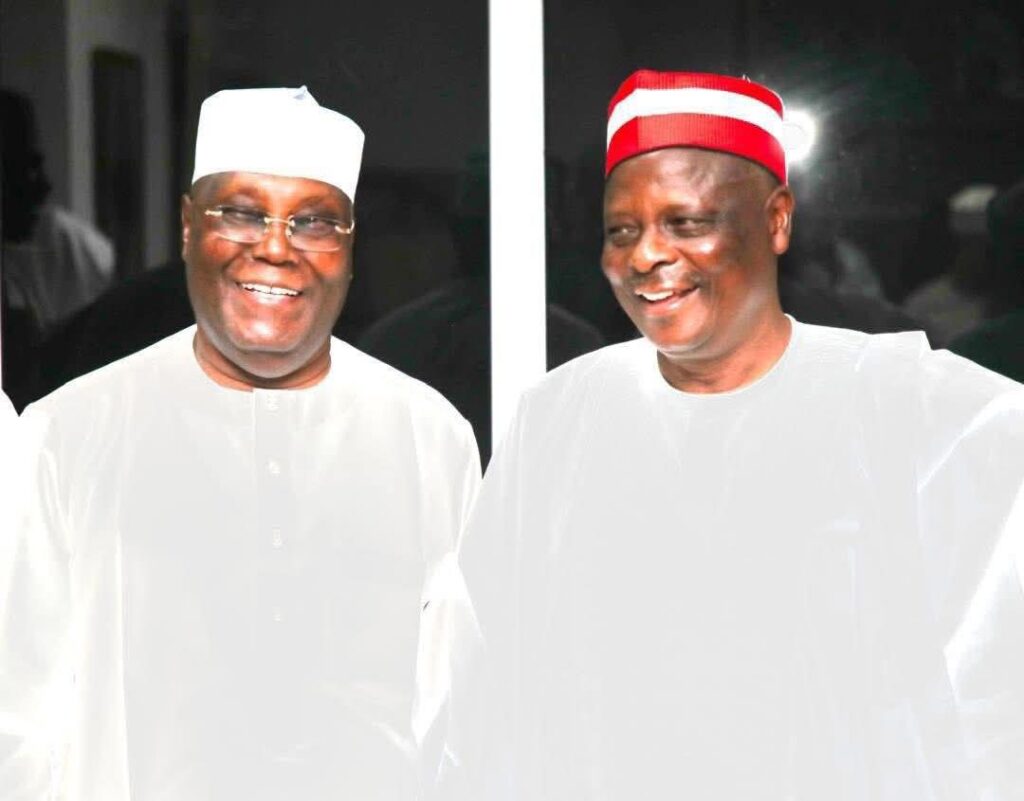
Peter Obi. Rabiu Kwankwaso. Atiku Abubakar.
These three men received a combined total of votes in 2023 that exceeded the winner’s tally. Read that sentence again slowly, because it is the central electoral fact of our political moment. The Nigerian people did not choose Bola Tinubu in 2023. The arithmetic of the ballot box chose a fragmented opposition. The ADC coalition exists precisely to ensure that fragmentation is never repeated, that the votes which were always there are never again split into defeat by a starting formation that lacked coordination.
Some will ask whether Atiku Abubakar, a man who has sought the presidency across multiple cycles, is the right captain for this moment. It is a legitimate question and it deserves a direct answer. A man who has contested, endured, regrouped, built alliances across geopolitical fault lines, and returned each time with a broader coalition is not a man diminished by persistence. He is a man hardened by it. The Nigerian electorate has never yet seen what Atiku Abubakar looks like with a unified opposition behind him, a competent running mate beside him, and the full weight of a betrayed nation at his back. That combination has not been tested. It is about to be.
Atiku wears the captain’s armband on a record. Between 1999 and 2007, as Vice President, Nigeria’s GDP grew from 58 billion dollars to 270 billion dollars. That is not sentiment. That is not campaign rhetoric. That is a number that lives in the data, that has been audited, cited, and verified. The man has been tested at the highest level of economic governance this country offers, and the ledger does not lie.
Obi flanks him with the discipline of a man who balanced a state budget when balancing state budgets was considered eccentric. Kwankwaso arrives from Kano, a state he governed twice, a state whose health and education infrastructure bore his fingerprints long before he was a national name, carrying with him the arithmetic of the North-West, the single most vote-dense region in the federation. This is not a front three assembled for optics. This is a front three assembled to score.
THE OPPOSITION’S TEAMSHEET
Bola Tinubu’s APC cannot field a First 11. What it has fielded, for two years, is a damage limitation squad, a side that defends its own penalty box while insisting it is attacking, that substitutes excuses for strikers, and whose manager has spent the better part of his tenure explaining why the score is not what the scoreboard says it is.
The naira is their own goal, struck cleanly, with conviction, in the first week of the season, and celebrated by no one. Petrol at over 1,300 naira per litre is the missed penalty that the crowd still cannot believe. The electricity tariff hike, imposed on citizens whose power supply arrives as a rumour and departs as a memory, is the red card the referee has declined to issue only because the referee sits in the same dressing room. And the food inflation that has made the average Nigerian market a place of quiet grief, that is not a result of bad luck or global headwinds. That is the consequence of a tactical system designed without the Nigerian people anywhere in the formation.
The Tinubu administration will tell you that global economic conditions are responsible for Nigeria’s suffering. They will invoke inherited debt, post-pandemic shocks, and the necessity of painful structural reforms. Let us test that argument against the data. Ghana, which underwent a comparable currency and debt crisis, negotiated an IMF programme, implemented its own painful adjustments, and has seen its inflation rate begin a measurable decline. Rwanda, with far fewer natural resources than Nigeria, has maintained single-digit inflation through the same global period. The argument that the world economy explains Nigeria’s condition collapses the moment you place Nigeria beside its peers. What separates Nigeria from those countries is not the global environment. It is the quality and integrity of its economic management.
This is not governance. It is a team that has confused the press conference for the pitch.
THE FINAL WHISTLE
Nigeria is not a failed state. It is a state that has been failed, repeatedly, systematically, and at considerable profit to those doing the failing.
The ADC First 11 is not a perfect squad. No squad ever is. But it is a squad assembled around a proposition that Nigerians across every region, every faith, every generation have earned the right to demand: that the people in power should be more afraid of the people than the people are afraid of them.
In 2027, the referee is not in anyone’s dressing room. The referee is the Nigerian voter. And when that final whistle blows, no amount of press conferences, no political manoeuvring, and no institutional capture will be sufficient to reverse what eighty million registered voters write on that ballot.
The teamsheet has dropped.
Study the names.
Study the formation.
Then decide which side of history you intend to stand on when the whistle blows in 2027.
Aare Amerijoye DOT.B
Director General
The Narrative Force