Aare Amerijoye DOT.B
There are moments in the life of a nation when clarity becomes a moral obligation. This is one of such moments. What confronts us is not a puzzle wrapped in ambiguity, but a reality so stark that only those intoxicated by sentiment can pretend not to see it. The prevailing political signals across Northern Nigeria are neither fluid nor confused. They are firm, they are directional, and they are unmistakably inclined towards a Northern presidency. That is not a conjecture fashioned for convenience; it is a reflection of political psychology, demographic weight, and historical behaviour. And in electoral politics, it is from such reservoirs that winning numbers are drawn.
Sentiment must therefore step aside. Strategy must take the wheel.
For too long, Nigerian politics has suffered from the dangerous illusion that emotional appeal can substitute for structural advantage. It cannot. Elections are not won by wishful thinking, nor by rhetorical comfort. They are won by cold calculations, disciplined alignments, and an unflinching understanding of where strength truly resides. That is why any serious pathway to victory must begin with a recognition of where the numbers are most reliably anchored. And today, that anchor sits firmly in the North.
Let us descend from illusion and confront another uncomfortable truth. The South West, under the present configuration, remains a terrain of entrenched incumbency. Bola Ahmed Tinubu does not merely occupy office; he sits atop a deeply rooted political machinery that has been cultivated over decades. Structures, loyalties, influence networks, and institutional leverage converge to give him a formidable advantage in that region. To approach the South West with the mindset of total conquest is to indulge in political fantasy. Our objective must be more intelligent, more surgical. We must compete, we must penetrate, and above all, we must reduce his margins to the barest minimum. Victory there may be improbable, but overwhelming dominance must be made impossible.
This strategic reality is further sharpened by the lived economic experience of Nigerians today. Inflationary pressures have eroded purchasing power, the cost of living has surged beyond sustainable thresholds, and economic hardship has deepened across both urban and rural communities. Yet, hardship alone does not automatically translate into electoral victory for the opposition. Without structure, without coordination, and without disciplined mobilisation, public frustration dissipates rather than consolidates. It is therefore not enough that Nigerians are dissatisfied; that dissatisfaction must be organised into votes, and those votes must be protected.
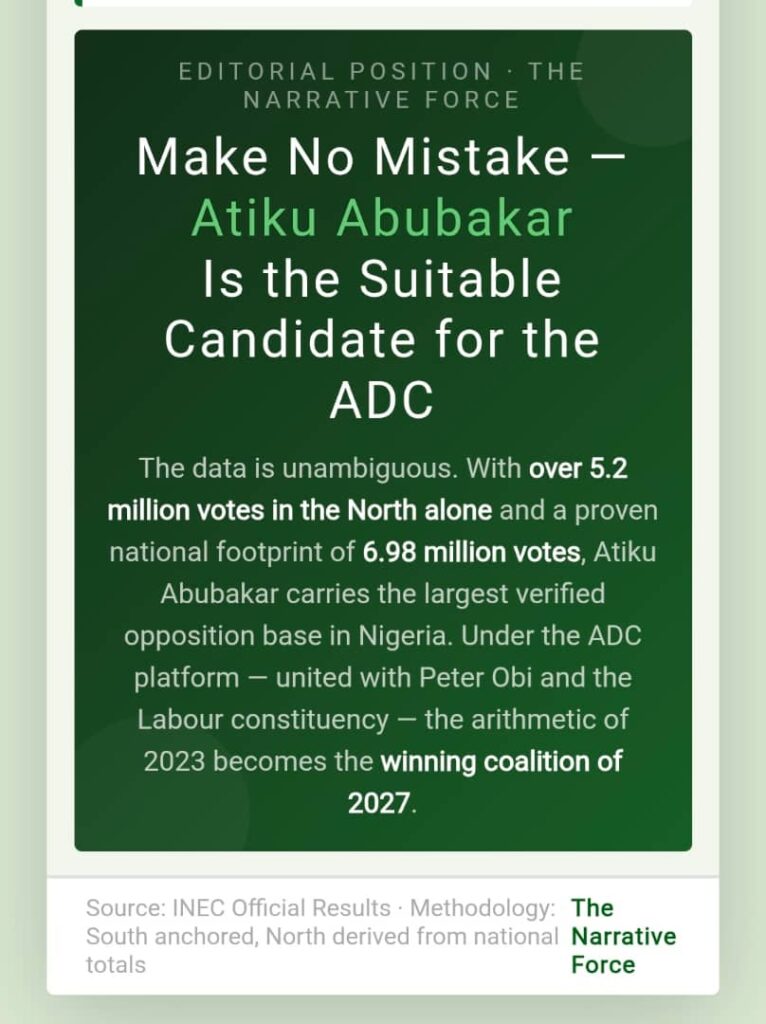
In contrast, the North West and North East present not just opportunities, but strongholds when Alhaji Atiku Abubakar stands as the candidate. This is not a hopeful projection; it is grounded in electoral history, entrenched relationships, and demographic realities. These regions have consistently demonstrated alignment patterns that, when properly mobilised, can produce decisive numbers. To ignore this advantage would be strategic negligence of the highest order.
Now, consider the multiplier effect of unity. If a strategic merger materialises with Peter Obi as the Vice Presidential candidate, the electoral equation shifts dramatically. The South East, driven by identity, loyalty, and political consolidation, naturally aligns within such a framework. What emerges is not merely an alliance, but a formidable bloc spanning three critical regions: the North West, the North East, and the South East. Against this configuration, the APC’s strongest structural dominance remains in the South West, even as it continues to compete across other regions. The map, at that point, begins to tilt with unmistakable clarity.
Yet elections are rarely decided on the obvious terrains. The true theatres of contest, the arenas where outcomes are ultimately forged, will be the South South and the North Central. These regions, fluid in alignment and sensitive to both persuasion and structure, will determine whether victory is narrow or overwhelming.
But politics is not a realm where ideal scenarios always prevail. Should Peter Obi choose the path of independent contest, the architecture changes, but it does not collapse. An Atiku–Amaechi ticket still retains formidable control of the North West and North East. The South South, though potentially fragmented, becomes competitively accessible through the political weight and regional influence of Rotimi Amaechi. The South East would likely consolidate behind Obi, creating a three-way electoral distribution. In such a scenario, the battleground does not shift; it intensifies. The North Central and South South become even more critical, even more decisive, and even more unforgiving.
And here lies the truth many fail to grasp. Elections are not won by colouring maps. They are won by counting numbers.
It is not the spread of states that determines victory, but the depth of votes within them. A narrow win in multiple regions can be defeated by overwhelming margins in fewer ones. The arithmetic of votes is superior to the geography of victories. This is the cold logic that must guide every serious political movement.
And this is precisely where vigilance becomes not just important, but indispensable.
The APC, seasoned in the mechanics of power, will not approach this contest passively. Their strategy, predictable yet potent, will operate on two fronts. In regions where we are strong, they will seek to suppress participation, disrupt mobilisation, and dilute turnout. In regions where they hold advantage, they will maximise turnout, consolidate structures, and expand margins. This is not speculation. It is a tested doctrine in electoral contests.
To confront such a strategy, we must build more than popularity. Popularity without protection is vulnerability. Support without structure is fragility. Enthusiasm without enforcement is futility.
Every polling unit must become a citadel of vigilance. Every vote must be protected with the seriousness of a mandate. Every region where we hold strength must not merely deliver victory, but deliver it in volumes too overwhelming to be undermined. The difference between winning and losing will not lie in speeches or slogans, but in organisation, discipline, and the capacity to defend every single ballot.
This election will not be decided by who speaks the loudest. It will be decided by who counts the most.
It is no longer a contest of rhetoric. It is a contest of arithmetic. A contest of structure. A contest of vigilance.
And as Obafemi Awolowo wisely warned, the greatest danger in politics is not opposition, but self-deception. Nations that mistake sentiment for strategy do not merely lose elections; they mortgage their future.
And those who understand this early will not just participate in history.
They will determine it.
Aare Amerijoye DOT.B
Director General
The Narrative Force