Aare Amerijoye DOT.B
Over 133 million Nigerians live in multidimensional poverty. The naira has lost over 70 percent of its value in three years. Youth unemployment stands at 53 percent. These are not statistics. They are a government’s confession of failure and 2027 is Nigeria’s opportunity to issue the verdict.
I. THE VERDICT OF HISTORY: LEADERSHIP IS EVERYTHING
Nigeria is not poor because her people lack ingenuity. Nigeria is not poor because her soil is barren. Nigeria is poor because she has been governed, decade after decade, by an elite that treats the commonwealth as a personal inheritance.
The evidence is damning. In the 1970s, South Korea and Nigeria had comparable income levels. Today, South Korea exports innovation to every corner of the globe. But the comparison that should shake every Nigerian awake is Rwanda. A country torn apart by genocide in 1994, that buried over 800,000 citizens in one hundred days of unimaginable horror, has rebuilt itself into one of Africa’s cleanest, most efficient, fastest-growing economies. Kigali has better roads than Abuja. Rwanda’s hospitals function. Her government answers to her people. Nigeria, with all her oil, all her land, all her talent, cannot make the same claim.
The difference is not resources. The difference is leadership.
“Each of their contemporaneous economies succeeded while ours failed, fundamentally because of the wide variability in the quality of the leadership that pursued their nations’ visions compared to ours.” — Oby Ezekwesili
We have not lacked resources. We have lacked leaders willing to deploy them for the people. We have not lacked brilliant citizens. We have lacked a government worthy of them. That era of organised mediocrity must end in 2027.
II. THE ELITE THAT FEASTS WHILE NIGERIA BURNS
There is a particular species of leader that has dominated Nigerian public life — one who rises not through demonstrated service but through manipulation, patronage, and the art of managing perceptions. They accumulate wealth as their constituencies rot. They invoke God at the pulpit while they loot at the treasury. And when they are done looting one party, they cross the aisle, rebrand, and loot the next.
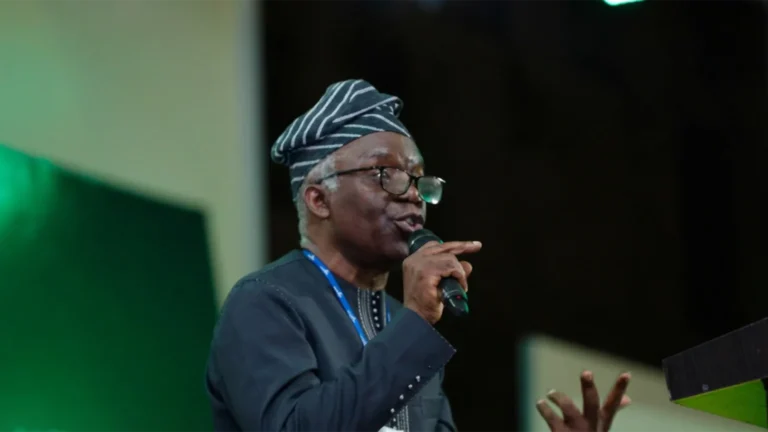
Nigeria’s foremost human rights lawyer, Barrister Femi Falana (SAN), has named this pathology without flinching. “The Nigerian ruling class has consistently looted the treasury and stashed the proceeds abroad while the majority of Nigerians wallow in abject poverty,” Falana has stated. “Until we have a government prepared to recover stolen assets and invest them in the welfare of the people, we will continue to go in circles.”
Those are not the words of a partisan. They are the words of a man who has faced tear gas, detention, and the hostility of successive governments without blinking and who refuses to pretend that Nigeria’s suffering is inevitable.
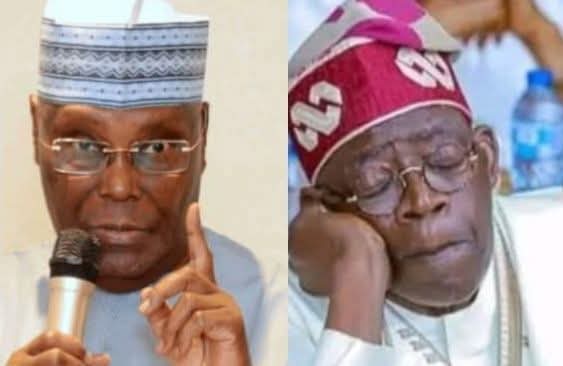
This is the machine that the ADC and Atiku Abubakar have pledged to dismantle, root and branch.
III. THE ATIKU STANDARD: A RECORD, NOT A PROMISE
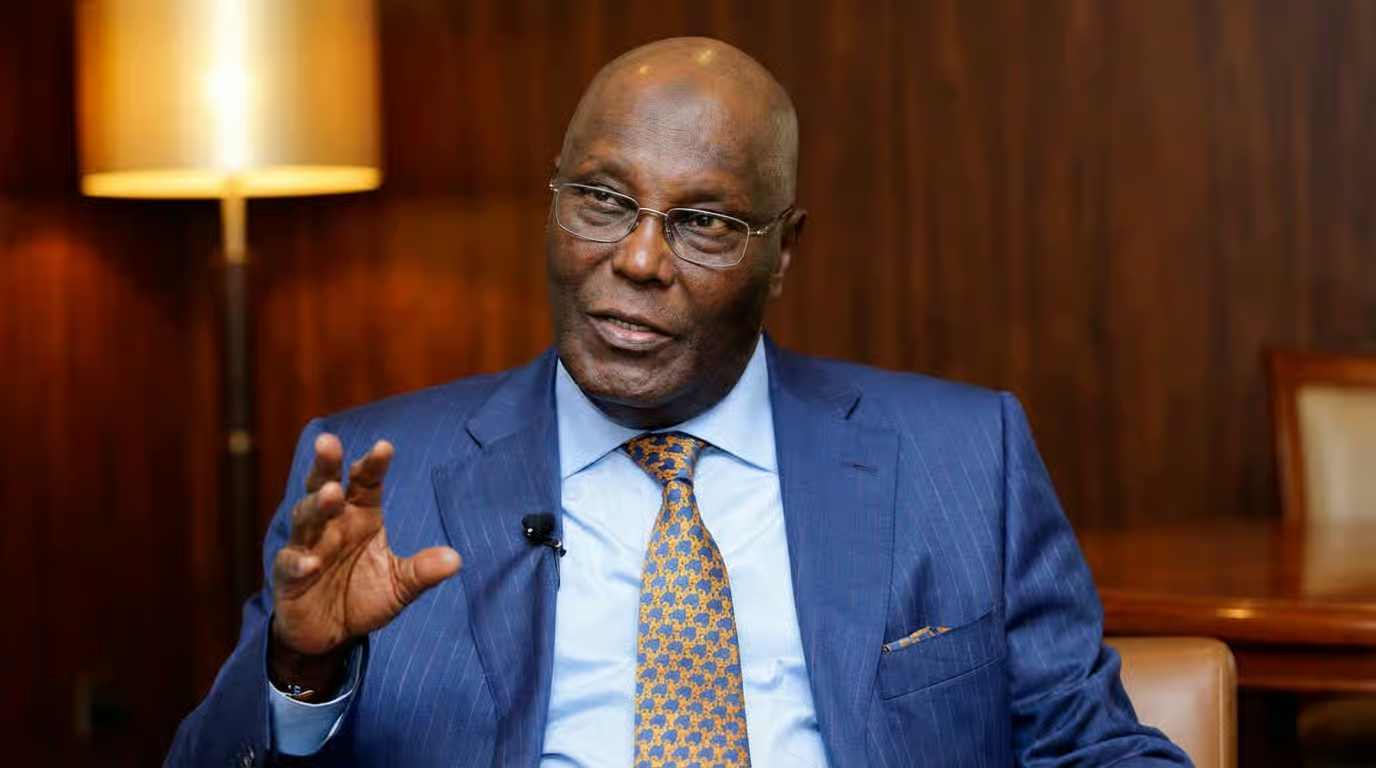
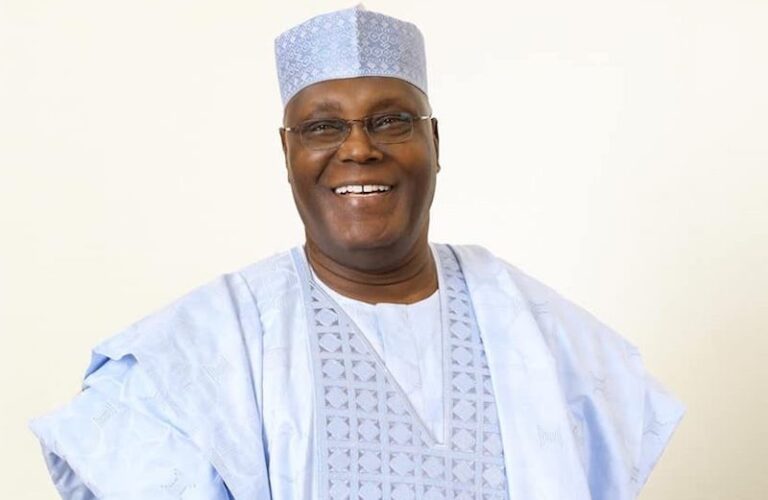
Atiku Abubakar is not an untested proposition. As Vice President from 1999 to 2007, he presided over the most aggressive privatisation programme in Nigerian history. Ports were concessioned. The telecommunications sector was liberalised. That single decision today connects over 200 million Nigerians, underpins an industry worth trillions of naira, and has produced some of the continent’s most innovative technology businesses. He did not just talk about private sector growth. He engineered it.
His critics ask: why has he run before and not won? The question deserves a direct answer. Atiku’s previous contests were not lost on merit. They were stolen. In 2007, international observers condemned the election as massively flawed. In 2019, evidence of widespread manipulation was documented by credible domestic and foreign observers alike. The system did not defeat Atiku. The system feared Atiku — because a President Atiku would not allow business as usual to continue.
Falana, never a man to offer flattery where scrutiny is warranted, has insisted that any government coming to power in Nigeria “must be ready to implement the provisions of the Nigerian constitution, particularly those that guarantee the right to education, health care, and a living wage for workers.” Atiku has made those precise commitments the centrepiece of his 2027 platform — not as rhetoric, but as a man who has demonstrated, in business and in office, that he knows how to build systems that actually deliver.
IV. THE ADC: RUPTURE, NOT RECYCLING.
The two dominant parties have governed Nigeria in rotation for nearly three decades. Under their watch, infrastructure has crumbled, the naira has collapsed, millions have been pushed below the poverty line, and banditry has seized territory that was once peaceful. These are not opposition talking points. They are documented facts that every Nigerian lives every single day.
Our best and brightest are fleeing in a japa wave of historic proportions, carrying their degrees and their dreams to countries that deserve them more than we have allowed ourselves to deserve them. And yet, come election season, the same faces return, offering the same promises, generating the same devastation.
The African Democratic Congress is not another vehicle for the same passengers. It has built genuine grassroots networks across all six geopolitical zones. It has recruited professionals, technocrats, and community leaders , not recycled politicians in fresh agbadas. It has committed to internal democracy as a non-negotiable operating principle. Falana has declared that Nigerians must resist surrendering their votes to those who have already proven they will not govern in the public interest. The ADC was built on exactly that resistance.
Nigerian citizens are not objects of governance. They are the very purpose of governance. Their prosperity, their security, their access to education and healthcare are not privileges. They are rights and 2027 is the year Nigerians collect.
V. ONE NIGERIA, ONE AGENDA
No presidential campaign that speaks to only one region deserves national power. Atiku understands this in his bones.
Born in Jada, Adamawa State, he is a son of the North who has governed, traded, and built across every fault line this country has manufactured. His Intels Group alone has employed tens of thousands of Nigerians from every state, every tribe, every faith. His vision for restructuring is not a Southern agenda imposed on the North. It is a Nigerian agenda — one that recognises that a Kano manufacturer, a Port Harcourt trader, a Lagos entrepreneur, and an Enugu farmer all deserve a government that works for them with equal commitment.
The North has suffered grievously. Banditry has turned Zamfara, Sokoto, and Kebbi into theatres of terror. Almajiri children fill the streets of Kano while billions meant for their education vanish into private pockets. The South has bled too. The Niger Delta remains an ecological catastrophe. South-East roads have collapsed into neglect. Lagos strains under a population that government has never adequately planned for.
This suffering is not regional. It is national. A national crisis demands a national leader. That leader is Atiku. That vehicle is the ADC.
VI. THE BLUEPRINT: WHAT VICTORY ACTUALLY DELIVERS.
Under an Atiku-led ADC government, Nigeria will witness the most aggressive pro-growth agenda in her history. Genuine fiscal federalism that gives states real control over their resources. An industrialisation strategy anchored in agro-processing, solid minerals, and manufacturing ,sectors where Nigeria has abundant raw materials and almost no value addition. A revolution in power generation. A technology policy that positions Nigeria’s 50 million digitally native youth as architects of Africa’s knowledge economy.
And a war on corruption so thorough that it does not merely jail a few high-profile thieves for spectacle , it dismantles the institutional culture that made the stealing possible in the first place.
These are not slogans. They are the ideas that transformed Malaysia from a rubber-tapping economy into a global manufacturing hub. They are the ideas that turned Dubai, a desert with no oil, into the business capital of an entire region. They work everywhere they are applied with discipline and political will. Nigeria has the discipline in her people. What she has lacked is the political will at the top. That changes in 2027.
VII. THE MORAL VERDICT
Femi Falana (SAN) has stated it with surgical precision: “Poverty in Nigeria is not natural. It is the result of wrong policies, corruption, and the deliberate marginalisation of the majority by a tiny, powerful elite.”
That verdict is confirmed every time a child sits in a classroom with no roof. Every time a graduate hawks recharge cards on an expressway. Every time a widow is turned away from a public hospital because she cannot pay unofficial fees. These are not acts of God. They are acts of a government that has chosen, repeatedly, not to govern for the people.
We cannot afford another cycle of performative governance. We cannot afford another administration that mistakes noise for action, motion for progress, survival for success. The generation inheriting this country deserves better than the wreckage being handed to them.
This is not merely an election. It is Nigeria’s most consequential civilisational choice since independence. The ADC and Atiku do not just offer a better government. They offer a fighting chance at a better Nigeria — and Nigerians must seize it with both hands.
JOIN THE ADC. REGISTER. MOBILISE. VOTE.
Bring your family. Bring your street. Bring your market. Bring your church. Bring your mosque. Bring every Nigerian who has ever looked at this country and wept — because now, finally, there is something worth fighting for.
The moment is 2027. The movement is ADC. The man is Atiku.
In 2027, Nigeria votes for Atiku. Nigeria votes for the ADC. Nigeria votes for itself.
Aare Amerijoye DOT.B
Director General
The Narrative Force