
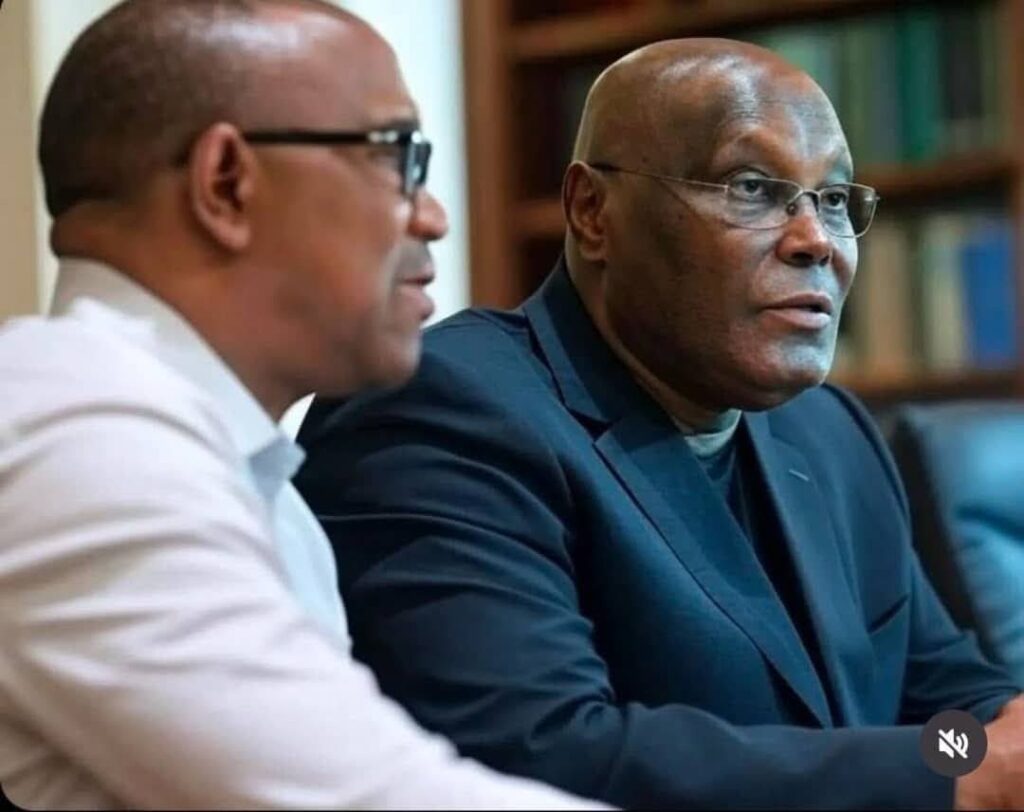
Aare Amerijoye DOT.B
Nigeria stands at a defining hour. Inflation has thinned household tables. Youth unemployment has dimmed once-bright ambitions. The naira has endured turbulence. Businesses strain under policy uncertainty. In such a moment, leadership cannot be experimental. It cannot be rhetorical. It must be competent, courageous and economically literate.
In this charged national atmosphere, one figure continues to embody tested capacity, strategic depth and reform-driven clarity , Atiku Abubakar. Not as myth. Not as nostalgia. But as a structured alternative forged by experience, resilience and economic understanding.
As 2027 approaches, the choice before Nigeria will not merely be political. It will be existential. Stability or stagnation. Reform or repetition. Competence or improvisation.
1.An inexhaustible passion for placing Nigeria on the right political and economic pedestal
While others manage headlines, Atiku has consistently focused on systems. His advocacy for economic restructuring, private sector empowerment and fiscal discipline has not wavered across decades. In a nation where policy reversals have eroded investor confidence, consistency becomes a strategic asset. His passion is not theatrical. It is architectural.
2.Towering intellect refined by calm wisdom
Nigeria does not merely need intelligence. It needs disciplined intelligence. Atiku combines analytical sharpness with executive patience. He understands macroeconomic frameworks, federal dynamics and global trade realities. Yet he tempers knowledge with reflection, avoiding impulsive policy oscillations that destabilise markets and citizens alike.
3.The rare gift of simplifying complexity
Economic reform is often communicated in abstractions that alienate the public. Atiku possesses the ability to translate fiscal reform, decentralisation and institutional restructuring into language the trader, the teacher and the technician can grasp. Leadership that cannot communicate clearly cannot mobilise effectively.
4.Respect across political divides
In a deeply polarised environment, Atiku commands recognition even among critics. Political actors across party lines acknowledge his strategic acumen. That respect is not accidental. It is the product of decades of negotiation, coalition-building and democratic endurance. Nigeria’s complexity requires bridge-builders, not barricade-builders.
5.Acute awareness of the real struggles of ordinary Nigerians
The hardship confronting citizens is not abstract. It is lived daily ,at fuel stations, in markets, in classrooms and on factory floors. Atiku’s discourse repeatedly centres economic relief, job creation and structural reform. He speaks not from insulated privilege, but from an understanding that governance must first stabilise the lives of its people.
6.Imagination anchored by decisiveness
Vision without execution breeds frustration. Execution without vision breeds confusion. Atiku’s political history reflects both strategic imagination and administrative decisiveness. Reforming institutions, strengthening economic structures and decentralising productivity require precisely that balance.
7 A seasoned politician tempered by maturity
Nigeria’s political terrain is turbulent. It tests temperament. It rewards endurance. Atiku has navigated opposition, alliances and transitions without abandoning democratic engagement. His maturity is steadiness under pressure.
8.Entrepreneurial pedigree and economic insight
Unlike career politicians detached from economic production, Atiku understands enterprise from within. He has built institutions, created employment and navigated investment climates. That lived economic experience equips him with practical insight into how policies affect business growth, job creation and national revenue.
9.Consistency of ideological direction
From restructuring advocacy to market-oriented reforms, Atiku’s economic philosophy has demonstrated continuity. In a policy environment often characterised by abrupt reversals, that steadiness signals predictability , a key ingredient for economic recovery.
10.Development centred on citizens, not ceremony
Development must translate into infrastructure, education, productivity and decentralised opportunity. Atiku’s vision consistently prioritises structural empowerment over symbolic gestures. Prosperity must reach households, not merely podiums.
11.Aversion to hollow promises
Political cycles often produce dramatic declarations detached from implementation capacity.Atiku’s messaging has leaned toward structured frameworks rather than applause lines. That restraint signals seriousness.
12.Commitment to measurable reform
His tenure as Vice President was associated with economic reform initiatives that strengthened institutional frameworks and private sector participation. Reform is not comfortable. But stagnation is costlier.
13.Transcending identity fault lines
Nigeria’s diversity is a strength if managed wisely and a liability if manipulated recklessly. Atiku’s political posture emphasises national integration over sectional advantage. Unity requires courage.
14.Solutions-driven orientation
Where complaint dominates discourse, Atiku emphasises frameworks. Decentralised governance. Investment climate reform. Fiscal restructuring. Institutional strengthening. These are not slogans; they are policy directions.
15.Capacity to mobilise across demographics
From youth engagements to professional communities, Atiku’s outreach reflects intentional coalition-building. A nation as plural as Nigeria cannot be governed through exclusion.
16.Executive experience at the highest level
Having served as Vice President, Atiku understands cabinet dynamics, federal bureaucracy and economic coordination. Governance is complex. Experience reduces costly learning curves.
17.Multisectoral exposure
Business, public administration, international engagement , his exposure spans arenas that modern leadership must navigate simultaneously. Global capital flows, domestic policy constraints and social expectations intersect. Familiarity with these intersections matters.
18.Vision of systemic renewal
Atiku’s broader vision points toward productivity replacing dependency, decentralised growth replacing central bottlenecks, and opportunity replacing economic suffocation. Reform must be structural, not cosmetic.
19.Listening leadership
Consultation is not weakness. It is intelligence distributed. Town halls, stakeholder engagements and cross-regional dialogues reflect a belief that leadership must absorb before it directs.
20.Preparedness for decisive transition
Nigeria’s next chapter demands steadiness, not experimentation. Economic literacy. Political maturity. Administrative familiarity. Strategic clarity. Atiku presents himself as prepared to confront systemic weakness with reform-driven resolve.
Nigeria cannot afford cyclical disappointment. It cannot continue navigating economic turbulence without structural recalibration. The stakes in 2027 will extend beyond party banners. They will touch livelihoods, security, investment confidence and generational opportunity.
History does not reward hesitation. It remembers courage.
History does not celebrate excuses. It records results.History does not bend to sentiment. It answers to competence.
2027 will not simply be another election year.It will be a verdict on direction.
Aare Amerijoye DOT.B
Director General,
The Narrative Force


I think is a good idea
Comrade Abdullahi, the ADC is not just a good party. It is the right party at the right moment in Nigeria’s history. A party built on conscience, coalition, and the genuine will to rescue this nation. Welcome aboard and stay engaged.
Good party