
Alex Ter Adum,Ph.D
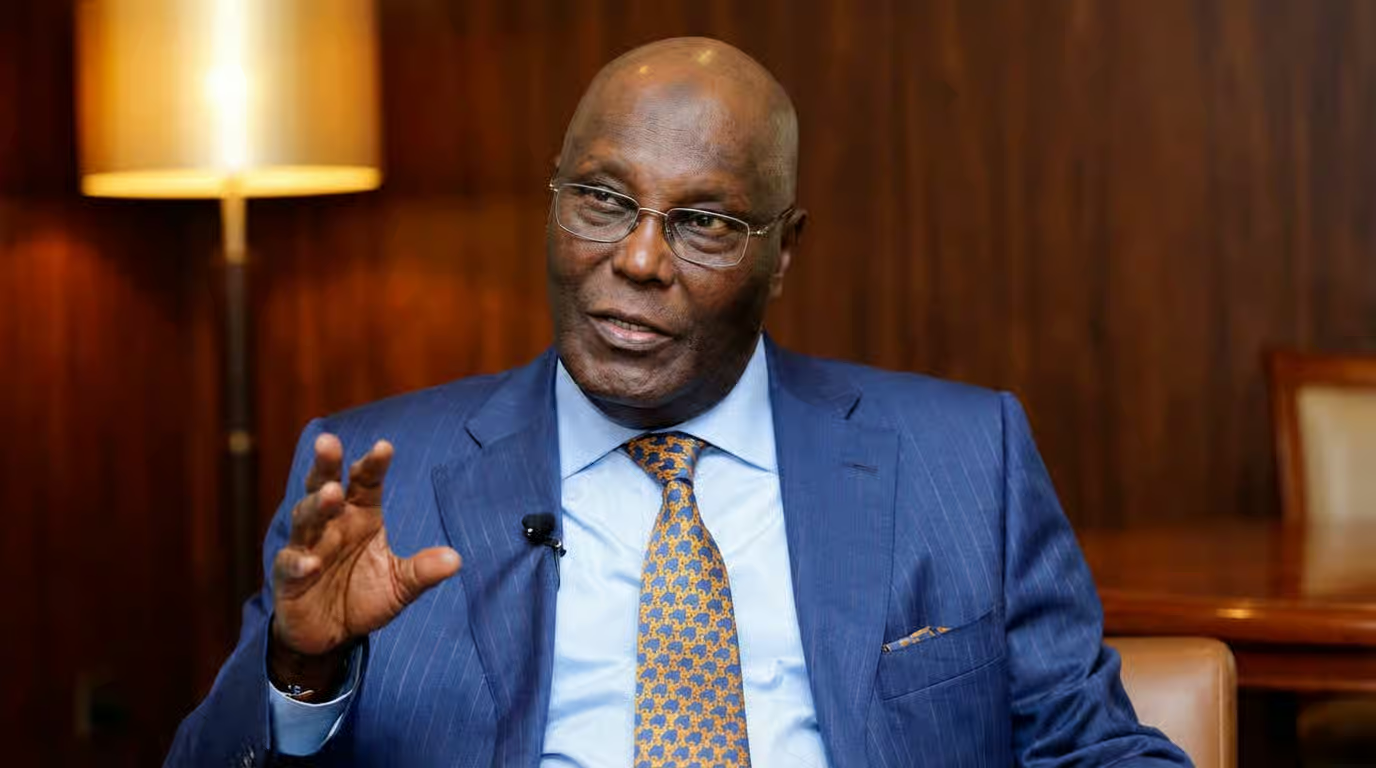
The call by H.E. Donald Duke, former governor of Cross River State, urging H.E. Atiku Abubakar not to contest the 2027 presidential election because he has been “contesting since 1992” on the occasion of his formal defection to the ADC is not only astonishingly shallow, it is a textbook example of lazy reasoning dressed up as elder statesmanship.
Let us begin with first principles. H.E Donald Duke as lawyer knows that the Constitution of the Federal Republic of Nigeria does not impose a term limit on ambition. It imposes limits only on tenure once elected. As long as a citizen meets the constitutional requirements, contesting for office is not a favour to be begged for, nor a privilege to be withdrawn by retired political commentators. It is a right. Atiku Abubakar does not need permission—moral or political—from anyone to exercise it.
Ironically, what Donald Duke frames as a weakness is, in truth, one of Atiku’s greatest strengths. Longevity in politics, when untainted by tyranny or incompetence, is called commitment to democracy. By that warped logic, Nelson Mandela should have quit politics early, and Winston Churchill should have retired quietly after losing elections. Persistence is not a crime; it is often the price of conviction.
The zoning argument fares no better. Zoning is not a constitutional doctrine; it is an internal party arrangement—useful when convenient, disposable when not. History is unkind to selective amnesia. It was first spectacularly breached when Goodluck Jonathan, after succeeding President Yar’Adua in 2010, insisted on contesting in 2011 and again in 2015—despite the fact that President Obasanjo from the South had completed eight full years just four years earlier. Nobody then sermonised about “too much ambition.”
Even more damning is the Buhari precedent. Muhammadu Buhari contested every presidential election from 2003 to 2011, against incumbents from both the South and the North. He lost repeatedly, persisted unapologetically, and eventually won in 2015—against Jonathan—while the presidency was still in the South.
By Donald Duke’s new doctrine, Buhari should have been permanently benched long before victory.
As for age or health, Atiku Abubakar has shown no physical or mental infirmity that remotely disqualifies him from office. On the contrary, he remains agile, coherent, nationally mobile, and intellectually engaged—fully capable of squaring up against his contemporary, President Bola Tinubu of the APC who though declares 73 is well past his mid 80s by authoritative accounts.
If age is suddenly a problem, then consistency demands it be applied universally, not opportunistically.
What is truly dangerous is the suggestion that Atiku should be excluded by fiat rather than tested by democracy. The law is clear: parties must choose candidates through democratically conducted primaries.
And for the ADC, this is not optional. Exclusion is not strategy; it is fear. The party’s strength lies in open competition, not gatekeeping.
H.E Donald Duke should also be reminded of recent history. While he joined forces with renegade elements within the PDP to weaken it—effectively greasing the path toward an APC one-party state—Atiku Abubakar chose the harder road: walking away to help build a new coalition, the ADC, with other compatriots committed to pluralism. To now defect into a house others built and demand that the builder must not live in it smacks unmistakably of a fifth columnist agenda.
ADC should resist such destabilisation—politely, firmly, and democratically.
Finally, if Donald Duke truly believes in his own competence, capacity, and relevance, the path is simple: declare, campaign, and compete. If not, he may wish to redirect his considerable talents toward reinventing his battered political image back home in Cross River—where, by prevailing sentiment, he is not even considered fit for a senatorial ticket.
Democracy rewards courage, not commentary. Let the people decide.
Alex Ter Adum, Ph.D
DDG THE NARRATIVE FORCE