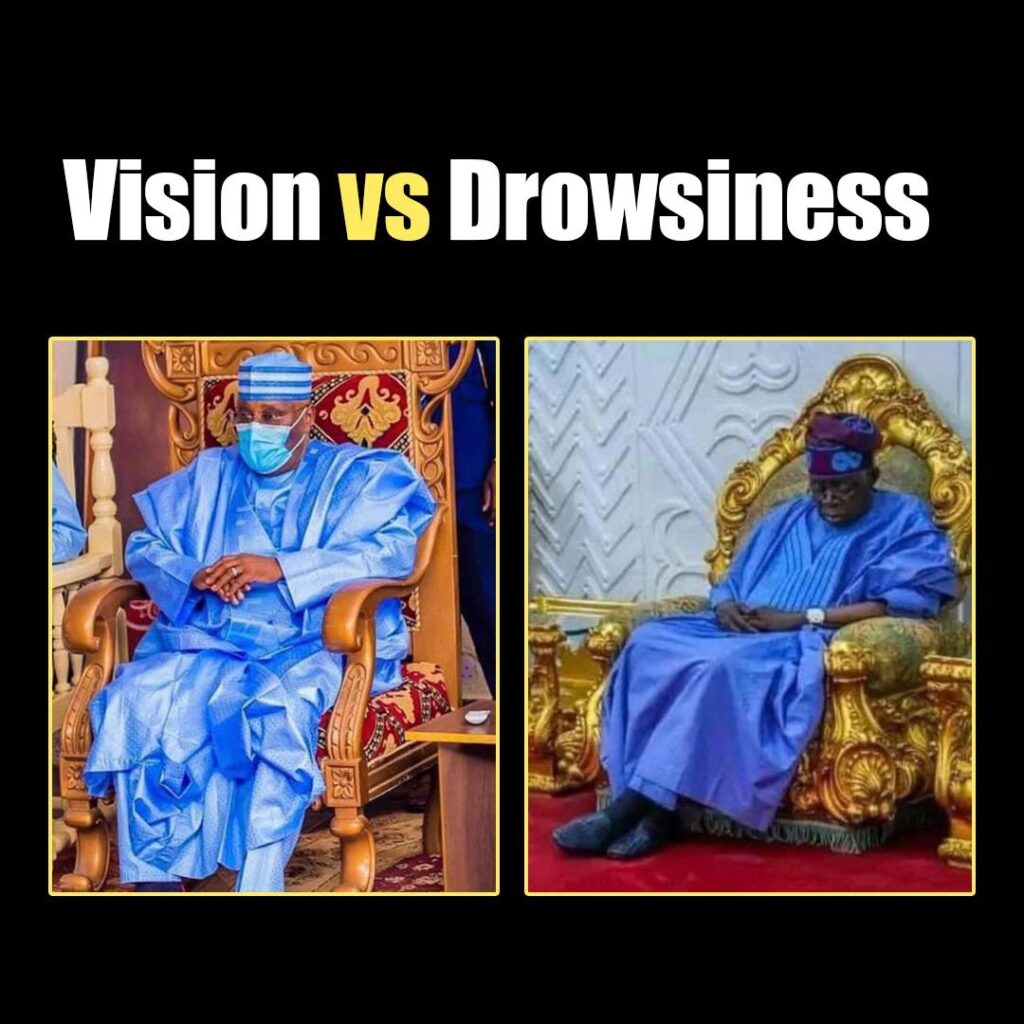
WHEN LEADERSHIP LOSES ITS BALANCE.

Aare Amerijoye DOT.B

There are moments in a nation’s life when images stop being incidental and begin to function as evidence. When what the public sees confirms what it has long endured. Nigeria is living through such a moment.

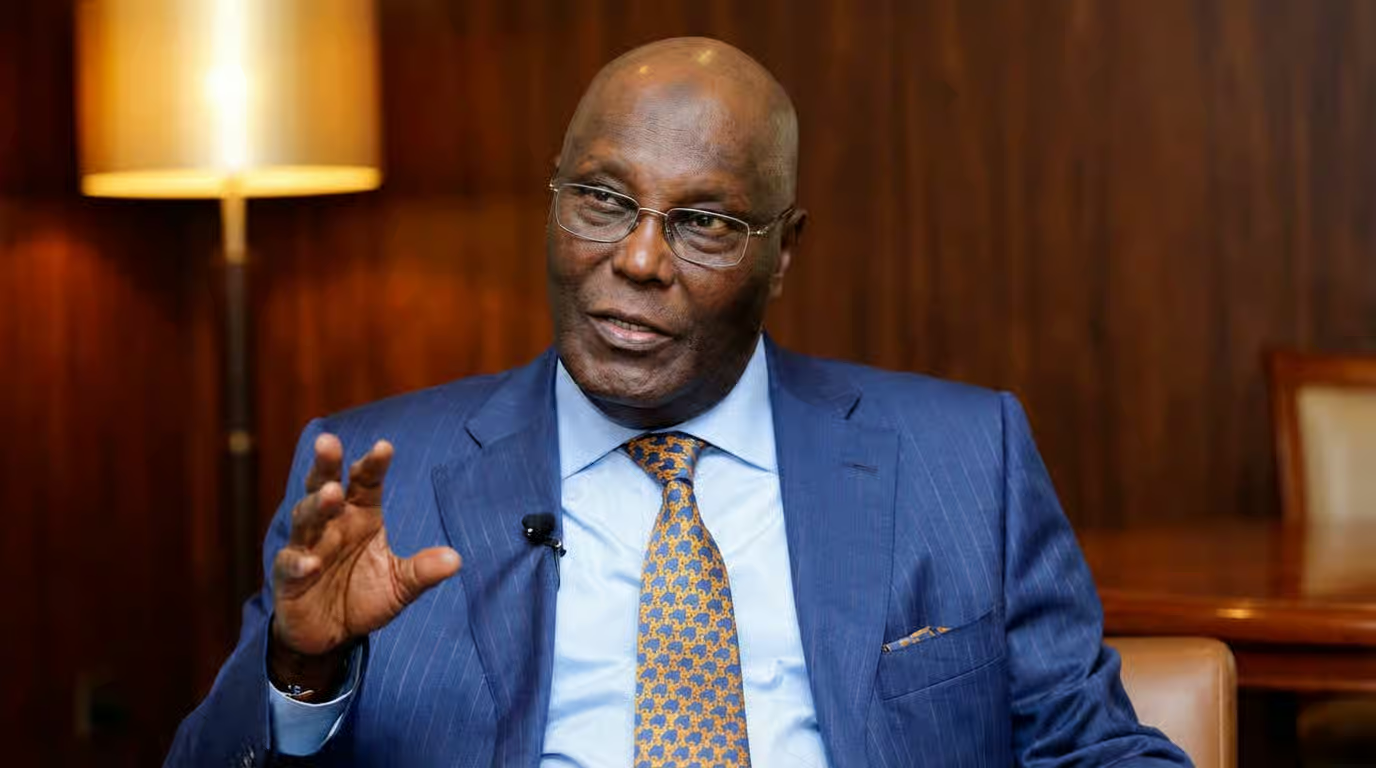
Under the stewardship of Bola Ahmed Tinubu, the country has descended not merely into economic hardship but into a deeper and more dangerous condition: administrative imbalance. Decisions wobble. Policies stagger. Explanations arrive breathless and belated, while consequences strike with ruthless immediacy. What Nigerians experience daily is not governance under pressure, but governance struggling to stay upright.

From the fuel subsidy debacle to the violent oscillations of the naira, from suffocating inflation to spreading insecurity, the Nigerian state now behaves like a structure built on exhaustion. Markets are anxious, workers are drained, families are rationing hope alongside food. This is not reform. It is a nation being managed by fatigue.

William Blake once warned that “If the doors of perception were cleansed, everything would appear to man as it is.” Blake wrote from the margins of power, dismissed in his lifetime, yet he understood what rulers often forget: when perception is clouded, reality becomes distorted. Today, Nigeria suffers not just from bad policy, but from blurred perception at the centre of power. This explains the contradictions, the policy reversals, the improvisations masquerading as strategy. A government that constantly explains itself is a government that has lost its grip on consequence.

The tragedy of the APC era is not simply that Nigerians are suffering; it is that suffering has been normalised. Pain is explained away. Hunger is intellectualised. Failure is rebranded as patience. Under the watch of the All Progressives Congress, hardship has been turned into a permanent policy environment.

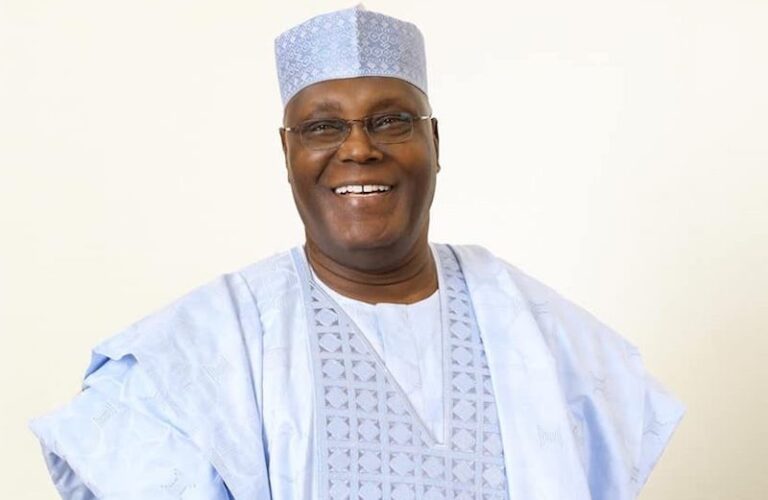
Contrast this with the widely circulated footage of Atiku Abubakar playing football—moving with coordination, balance, and alertness. This is not theatre. It is not symbolism manufactured for applause. It is a quiet but powerful demonstration of readiness. Leadership is not about appearing; it is about endurance under pressure. A nation of over two hundred million people cannot be governed by reaction, excuses, or a shrinking circle of damage control.

Robert K. Greenleaf, the philosopher of servant leadership, insisted that “The true test of leadership is whether those served grow as persons.” Greenleaf arrived at this insight after decades inside large institutions where authority was loud but ineffective. He understood that leadership obsessed with control rather than service produces dependency, not development. By this measure, Nigeria under APC rule has failed profoundly. Citizens are shrinking, not growing. Youth energy is consumed by survival, not innovation. Enterprise suffocates before it matures. Migration is no longer ambition-driven; it is oxygen-seeking.

Under Tinubu and the APC, governance has become ceremonial while power drifts away from responsibility. Empathy has evaporated. Accountability has thinned. The state reacts instead of anticipating. This is what happens when leadership loses its balance.

This is why comparison is unavoidable. Not out of mockery, but out of necessity. Leadership is contrast. Vision is alertness. Capacity is stamina. Governance is not poetry; it is performance sustained over time.

The alternative emerging around the African Democratic Congress is not sentimental noise. It is a demand for seriousness. ADC represents a refusal to canonise exhaustion and incompetence. And Atiku Abubakar represents something dangerously scarce in Nigeria’s political space today: structural readiness—mentally, physically, and institutionally.

Nigeria does not need slogans. Nigeria needs balance.

Nigeria does not need excuses. Nigeria needs capacity.

Nigeria does not need symbolism. Nigeria needs leadership that can stand steady while carrying the full weight of the state.

When leadership loses its balance, the nation staggers.Nigeria must decide whether it will continue to stagger or regain its footing.

Aare Amerijoye DOT.B
Director-General,
The Narrative Force (TNF)

Aare Amerijoye Donald Olalekan Temitope Bowofade (DOT.B) is a Nigerian political strategist, public intellectual, and writer. He serves as the Director-General of The Narrative Force (TNF), a strategic communication and political-education organisation committed to shaping ideas, narratives, and democratic consciousness in Nigeria.An indigene of Ekiti State, he was born in Osogbo, then Oyo State, now Osun State, and currently resides in Ekiti State. His political and civic engagement spans several decades. In the 1990s, he was actively involved in Nigeria’s human-rights and pro-democracy struggles, participating in organisations such as Human Rights Africa and the Nigerianity Movement among many others, where he worked under the leadership of Dr. Tunji Abayomi during the nation’s fight for democratic restoration.Between 2000 and 2002, he served as Assistant Organising Secretary of Ekiti Progressives and the Femi Falana Front, under Barrister Femi Falana (SAN), playing a key role in grassroots mobilisation, civic education, and progressive political advocacy.He has since served in government and party politics in various capacities, including Senior Special Assistant to the Ekiti State Governor on Political Matters and Inter-Party Relations, Secretary to the Local Government, and Special Assistant on Youth Mobilisation and Strategy. At the national level, he has been a member of various nationally constituted party and electoral committees, including the PDP Presidential Campaign Council Security Committee (2022) and the Ondo State 2024 election committee.Currently, he is a member of the African Democratic Congress (ADC) and serves as Secretary of the Ekiti State ADC Strategic Committee, where he plays a central role in party structuring, strategy, and grassroots coordination.Aare Amerijoye writes extensively on governance, leadership ethics, party politics, and national renewal. His essays and commentaries have been published in Nigerian Tribune, Punch, The Guardian, THISDAY, TheCable, and leading digital platforms. His work blends philosophical depth with strategic clarity, advancing principled politics anchored on truth, justice, and moral courage.

Leave a Reply

Your email address will not be published. Required fields are marked *

Recent News

Trending News

Editor's Picks

THE AUTOPSY WE MUST NEVER CONDUCT

Aare Amerijoye DOT.B. If we will not like gathering in 2027 to conduct a political postmortem, dissecting how victory slipped through our fingers, how history brushed past us but refused to embrace us, then the time for lamentation must give way to mobilisation. Reflection without reorganisation is self-deception. Memory without structure is ritual mourning. Politics,...

ATIKU ABUBAKAR: A BEACON OF NIGERIAN LEADERSHIP EXCELLENCE

Aare Amerijoye DOT.B Nigeria stands at a defining hour. Inflation has thinned household tables. Youth unemployment has dimmed once-bright ambitions. The naira has endured turbulence. Businesses strain under policy uncertainty. In such a moment, leadership cannot be experimental. It cannot be rhetorical. It must be competent, courageous and economically literate. In this charged national atmosphere,...

Nigeria’s Democracy at Risk: Senate’s Rejection of Mandatory Electronic Transmission Reopens Door to Electoral Manipulation

By Kunle Oshobi In what critics are calling a devastating blow to Nigeria’s electoral integrity, the Nigerian Senate has rejected proposals to make the electronic transmission of election results mandatory, opting instead to retain ambiguous language that leaves critical loopholes open for potential manipulation ahead of the 2027 general elections. During the clause-by-clause consideration of...

NIGERIANS MUST REJECT SENATE’S TECH ILLITERACY AS ELECTORAL POLICY

The Akpabio-led Senate is fast proving itself to be an anti-democratic contraption. I have listened carefully to the arguments advanced by the Senate President Godswill Akpabio and the Senate spokesperson and other proponents of retaining the discretionary provisions of 2022 Electoral Act on electronic transmission of results rather than upholding the mandatory provisions of the...

Must Read

©2026. The Narrative Force. All Rights Reserved