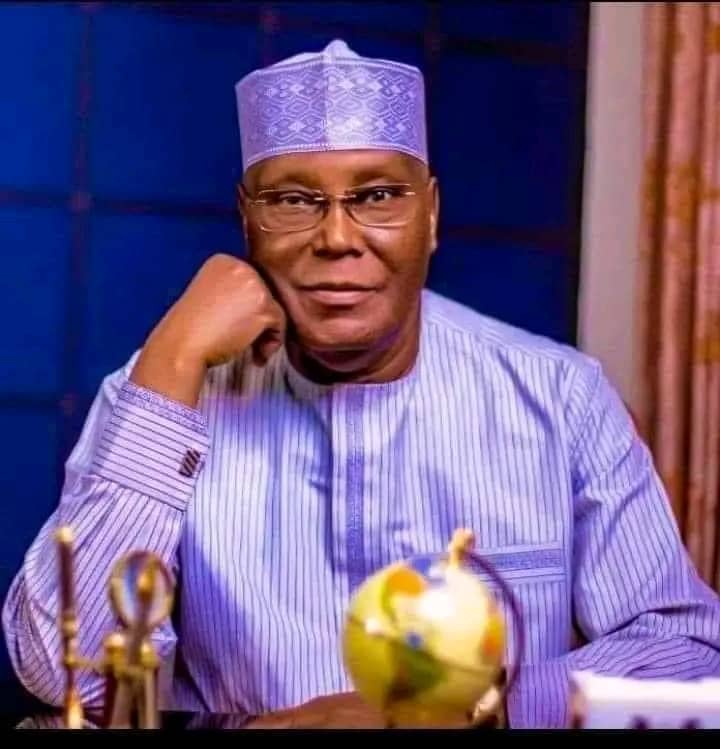
WHO IS AFRAID OF ATIKU ABUBAKAR GCON (WAZIRI ADAMAWA)?

Aare Amerijoye DOT.B.

Those who profit from Nigeria remaining broken.

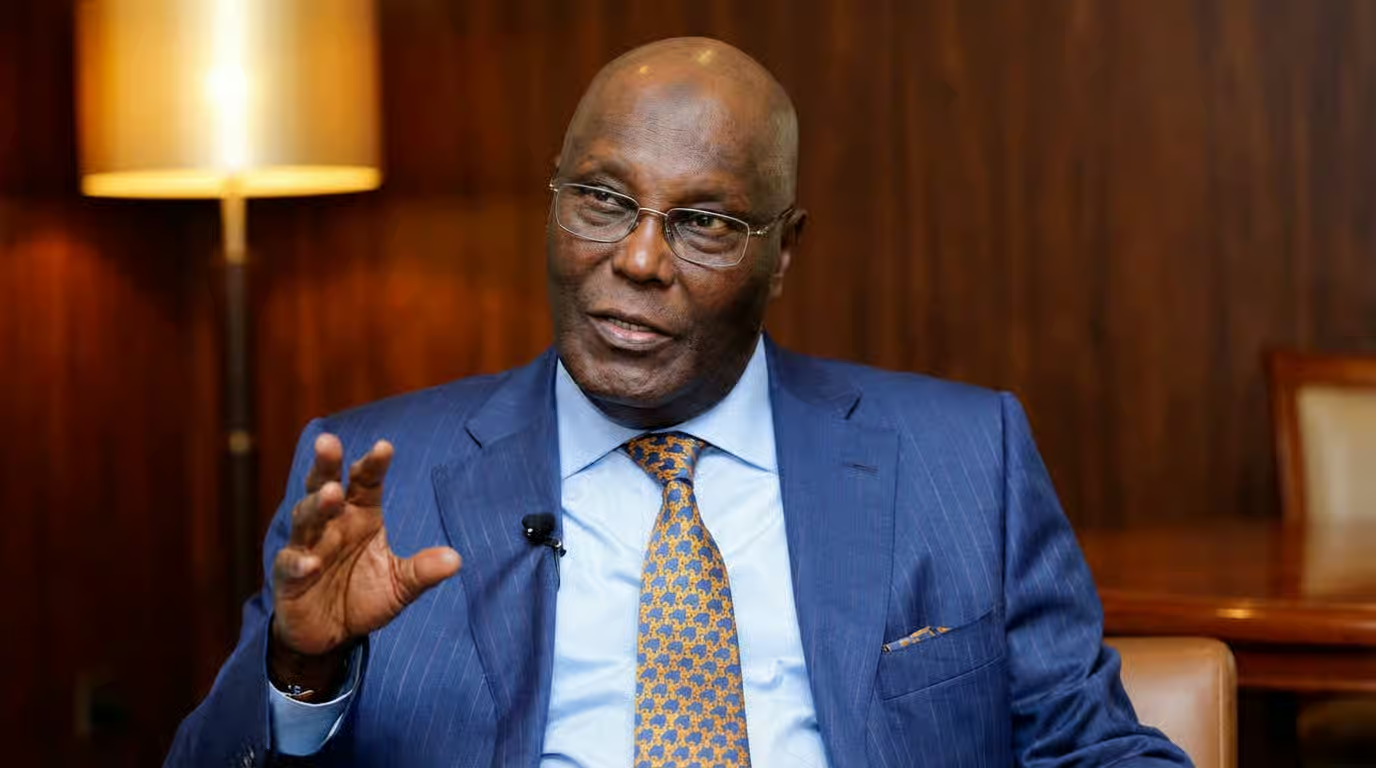
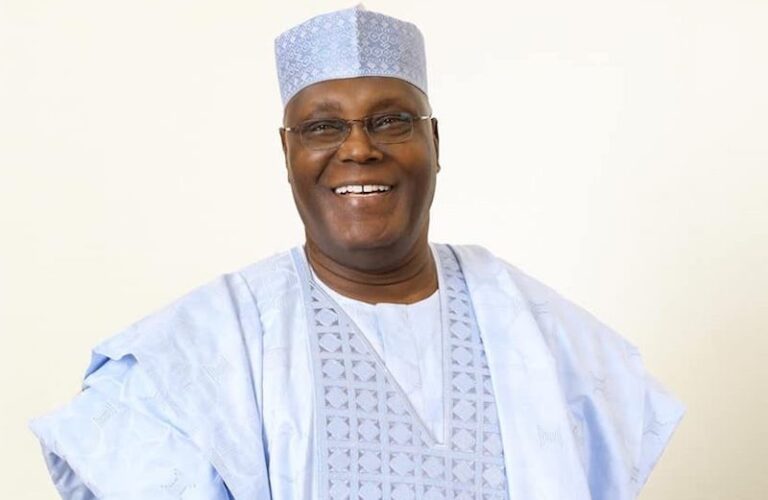
Not the ordinary citizen struggling with food prices. Not the graduate trapped between certificates and joblessness. Not the trader suffocating under policy chaos. The anxiety surrounding Atiku Abubakar belongs to a narrower constituency: beneficiaries of dysfunction, custodians of institutional weakness, and merchants who convert state failure into private advantage.

Atiku unsettles them because he represents an anomaly in Nigerian politics — a public figure whose record can be interrogated without mythology. His political life does not depend on mysticism, folklore, or emotional theatrics. It is anchored in policy decisions, structural reforms, and measurable outcomes. In a system where ambiguity is often weaponised as protection, clarity becomes dangerous.

The clearest illustration remains the telecommunications revolution. Prior to Atiku’s tenure as Vice President, Nigeria’s telephone system was a monument to stagnation: scarce lines, endless waiting lists, suffocating inefficiency, and an economy haemorrhaging productivity. Under the reformist thrust he championed within the Obasanjo administration, the sector was liberalised. Monopoly was dismantled, private capital invited, competition enforced, and regulation institutionalised. What followed was not incremental improvement but transformation ,explosive growth in connectivity, millions of new lines, mass employment, and the birth of Nigeria’s digital economy. Fintech, e-commerce, tech startups, remote work, and modern service delivery all trace their roots to that single policy choice. That is not rhetoric; that is consequence.

This is why fear follows his name. Those who survive on patronage rather than productivity understand that competence, once armed with authority, is existentially threatening. Serious governance collapses rent-seeking ecosystems. Order suffocates chaos merchants.

Equally unsettling to his opponents is Atiku’s national breadth. He is not a sectional candidate assembled through ethnic improvisation. In the South-West, his market-driven philosophy aligns naturally with enterprise culture and private-sector logic. In the South-East, his long-standing bridges, inclusionary posture, and respect for commerce resonate deeply with a region historically marginalised yet economically indispensable. In the South-South, his grasp of federalism, equity, and development partnership speaks directly to long-standing questions of fairness and resource justice. In the North, his roots, experience, and stabilising presence offer continuity without regression, identity without extremism. Few Nigerian politicians command such acceptance across regions without resorting to tribal performance.

It is therefore no accident that attacks against him rarely engage policy. They retreat instead into distortion, emotional baiting, and propaganda noise. Performance is uncomfortable terrain for those with little to defend. Atiku’s presence drags politics back to an unforgiving arena ,records, comparisons, competence, and outcomes.

Notice what his adversaries are not afraid of. They are not afraid of slogans. They are not afraid of social-media hysteria. They are not afraid of fan-base skirmishes. They are afraid of a serious national conversation one in which governance is stripped of excuses and failure can no longer hide behind identity.

History has always been cruel to systems that profit from decay. Reformers do not merely challenge power; they expose it. The persistent unease surrounding Atiku Abubakar is therefore not accidental, it is diagnostic. It reveals a political order that understands, perhaps better than it admits, that it cannot survive sustained scrutiny.

That, ultimately, is who is afraid and why.

Aare Amerijoye DOT.B,

Director General,
The Narrative Force

Aare Amerijoye Donald Olalekan Temitope Bowofade (DOT.B) is a Nigerian political strategist, public intellectual, and writer. He serves as the Director-General of The Narrative Force (TNF), a strategic communication and political-education organisation committed to shaping ideas, narratives, and democratic consciousness in Nigeria.An indigene of Ekiti State, he was born in Osogbo, then Oyo State, now Osun State, and currently resides in Ekiti State. His political and civic engagement spans several decades. In the 1990s, he was actively involved in Nigeria’s human-rights and pro-democracy struggles, participating in organisations such as Human Rights Africa and the Nigerianity Movement among many others, where he worked under the leadership of Dr. Tunji Abayomi during the nation’s fight for democratic restoration.Between 2000 and 2002, he served as Assistant Organising Secretary of Ekiti Progressives and the Femi Falana Front, under Barrister Femi Falana (SAN), playing a key role in grassroots mobilisation, civic education, and progressive political advocacy.He has since served in government and party politics in various capacities, including Senior Special Assistant to the Ekiti State Governor on Political Matters and Inter-Party Relations, Secretary to the Local Government, and Special Assistant on Youth Mobilisation and Strategy. At the national level, he has been a member of various nationally constituted party and electoral committees, including the PDP Presidential Campaign Council Security Committee (2022) and the Ondo State 2024 election committee.Currently, he is a member of the African Democratic Congress (ADC) and serves as Secretary of the Ekiti State ADC Strategic Committee, where he plays a central role in party structuring, strategy, and grassroots coordination.Aare Amerijoye writes extensively on governance, leadership ethics, party politics, and national renewal. His essays and commentaries have been published in Nigerian Tribune, Punch, The Guardian, THISDAY, TheCable, and leading digital platforms. His work blends philosophical depth with strategic clarity, advancing principled politics anchored on truth, justice, and moral courage.

Leave a Reply

Your email address will not be published. Required fields are marked *

Recent News

Trending News

Editor's Picks

THE AUTOPSY WE MUST NEVER CONDUCT

Aare Amerijoye DOT.B. If we will not like gathering in 2027 to conduct a political postmortem, dissecting how victory slipped through our fingers, how history brushed past us but refused to embrace us, then the time for lamentation must give way to mobilisation. Reflection without reorganisation is self-deception. Memory without structure is ritual mourning. Politics,...

ATIKU ABUBAKAR: A BEACON OF NIGERIAN LEADERSHIP EXCELLENCE

Aare Amerijoye DOT.B Nigeria stands at a defining hour. Inflation has thinned household tables. Youth unemployment has dimmed once-bright ambitions. The naira has endured turbulence. Businesses strain under policy uncertainty. In such a moment, leadership cannot be experimental. It cannot be rhetorical. It must be competent, courageous and economically literate. In this charged national atmosphere,...

Nigeria’s Democracy at Risk: Senate’s Rejection of Mandatory Electronic Transmission Reopens Door to Electoral Manipulation

By Kunle Oshobi In what critics are calling a devastating blow to Nigeria’s electoral integrity, the Nigerian Senate has rejected proposals to make the electronic transmission of election results mandatory, opting instead to retain ambiguous language that leaves critical loopholes open for potential manipulation ahead of the 2027 general elections. During the clause-by-clause consideration of...

NIGERIANS MUST REJECT SENATE’S TECH ILLITERACY AS ELECTORAL POLICY

The Akpabio-led Senate is fast proving itself to be an anti-democratic contraption. I have listened carefully to the arguments advanced by the Senate President Godswill Akpabio and the Senate spokesperson and other proponents of retaining the discretionary provisions of 2022 Electoral Act on electronic transmission of results rather than upholding the mandatory provisions of the...

Must Read

©2026. The Narrative Force. All Rights Reserved