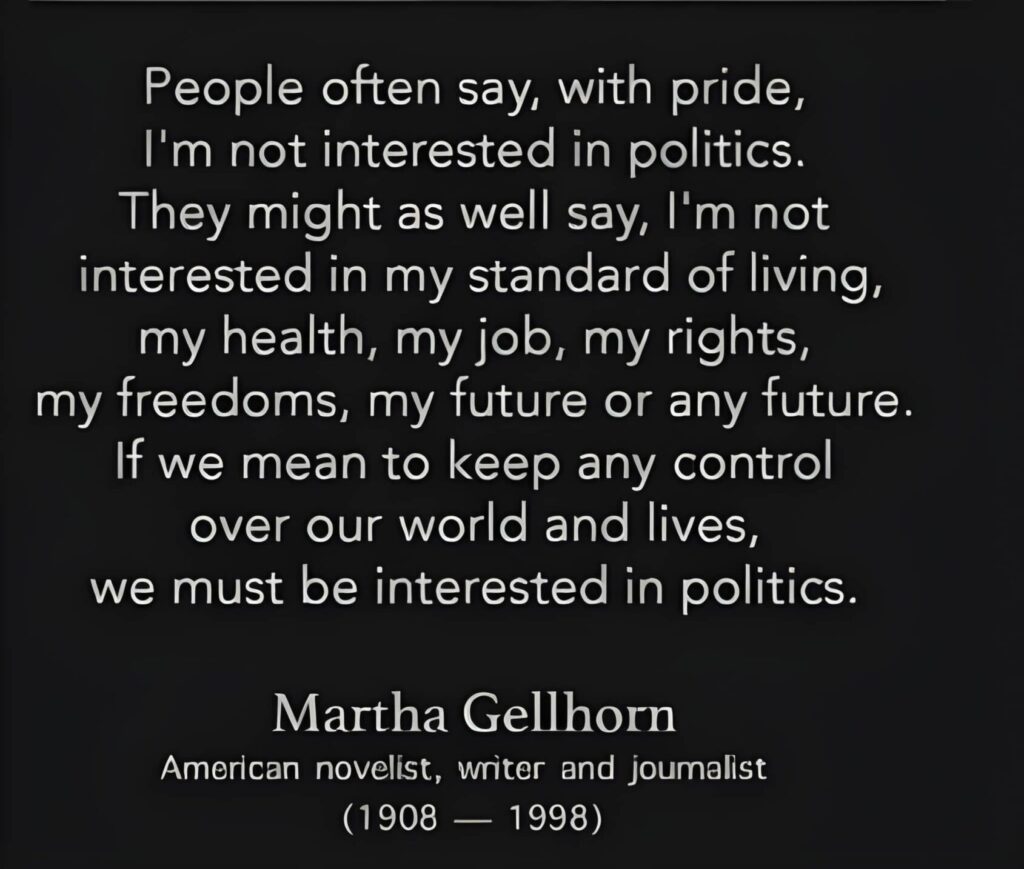
There is a dangerous lie that circulates comfortably among the indifferent, “I don’t do politics.”
It sounds harmless, it sounds neutral, it sounds sophisticated.But in truth, it is a confession of surrender.
To renounce politics is not to rise above it, it is to abandon your wages, your health, your dignity, your tomorrow, and the inheritance of your children to the whims of whoever shows up. Political apathy is not innocence, it is abdication, it is silence masquerading as wisdom.
Martha Gellhorn was brutally honest when she warned that anyone uninterested in politics might as well declare disinterest in their standard of living, their rights, their freedoms, and their future. That statement was not philosophical flourish, it was a civic diagnosis. Politics is not an abstract sport played by elites in Abuja, it is the invisible hand that decides whether hospitals heal or kill, whether education liberates or traps, whether youth dream or flee.
Nigeria today is the loudest evidence of what happens when a generation checks out.
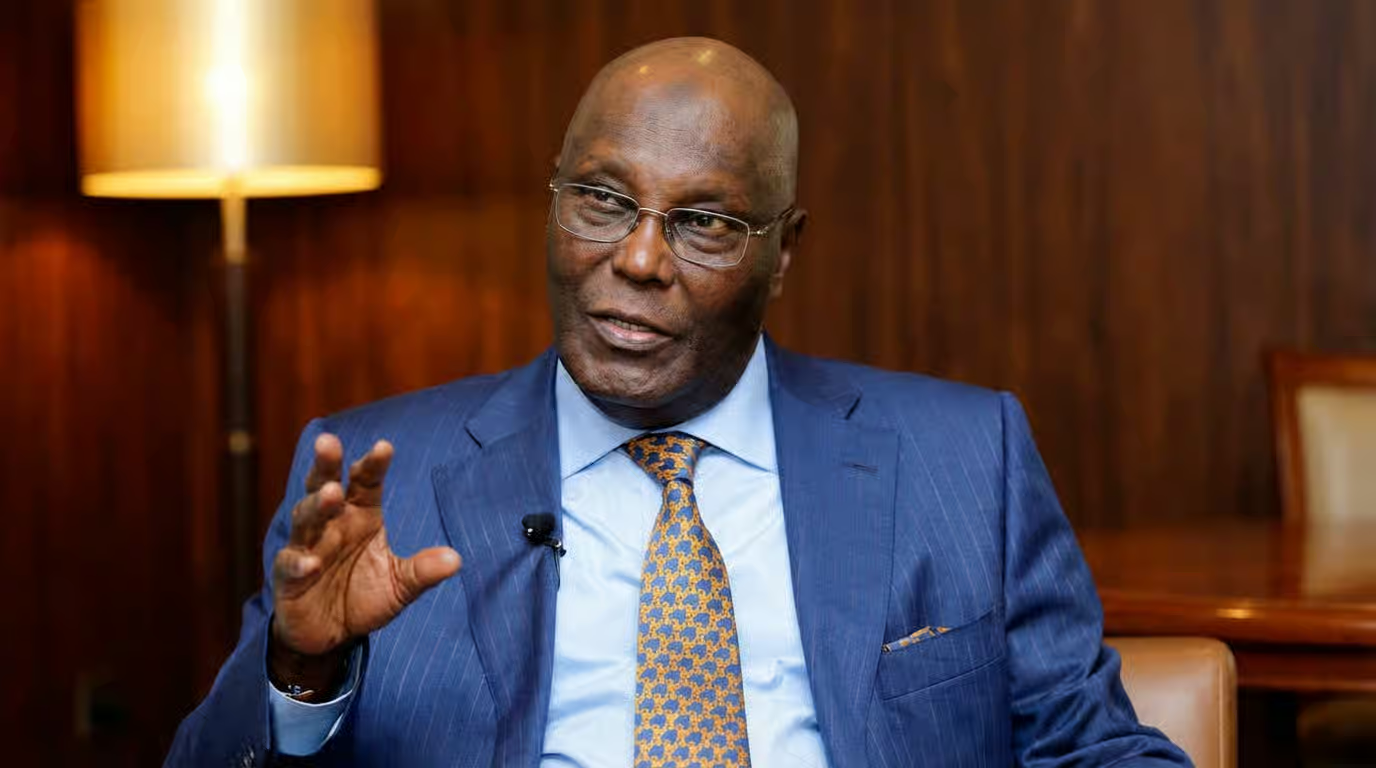
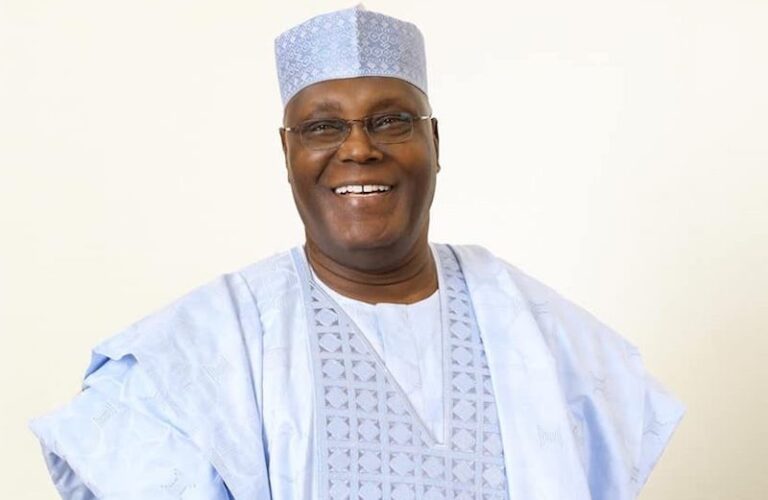
Now imagine, truly imagine, a Nigeria governed with competence instead of chaos, planning instead of improvisation, empathy instead of indifference. Imagine a country where leadership is not a performance but a responsibility. That imagined Nigeria has a name, and it is Atiku Abubakar.
Under Atiku, progress would not arrive with theatrical noise, it would arrive with measurable impact. Roads that last, jobs that matter, policies that breathe life into productivity. A quiet revolution, efficient, disciplined, and relentless. This is not fantasy, it is what happens when experience meets vision and governance is treated as serious work.
The Nigerian youth must confront an uncomfortable truth, history does not forgive ignorance. George Santayana’s warning rings like a siren, those who forget yesterday are sentenced to relive it. Our present hardship is not accidental, it is recycled consequence. Each election ignored, each voice withheld, each shrug of indifference compounds the suffering we now complain about.
Political disengagement has cost this generation dearly, yet disengagement is not destiny.
Under Atiku’s leadership, governance would cease to be an experiment conducted on helpless citizens. Healthcare would no longer be a privilege for the connected, employment would no longer be a miracle, rights would no longer be seasonal, freedom would no longer be rhetorical. What Atiku offers is not perfection, but seriousness, something Nigeria has been denied for far too long.
There is an old truth that says a stitch in time saves nine. Nigeria has delayed for decades, and the fabric is tearing. Atiku’s agenda, economic revitalisation, infrastructural coherence, educational depth, and institutional reform, is not cosmetic sewing, it is structural repair. Delay further, and the cloth may not hold.
Nigeria today suffers from a cruel irony, a nation overflowing with potential yet drowning in mismanagement. We are rich in talent but poor in opportunity, blessed in population but cursed by policy failure. This contradiction persists because apathy has been normalised and accountability postponed.
Plato warned centuries ago that when good people withdraw from public life, they hand power to the worst among them. That warning has aged painfully well. Our silence has been expensive, our indifference has been catastrophic.
Supporting Atiku in 2027 is not merely about electing a president, it is about rejecting decay. It is about choosing competence over confusion, structure over chaos, nationhood over narrow interests. It is about insisting that leadership must once again serve the people rather than exhaust them.
Nigerian youths, the hour is late, but it is not lost. History is knocking, not politely, but urgently. The future is demanding participation, not commentary. In Atiku Abubakar stands a bridge between what Nigeria is and what it must become.
This is not a call for blind loyalty, it is a call for conscious engagement.
Politics determines whether you thrive or merely survive. It decides whether your dreams grow wings or shackles. To disengage is to consent to misery, to engage is to reclaim agency.
The moment for hesitation has passed. The era of spectatorship must end. Nigeria’s renewal requires voices, votes, and vigilance.
The change we seek does not begin tomorrow.
It begins now.
And it begins with choice.
Aare Amerijoye DOT.B
Director-General
The Narrative Force