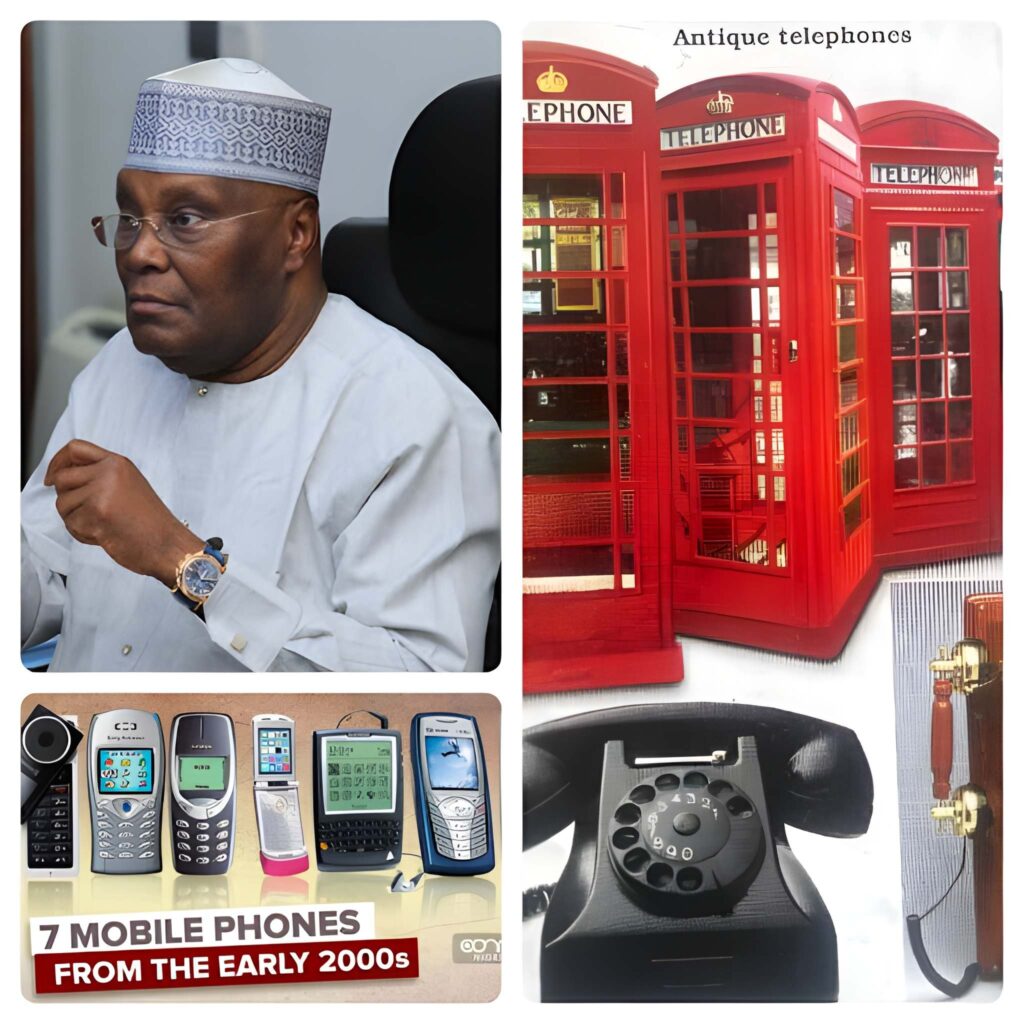
There are moments in the life of a nation when history ceases to be a record and becomes an indictment.
There are seasons when memory is no longer an exercise in nostalgia but a moral interrogation.
Nigeria is standing in such a moment.
The question before us is not whether we desire prosperity, innovation, and employment.
We mouth those desires daily.
The real question is far more uncomfortable: are we willing to acknowledge the man whose decisions already delivered them?
This is not an essay in sentiment.
It is an inquiry in justice.
It is not a hymn of praise.
It is a reckoning.
And at the centre of this reckoning stands Atiku Abubakar.
Let us ask, patiently and Socratically, without noise or propaganda: what single policy intervention in Nigeria’s post-independence history has created more wealth, more jobs, more innovation, and more social mobility than the telecommunications revolution of the early 2000s?
And having answered that honestly, let us ask the harder question still: who made it possible?
Before 1999, Nigeria was a country trapped in silence.
Telephony was not merely inadequate; it was humiliating.
Fewer than half a million working telephone lines served a population already exceeding one hundred million.
To own a landline was a privilege reserved for the powerful.
To apply for one was to enter a bureaucratic purgatory that could last ten years or more.
Businesses collapsed not for lack of ideas but for lack of communication.
Entrepreneurs died in infancy because the arteries of commerce were blocked.
Ask yourself: how does a modern economy breathe without connectivity?
How do markets function when sellers and buyers cannot reach each other?
How do ideas travel when voices are imprisoned?
Nigeria before the turn of the millennium was not poor because its people lacked talent.
It was poor because the infrastructure of possibility had been denied them.
Then came 1999.
Then came governance that understood that markets are not enemies of the people but instruments of their liberation when properly regulated.
Under the presidency of Olusegun Obasanjo, it was Atiku Abubakar, as Vice President and chief economic coordinator, who chaired the National Council on Privatisation and drove the liberalisation logic that would change Nigeria’s destiny.
This was not accidental reform.
It was deliberate architecture.
The NITEL monopoly was dismantled.
The GSM licences were issued transparently.
Regulatory credibility was strengthened.
Foreign capital was invited not as a predator but as a partner.
The signal Nigeria sent to the world was simple and revolutionary: this market is open, serious, and ready.
What followed was not magic.
It was economics obeying logic.
Yesterday, in Oshogbo, I sat once again with a circle of men and women whose lives have been intertwined with mine for over three decades.
For thirty-one years, I have had the honour of serving as President of the Independent Democratic Elite Association, IDEA, an ideological organisation not founded on opportunism but on ideas, discipline, and fellowship.
Time has done what sincerity always does; it has rewarded consistency.
As we looked around the room, the evidence of shared growth was impossible to miss.
Professors whose academic journeys began as modest aspirations now shaping minds across universities.
Bankers who rose through systems not by shortcuts but by competence.
State and Federal civil servants whose signatures quietly carry the weight of governance.
Entrepreneurs who once borrowed ideas and today export value.
Two of us in that gathering are also typical politicians of different political hues, one aligned with the ADC and the other with the APC; yet seated not as partisans but as thinkers bound by shared memory and evidence.
These were not accidental successes; they were the fruits of an era that allowed ambition to breathe.
As conversations flowed, memory did what memory always does; it asked questions.
One question, raised casually but pregnant with meaning, lingered longer than the rest: “How did we really get here?”
Almost instinctively, the discussion turned to leadership, to policy, to moments in Nigeria’s past when decisions mattered more than slogans.
Atiku Abubakar’s name surfaced, not as a chant but as a subject of inquiry.
I found myself explaining, not persuading.
I spoke about ideals, about capacity, about the difference between desiring power and understanding power.
And then, almost naturally, the conversation arrived where history always leads honest minds: the telecommunications revolution.
Phones that once symbolised privilege became tools of survival and success.
Businesses were born because communication became possible.
Careers took flight because access replaced isolation.
As I traced those policy decisions, those deliberate economic choices, I could see recognition dawn across faces that had lived the results long before they connected them to their architect.
There was appreciation, not for me but for the clarity that memory brings when it is properly ordered.
By the time the meeting ended, what lingered was not applause but gratitude, for being reminded that Atiku is not just a candidate to be supported but a story to be told.
Leaving Oshogbo and returning to Ekiti this morning, I felt elated, not with political excitement but with the quiet confidence that comes from knowing there is good news to share.
Because one thing is to have a candidate.
Another thing entirely is to have something concrete, historical, and transformative to say about that candidate.
It is from that place of lived reflection, collective memory, and intellectual honesty that this inquiry proceeds.
Within a few short years, Nigeria leapt from communicative obscurity into global relevance.
Millions of Nigerians acquired mobile phones.
Tens of millions followed.
Foreign direct investment flowed in billions of dollars.
Telecommunications became one of the fastest-growing sectors of the economy, contributing significantly to GDP and, more importantly, to everyday livelihoods.
Pause here and ask: how many families ate because of recharge card sales?
How many young Nigerians found dignity as phone technicians, network engineers, marketers, customer service agents, distributors, and vendors?
How many women entered commerce because a phone put markets in their hands?
How many rural traders were connected to urban demand? This was not trickle-down economics.
It was circulatory economics.
Money moved because communication moved. Opportunity spread because access spread. No government handout achieved what a ringing phone achieved. Telecommunications did not stop at calls and texts. It lit the fuse of an innovation cascade whose consequences we are still living with.
If you are under thirty-five, you may not remember a Nigeria without GSM, not because you are careless with history, but because access arrived before awareness.
The phone in your hand, the data you buy, the transfers you make, the online work you chase, the content you monetise, and the hustles that survive on connectivity all rest on a decision taken before you had a vote.
What you experience daily as normal life was once impossible. That is the quiet power of policy done right, and it raises a simple question for your generation: if leadership once expanded your access to the world, who is best prepared to expand it again?
- Fintech.
- Mobile banking.
- Online media.
- Digital activism.
- E-commerce.
- Logistics platforms.
- Ride-hailing.
- Content creation.
- Diaspora remittances.
- Political organising.
All of these trace their DNA to that singular policy decision to open Nigeria’s airwaves.
Ask again, honestly: could fintech exist without GSM penetration?
Could today’s digital economy stand without yesterday’s liberalisation?
Could Nigeria’s youth even imagine global relevance without the tools that connected them to the world?
If we are truthful, we must admit this: the Nigerian digital story began not in a startup hub but in a policy room chaired by Atiku Abubakar.
Democracy is often described as choice.
But it is also gratitude made political.
When a nation benefits from a decision, it incurs a debt, not of loyalty but of justice.
To enjoy the fruits of reform while demonising its architect is not opposition; it is moral incoherence.
Can a nation cry about unemployment while rejecting the man whose policies created millions of indirect jobs?
Can we lament poverty while scorning the architect of one of our most successful wealth-creating interventions?
Can we demand innovation while distrusting the leader who already proved that he understands how innovation ecosystems are built?
This is not about personalities.
It is about precedent.
Atiku Abubakar has done it before.
Nigeria has seen the results.
To deny him leadership now is not caution; it is economic amnesia.
Without shouting, without insults, comparison does the work.
Then, policy clarity attracted capital.
Today, policy confusion repels it.
Then, reforms multiplied opportunity.
Today, improvisation multiplies hardship.
Then, youth energy was absorbed into expanding markets.
Today, youth energy is wasted in survival economics.
The difference is not fate.
It is competence.
To argue for Atiku Abubakar in 2027 is not to look backward sentimentally.
It is to look forward rationally.
It is to say that leadership is not an experiment but a responsibility.
It is to insist that those who have successfully engineered growth before should be trusted to do so again, especially in a nation desperate for wealth creation, not slogans.
Atiku represents economic literacy in a time of confusion.
He represents market confidence in an era of flight.
He represents the logic of production over the theatre of hardship.
He represents the understanding that governments do not create wealth by decree but by designing environments where citizens can create it themselves.
Here is the ultimate Socratic challenge: if a man’s ideas once lifted millions out of isolation and into opportunity, by what logic do we deny him the chance to lift a nation again?
History has already delivered its evidence.
The telecommunications revolution stands as a living monument to what is possible when vision meets policy and courage meets competence.
The only unresolved matter is whether Nigeria will recognise its benefactor, not with applause but with ballots.
Nigeria does not owe Atiku Abubakar praise; Nigeria owes him fairness; and in a democracy, fairness is called a vote.
In 2027, the question will not be whether Atiku Abubakar deserves Nigeria.
The question will be whether Nigeria is wise enough to choose the man who already proved that prosperity is not a promise but a practice.
Where memory meets responsibility.
And so, as these reflections circle back to where they began, I return again in thought to Oshogbo, to the Independent Democratic Elite Association, IDEA, and to that room filled with lives shaped quietly by policy choices made years ago.
What was discussed there was not campaign rhetoric but lived evidence; not persuasion but recognition.
IDEA was formed to interrogate power with reason, to measure leadership by outcomes, and to resist the amnesia that often passes for political debate.
As I returned to Ekiti this morning, carrying the afterglow of that Oshogbo conversation, I felt a renewed clarity of purpose, because the journey back was not geographical alone but intellectual and moral.
In that sense, this essay is not merely personal reflection but institutional conscience.
If ideas matter, if memory has value, and if nations must learn from their own successes, then the obligation before Nigeria in 2027 is clear.
What IDEA affirmed in conversation, history has already confirmed in practice: when Atiku Abubakar’s ideas were trusted once, the nation prospered.
To acknowledge that truth again is not loyalty to a man but fidelity to reason.
Aare Amerijoye DOT.B
Director General,
The Narrative Force